- Private car and driver in Delhi / India
- +91-8447445445
- info@discoverindiabycar.com sugar.ankit@yahoo.com
 +91-9818434712
- Follow us:



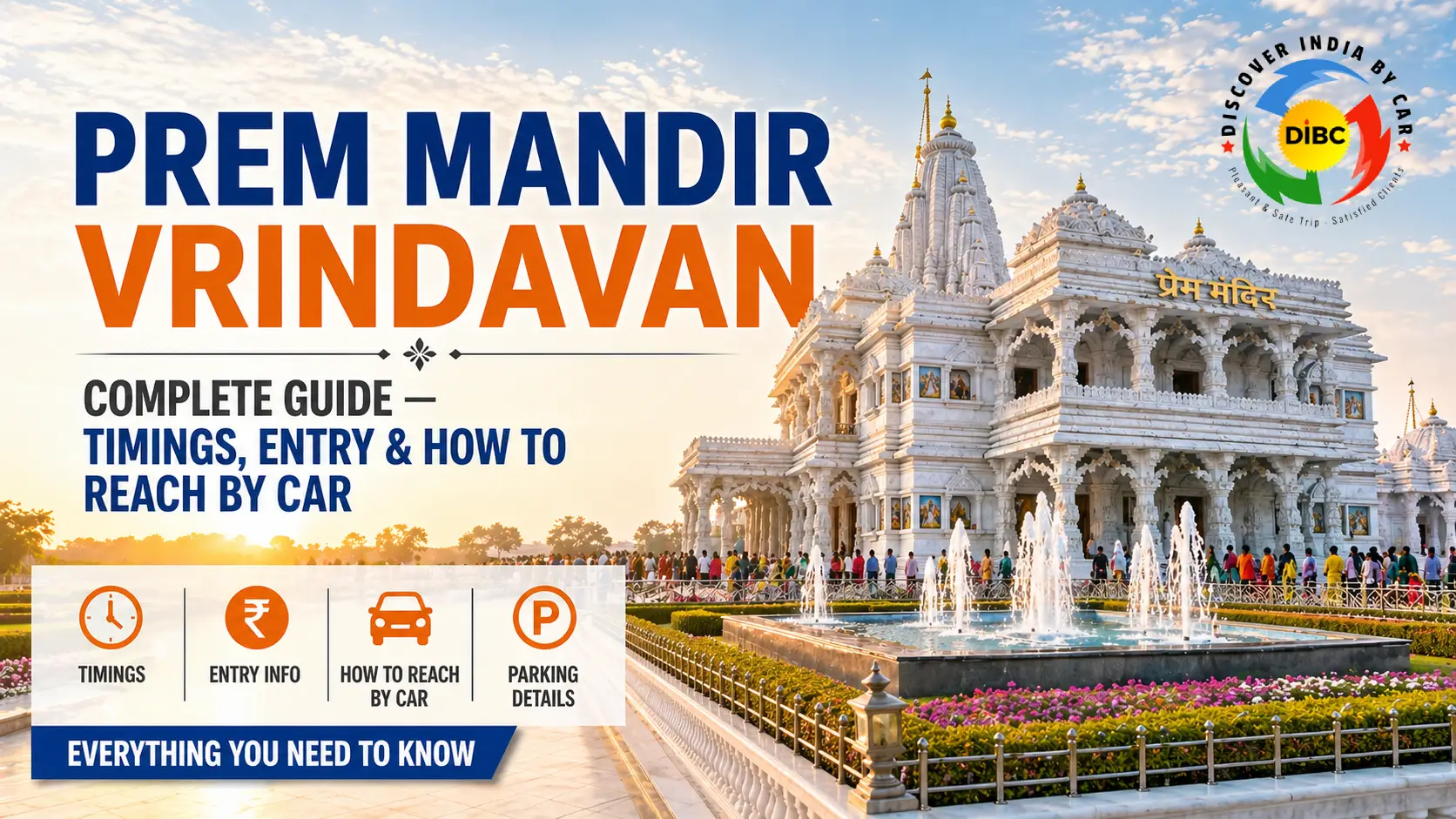
Prem Mandir Vrindavan: Timings, Entry & How to Reach by Car
✍️ Written by Ankit Sugar | Road Trip Expert & Founder, Discover India By Car
Having driven thousands of kilometres across Uttar Pradesh’s highways — from the Yamuna Expressway to Vrindavan’s temple lanes — and visited Prem Mandir multiple times across different seasons, I created this ground-reality guide to help fellow travelers experience Vrindavan without the logistical stress. Every route, parking tip, and timing in this article comes from personal experience behind the wheel.
I’ll be honest with you — I nearly skipped Prem Mandir on my first trip to Vrindavan.
I had the whole day planned around Banke Bihari and the ghats, and Prem Mandir felt like a “tourist trap” kind of addition. Big, modern, Instagrammable. Not the kind of place I usually stop for.
That was a mistake I corrected on my very next visit.
If you are driving to Vrindavan — whether from Delhi, Agra, or Mathura — Prem Mandir is not optional. It is the kind of place that quietly earns a permanent spot in your “places I keep thinking about” list. Especially in the evening, when the whole thing lights up and you are standing there wondering how you almost didn’t come.
This guide has everything you need before you go — timings, parking, the best route by car, what to actually see once you are inside, and a few things I wish someone had told me before my first visit.
What Exactly is Prem Mandir?
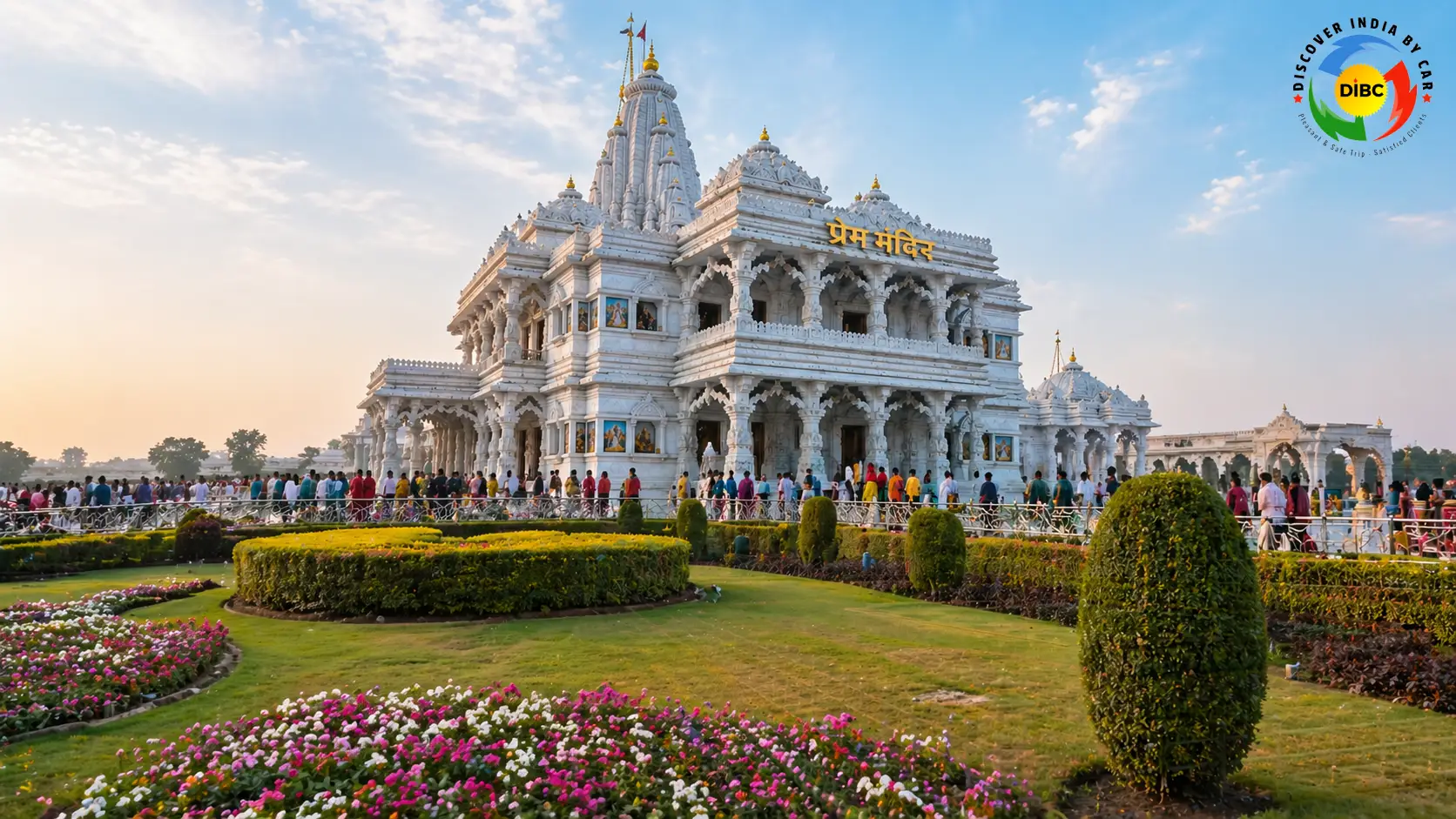
Prem Mandir is a Hindu temple in Vrindavan dedicated to Radha Krishna and Sita Ram. It was established by Jagadguru Shri Kripalu Maharaj — the fifth original Jagadguru in India’s spiritual lineage — and took over eleven years to build. Construction started in 2001, and the temple opened its doors in February 2012.
Over a thousand craftsmen from Rajasthan worked on it. The entire structure is Italian white marble, and when you see the carvings up close — every panel, every pillar, every archway — you start to understand where all those years went.
The complex sits on 54 acres and the main temple tower rises 125 feet. It’s big. But it doesn’t feel overwhelming the way some large temples do. The gardens are laid out well, there’s room to breathe, and the whole place has a calmness to it that surprises you.
Entry is completely free. Always has been. The temple is run by Jagadguru Kripalu Parishat, a non-profit spiritual trust, and they have never charged admission. No tickets, no “suggested donation” at the gate, nothing.
Prem Mandir Timings — When Does Prem Mandir Open?
This is probably the most searched question about the place, so let me be straightforward about it.
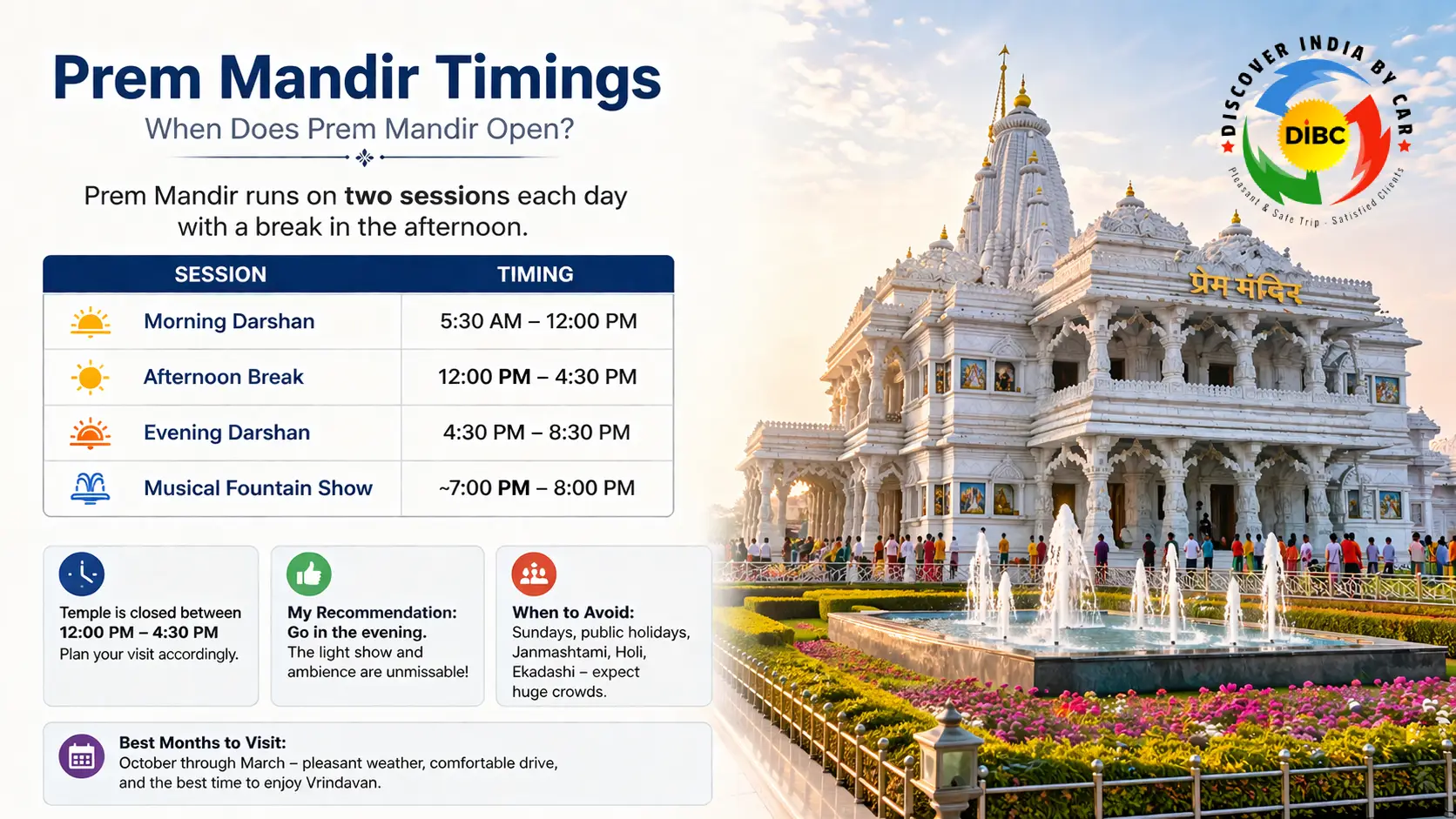
Prem Mandir runs on two sessions each day with a break in the afternoon:
Session | Timing |
Morning Darshan | 5:30 AM – 12:00 PM |
Afternoon Break | 12:00 PM – 4:30 PM |
Evening Darshan | 4:30 PM – 8:30 PM |
Musical Fountain Show | ~7:00 PM – 8:00 PM |
The temple is closed between noon and 4:30 in the afternoon. If you arrive during that window, you’ll have to wait outside or go explore other parts of Vrindavan and come back.
My honest recommendation: Go in the evening. The morning is quieter and the light on white marble is genuinely beautiful, but the evening session is a different experience altogether. The fountain show runs daily, the whole complex gets illuminated after sunset, and the atmosphere shifts into something you won’t easily forget. If you can only pick one, pick evening.
When to avoid: Sundays, public holidays, and major festivals like Janmashtami, Holi, and Ekadashi bring huge crowds. The temple is still worth visiting on those days — sometimes the energy is extraordinary — but go in knowing it will be packed.
Best months: October through March. The weather is comfortable, the drive is pleasant, and Vrindavan in winter has a particular softness to it that suits the place well.
Prem Mandir Entry Fee — How Much Does it Cost?
Nothing. Zero. Free.
General admission to Prem Mandir has always been free. No entry ticket, no queue for paid darshan, no locker fee, no compulsory “prasad purchase.” You walk in, spend as much time as you want, and walk out.
A few practical things to know:
You will need to leave your shoes at the deposit counter outside before entering. The counters are well-managed and free of charge. Carry a small cloth bag to put your shoes in — it makes the whole thing smoother.
The temple doesn’t have a strict dress code, but modest clothing is expected. Shorts and sleeveless tops are generally fine outside in the gardens, but wear something that covers your shoulders and knees if you plan to enter the main sanctum.
Photography is allowed throughout the outer complex and gardens. Inside the main temple hall, photography may be restricted depending on the day — just check at the entrance.
How to Reach Prem Mandir Vrindavan by Car
This is where things get genuinely useful if you’re planning a road trip. Let me break it down by starting point.
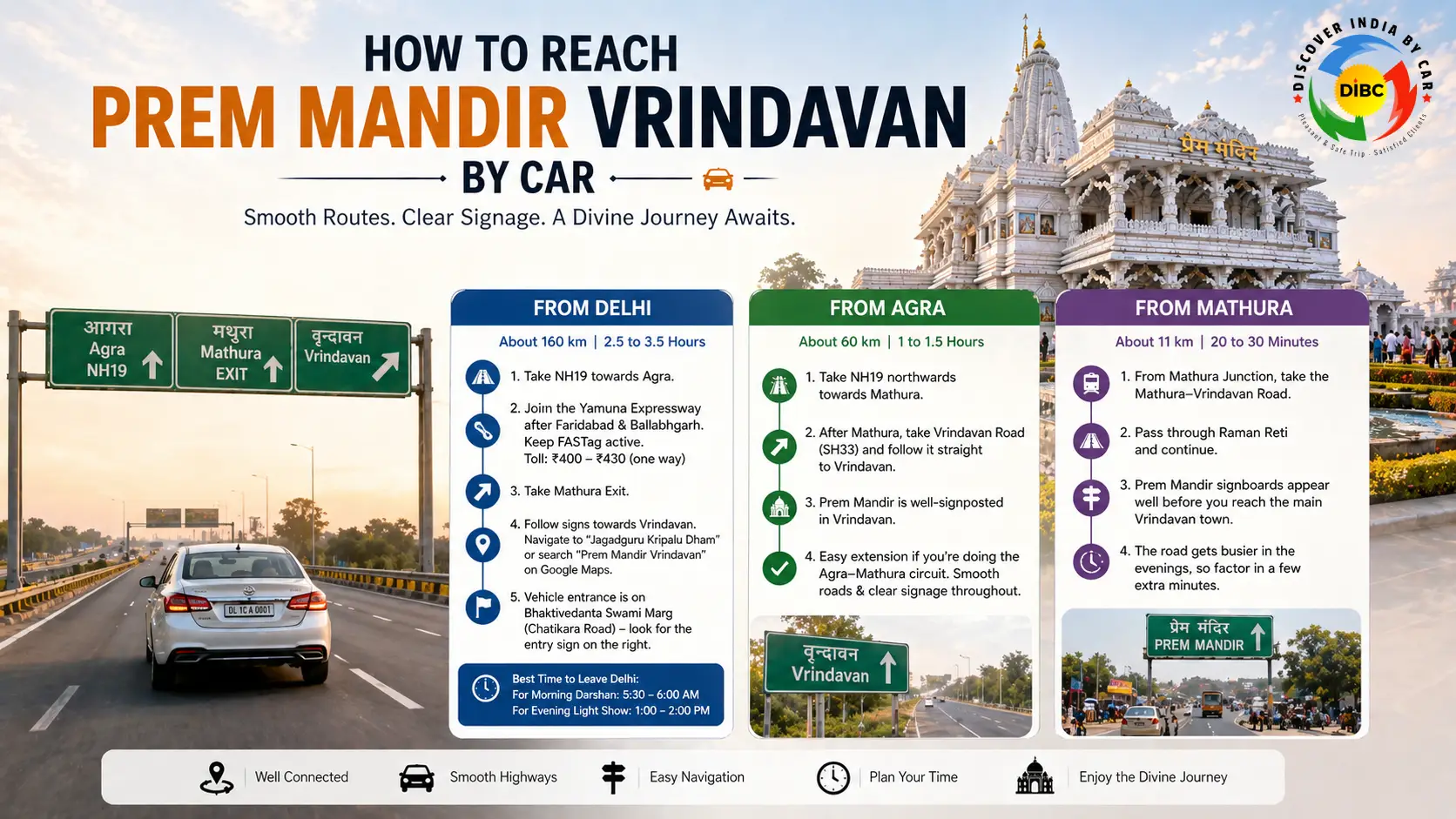
From Delhi — About 160 km, 2.5 to 3.5 Hours
The cleanest route is via NH19 and the Yamuna Expressway.
Leave Delhi heading toward Agra on NH19. Once you’re past Faridabad and Ballabhgarh, you’ll join the Yamuna Expressway. Keep your FASTag active — there are toll plazas along the way and the toll for a standard car runs around ₹400–430 one way.
Take the Mathura exit (it’s well-signposted) and from there follow signs toward Vrindavan. Once you’re inside Vrindavan, navigate to Jagadguru Kripalu Dham or simply search “Prem Mandir Vrindavan” on Google Maps — it’s accurately listed.
The main entrance for vehicles is on Bhaktivedanta Swami Marg (also called Chatikara Road). There’s a vehicle entry sign on the right as you approach.
Timing your departure: If you want the morning session, leave Delhi by 5:30 to 6:00 AM. If you’re aiming for the evening light show, leaving by 1:00–2:00 PM is comfortable even with traffic.
From Agra — About 60 km, 1 to 1.5 Hours
Take NH19 northward toward Mathura. It’s a smooth road with good visibility. After Mathura, take the Vrindavan Road (SH33) and follow it straight to Vrindavan. From there, Prem Mandir is well-signposted.
If you’re already doing the Agra–Mathura circuit, adding Vrindavan and Prem Mandir is an easy extension. The drive between the three cities is one of the better short road trips in north India — flat roads, clear signage, decent highway condition.
From Mathura — About 11 km, 20–30 Minutes
From Mathura Junction, take the Mathura–Vrindavan Road. Pass through Raman Reti and continue. You’ll see Prem Mandir signboards well before you reach the main Vrindavan town. The road gets busier as you get closer, especially in the evenings, so factor in a few extra minutes.
Parking at Prem Mandir
Let me talk about this properly because it’s something most travel guides gloss over with a single line, and it genuinely matters when you’re arriving by car.
Prem Mandir has one of the better-organised temple parking lots I’ve come across in Uttar Pradesh. It’s large — easily a few hundred cars — paved, shaded in parts, and supervised by staff who will actually direct you to a spot rather than just waving you in and leaving you to figure it out.
Parking is completely free. No token, no attendant tip expected, nothing.
The vehicle entry lane is separate from the pedestrian entrance. As you approach on Bhaktivedanta Swami Marg (Chatikara Road), look for the vehicle entry sign on the right side — it’s easy to miss if you’re not watching for it, especially the first time. If you find yourself at the pedestrian gate, you’ve gone slightly too far. Just reverse and take the turn.
SUVs, MUVs, and larger vehicles park comfortably. I’ve been there in a Fortuner and never had an issue finding space, even on a busy Sunday afternoon.
A few things I’d tell you from experience:
During Janmashtami, Holi, Ekadashi, and major festival weekends, the lot fills up by mid-morning and again by late afternoon. On those days, arriving early (before 8 AM) or after 4 PM when there’s more turnover is the smarter move. Some visitors end up parking on the outer road and walking in, which isn’t a disaster but adds 10–15 minutes each way.
On regular weekdays — especially Tuesday and Wednesday — I’ve pulled in and found a spot within two minutes, ten metres from the entrance. It’s genuinely stress-free.
If you’re visiting with elderly family members, the parking lot is close enough to the main entrance that the walk is manageable. There’s no shuttle needed, but the entrance gates do have ramps for those who need them.
One more thing: the lot has no overnight parking permitted. If you’re staying nearby and want to walk to the evening show, check with your hotel about leaving the car there — most hotels near the temple area are fine with it.
My Real Visit Experience at Prem Mandir
I want to be upfront — I’ve been to Prem Mandir more than once, and the experience has been different each time in ways I didn’t expect.
My first visit was on a December morning, mid-week. I arrived around 8 AM. The fog hadn’t fully lifted yet and the white marble of the temple was catching the soft winter light in a way that made the whole complex look almost unreal — like a scene from something imagined rather than built. There were maybe two hundred people there, mostly local devotees doing the Pradakshina path quietly. No noise, no crowds. I walked the 84 leela panels slowly, stopped at almost every one, and spent nearly an hour just on the circumambulation path. I remember thinking: this is one of those places that would be completely different in a crowd, and I happened to get it at its quietest.
My second visit was on a Sunday evening in March. That was a different story entirely. The parking lot was almost full by the time I arrived at 5 PM. The gardens were packed — families, pilgrims, young couples, school groups on excursions, foreign tourists. The whole atmosphere was festive rather than contemplative. I had to push gently through crowds to move around the Pradakshina path. But then 7 PM arrived, the lights came on, the fountain started, and suddenly none of the crowd felt like a problem. Everyone around me stopped talking. The collective silence in a packed garden when that temple lights up — I hadn’t expected that.
Third visit: Janmashtami. I won’t pretend that one was relaxed. It was extraordinary and overwhelming in equal measure. Tens of thousands of people, devotional music blasting from every direction, the temple decorated beyond its usual illumination. Beautiful, chaotic, and deeply memorable — but not what I’d recommend for a first visit if you want to actually absorb the place.
Here’s what I’ve concluded: Prem Mandir rewards patience. It’s a big complex, and if you rush through it in 45 minutes taking photos and leaving, you’ll enjoy it but you won’t fully understand what makes it worth remembering. Give it two to three hours minimum. Walk slowly. Sit in the garden for a while before the fountain show. Let the place settle on you.
What to Actually See Inside Prem Mandir
Most people spend their time either rushing through or lingering in only one part of the complex. Here’s what’s worth your attention.
The Main Temple Building
Before you even go inside, walk a full circle around the exterior. The outer walls of the main temple are covered in carved marble panels — scenes from the Bhagavata Purana, Radha Krishna’s Ras Leela, Krishna lifting Govardhan Parvat, episodes from the Ramayana on the Sita Ram panels. The detail is extraordinary. People who’ve visited temples across Rajasthan and Gujarat come to Prem Mandir and find themselves genuinely surprised.
Give this 20 minutes minimum. Most visitors rush past it to get inside, and they miss the best part of the architecture.
The 84-Panel Pradakshina Path
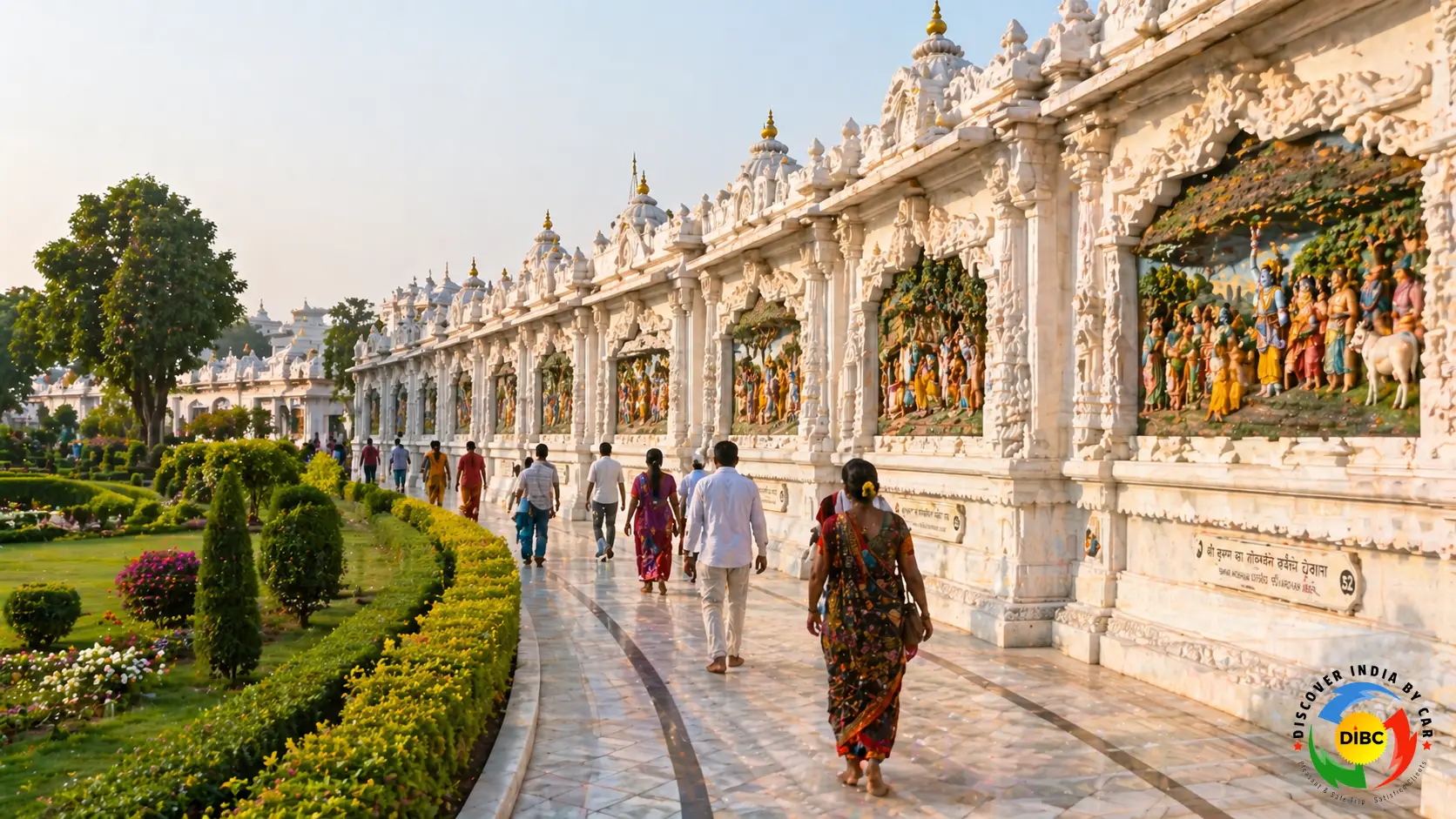
The circumambulation path around the main temple is lined with 84 large marble tableaux — life-sized depictions of Radha Krishna’s leelas. Each panel is framed in its own carved alcove, set within immaculate gardens.
This is where I personally spend most of my time. There’s a particular quiet to it in the early morning or late afternoon, with the white marble against the green of the gardens, and devotees walking slowly around the path. Budget 45–60 minutes here.
The Musical Fountain Show
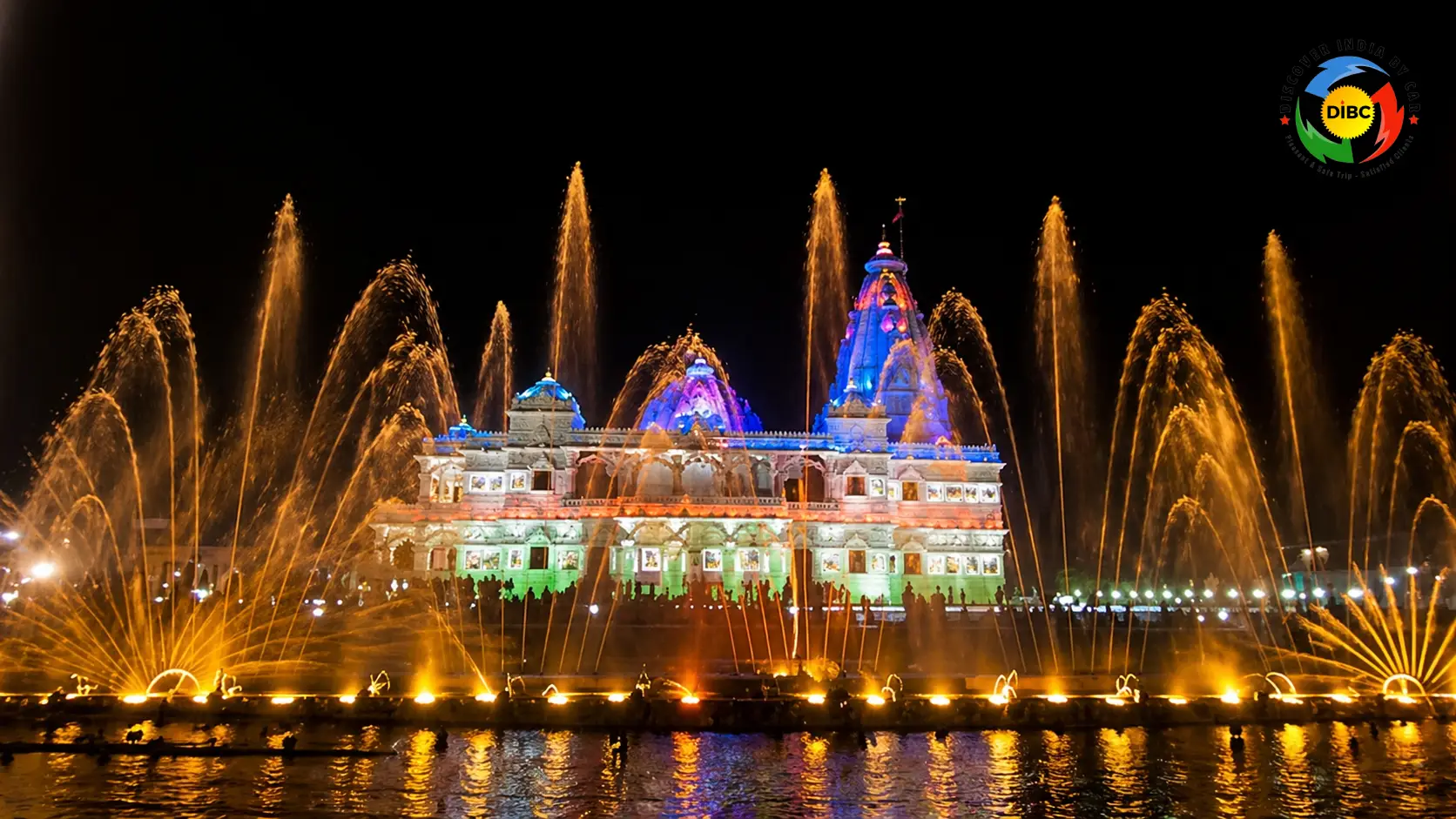
Every evening, around 7:00 PM, the gardens in front of the temple come alive. The fountains are synchronized with devotional music and lit in rotating colors — gold, saffron, white, blue. The main temple is fully illuminated behind them.
Find your spot by 6:30 PM. The area fills up fast, especially on weekends. There’s no bad view exactly, but standing in the central garden axis gives you the fountains in the foreground and the full temple behind — the best composition.
The show runs for about an hour and you don’t need to do anything except show up and stand there.
The Vrindavan Diorama
Inside the complex, there’s a detailed scale model of Vrindavan’s sacred geography — rivers, forests, temples, the locations associated with Krishna’s life here. It’s well-made and surprisingly informative even if you already know the stories. Worth 15 minutes.
The Inner Sanctum
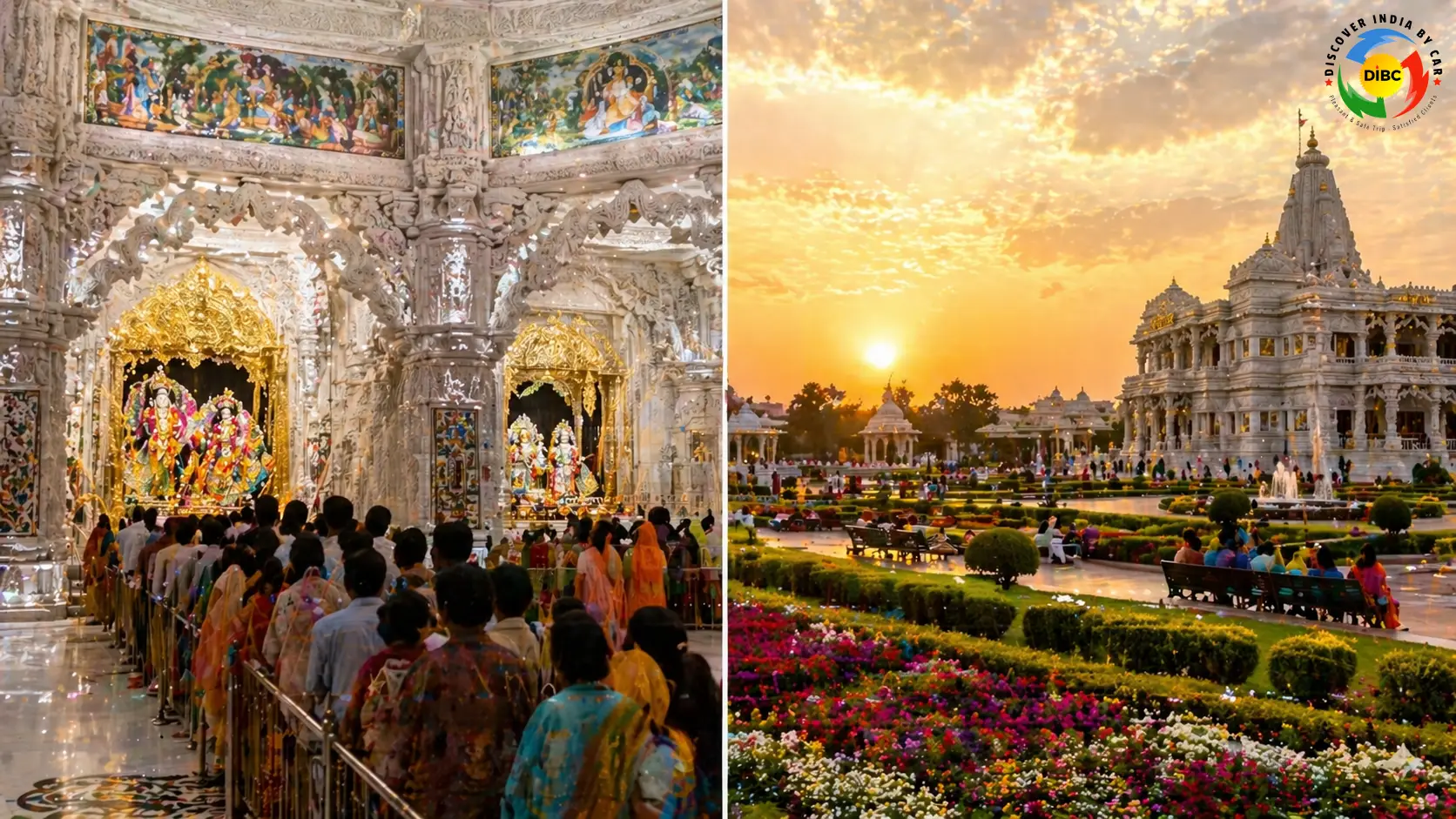
The main prayer hall inside the temple houses the primary deities — Radha Krishna on one side and Sita Ram on the other. The idol work is intricate, the hall is air-conditioned, and the atmosphere shifts noticeably as you step inside. Quieter, more focused. The marble floors are cool underfoot even in summer.
Darshan timings inside the sanctum follow the main temple schedule. During busy periods, there may be a slow-moving queue — typically 15–30 minutes. On quiet weekday mornings, you can stand and spend as much time as you want without any rush.
The Gardens
I keep coming back to the gardens because they’re genuinely worth mentioning as a standalone experience. The entire 54-acre complex is landscaped to a level that’s unusual for temple grounds in India — manicured lawns, flowering plants in season, stone paths, and benches placed in good spots. In the cooler months, the gardens in the evening are perfect for a slow walk after the fountain show winds down. There’s no rush to leave. People sit, talk quietly, let the children run. It’s peaceful in a way that big temple complexes rarely manage.
How Much Time is Needed at Prem Mandir?
This question comes up a lot, and the honest answer is: more than most people plan for.
I’ve seen visitors arrive, do a quick lap of the gardens, take a few photos, and leave in 30–40 minutes. They’ve technically “been to Prem Mandir” but they’ve missed most of what makes it worth the drive.
Here’s a more realistic breakdown depending on what you want from the visit:
Quick visit (1 to 1.5 hours): Main temple exterior, a partial walk of the Pradakshina path, brief stop inside the sanctum. You’ll see the highlights but not linger.
Comfortable visit (2 to 2.5 hours): Full walk of all 84 leela panels on the Pradakshina path, time inside the sanctum, the diorama, and a sit in the gardens. This is the minimum I’d recommend for a first visit.
Full evening visit (3 to 3.5 hours): Arrive by 5 PM, explore everything unhurriedly, find a good spot in the garden by 6:30 PM, watch the full fountain show until 8:00–8:30 PM. This is the version I always recommend to people visiting for the first time. It covers everything and ends with the best part.
If you’re visiting with children, add 30 minutes. Kids tend to want to run in the gardens and look at every carved panel up close — which is actually the right way to experience it, if you think about it.
The Evening Light Show — The One Thing You Cannot Miss
I’ve mentioned this already but it deserves its own section because it’s genuinely the main reason most people come back.
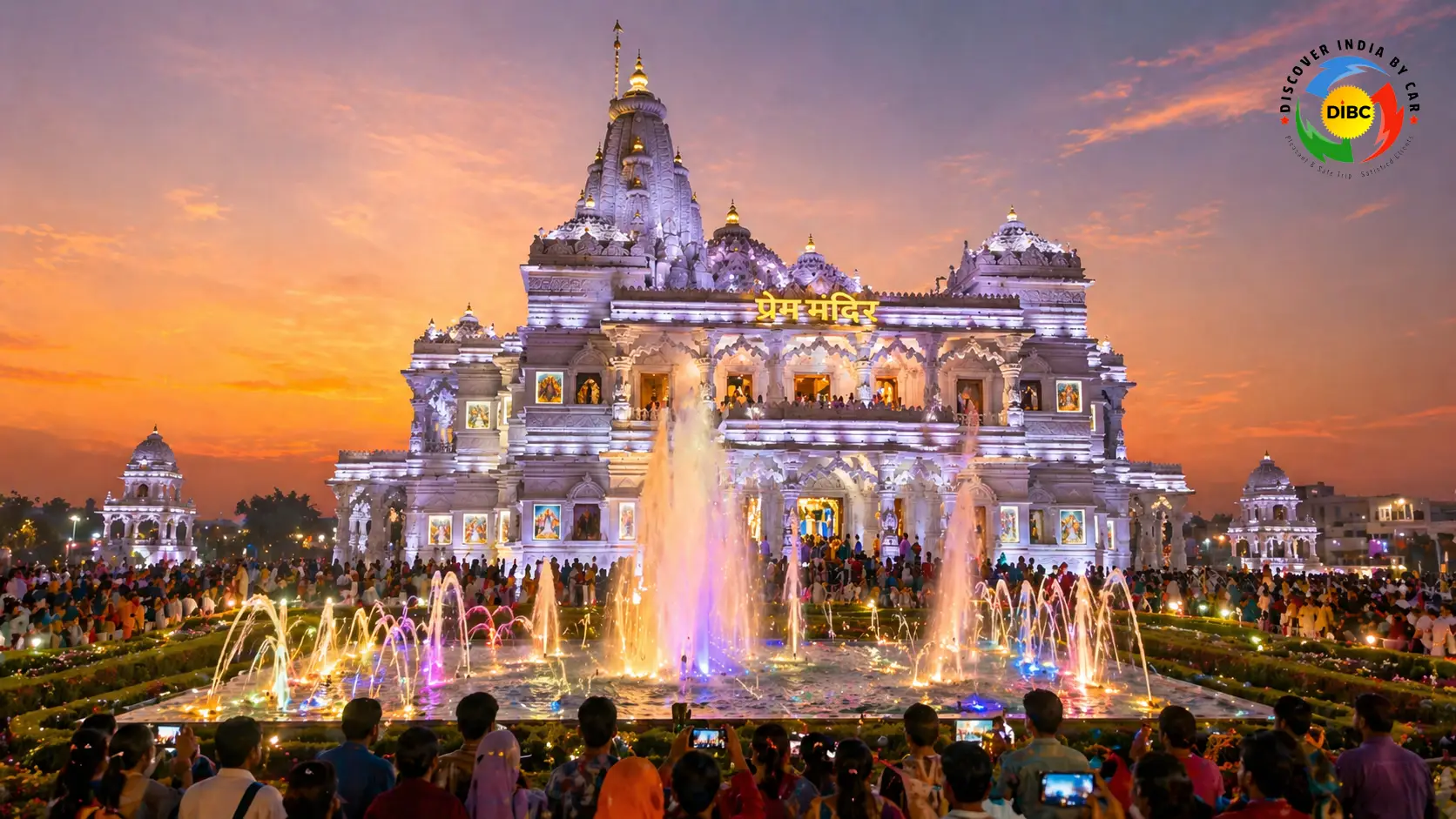
From around 7:00 PM, Prem Mandir is lit with slowly changing colored LEDs — the temple shifts between gold, white, pink, and blue in long, gradual cycles. The marble catches the light in a way that makes the whole building seem to glow from within. Combined with the fountain and the darkening sky, it’s a visual experience that’s hard to describe without sounding dramatic.
I’ve been there on a quiet Tuesday evening with just a few hundred people standing in the garden in complete silence watching it. I’ve also been there on Janmashtami with tens of thousands of people. Both were worth it.
If you are visiting Vrindavan and you leave before sunset, you are leaving at the wrong time.
For photographers: The best spot is about 60–70 metres directly in front of the main temple entrance, wide enough to include the fountains. The 30 minutes after sunset, before the LED show fully takes over, gives you the most interesting mixed light.
Where to Stay Near Prem Mandir
If you’re spending the night, here’s how to think about accommodation as a car traveler — parking availability is as important as the room.
Budget (under ₹2,000/night): Several dharamshalas and simple guesthouses operate within walking distance of Prem Mandir. Basic, clean, functional. Good if you’re here purely for the pilgrimage and don’t need amenities.
Mid-range (₹2,000–₹5,000/night): Better options are scattered along Chatikara Road and near the ISKCON temple area. When you’re booking, explicitly ask whether they have parking for your vehicle type. “Near Prem Mandir” can mean anything from 500 metres to 4 km, so confirm the actual distance.
A practical tip: Search for “hotel near Prem Mandir Vrindavan with parking” specifically on MakeMyTrip or Booking.com and filter by distance. The results are better when you’re that specific.
Other Temples to Visit the Same Day
If you’ve driven all the way to Vrindavan, it makes sense to make a full day of it. Here’s what I’d do in sequence, all by car:
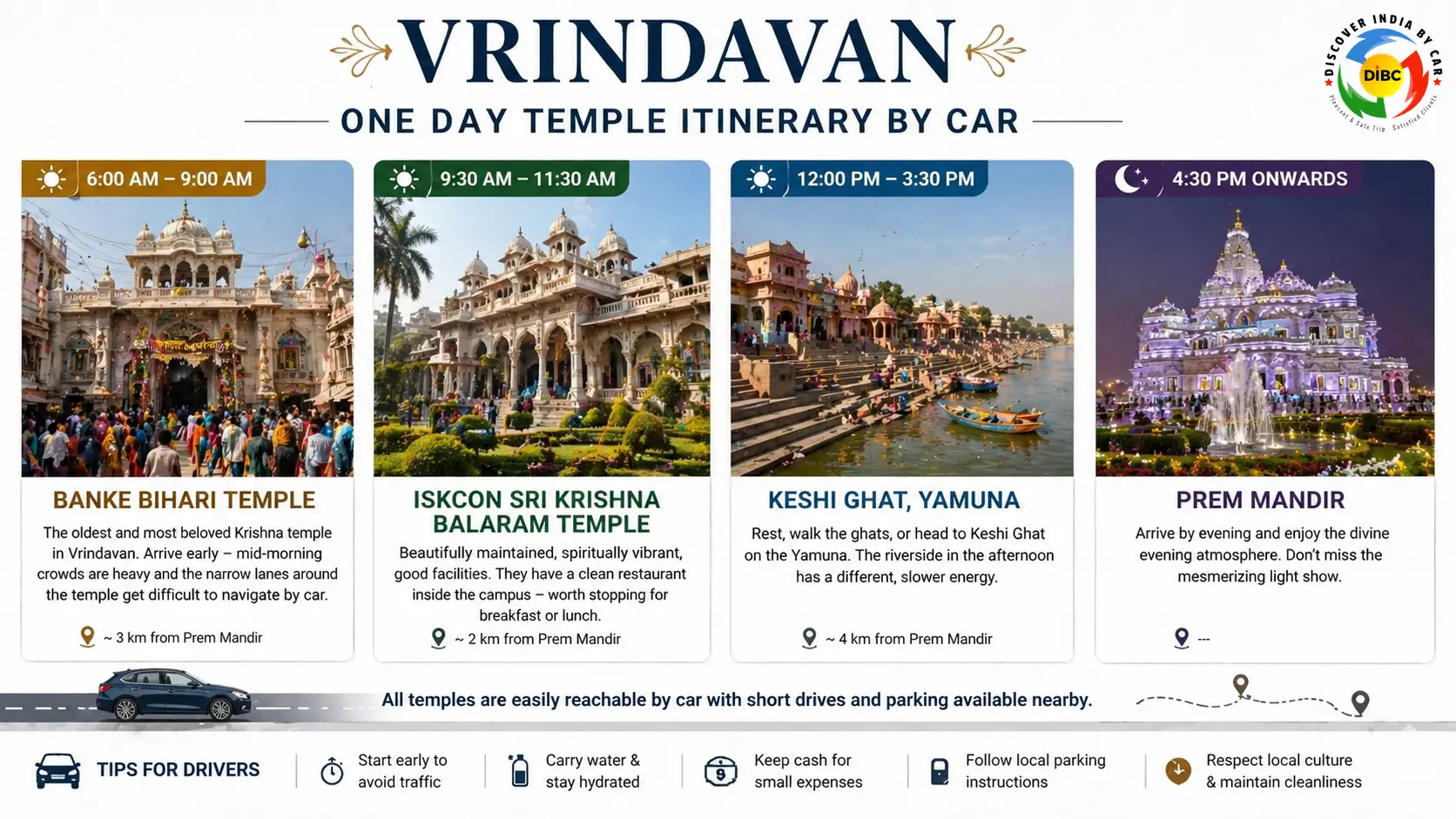
Morning, 6:00–9:00 AM: Banke Bihari Temple. The oldest and most beloved Krishna temple in Vrindavan. It’s about 3 km from Prem Mandir. Arrive early — mid-morning crowds are heavy and the narrow lanes around the temple get difficult to navigate by car.
Mid-morning, 9:30–11:30 AM: ISKCON Sri Krishna Balaram Temple. Beautifully maintained, spiritually vibrant, good facilities. About 2 km from Prem Mandir. They have a clean restaurant inside the campus — worth stopping for breakfast or lunch.
Afternoon: Rest, walk the ghats, or head to Keshi Ghat on the Yamuna. The riverside in the afternoon has a different, slower energy.
Evening, 4:30 PM onwards: Prem Mandir. Stay for the full light show.
Every one of these is reachable by car with easy, short drives. Parking is available at or near each location.
Travel Tips for First-Time Visitors
If this is your first time at Prem Mandir, a few things I learned the hard way — so you don’t have to.
Download offline maps before you leave home.
Mobile data gets unreliable in parts of Vrindavan, especially near the temple on crowded days. I’ve had Google Maps freeze mid-navigation inside Vrindavan more than once. Download the area offline before you start driving.
Fill your fuel tank in Mathura, not Vrindavan.
Fuel stations inside Vrindavan are limited and not conveniently placed near the temple. Mathura has multiple petrol pumps near the highway exits — stop there.
Wear footwear you can slip off and on in under five seconds.
You will remove your shoes at the main entrance and possibly again at inner areas. Laces are a bad idea here. Slip-on sandals or loafers are the sensible choice, and your feet will thank you.
Carry a small drawstring bag or cloth tote.
When you deposit your shoes, you don’t always want to hand over your phone and wallet at the same counter. A small bag you can wear across your body keeps your valuables with you and your shoes in one place when you pick them up.
Go to the sanctum first, then walk the gardens.
Most first-time visitors do it the other way and run out of energy for the interior. The queue inside the sanctum tends to be shorter in the first 30–45 minutes of the evening session.
Don’t underestimate the summer heat.
In April, May, and June, the white marble radiates heat in the afternoon sun and the open gardens offer limited shade. If you’re visiting in summer, early morning or post-sunset evening is the only sensible window. Carry a water bottle regardless of season — there are drinking water stations inside but they can get crowded.
Visiting with elderly family members?
The paths are paved and mostly flat. The Pradakshina path is a gentle walk with no steep sections. The main temple entrance has ramps. It’s one of the more accessibility-friendly large temple complexes I’ve visited, though the walk from parking to the entrance is still around 200–300 metres.
Don’t rush the Pradakshina path.
I know I keep saying this, but it’s genuinely the most common mistake. The 84 marble panels are the soul of the visit. Take your time with each one. There are names and descriptions on small plaques near each tableau — read a few. You’ll understand the place much better for it.
Photography Tips at Prem Mandir
Prem Mandir is one of the most photogenic temples in north India, and the good news is that photography is permitted throughout most of the complex. Here’s how to actually get good shots rather than just snapshots.
Best time for exterior shots: Two windows — early morning and evening. In the morning, the white marble picks up warm, diffused light that brings out the texture of the carvings beautifully. No harsh shadows, no washed-out whites. The hour after sunrise is ideal. In the evening, the LED illumination changes the character of the temple completely. Different look, both worth having.
Best position for the full temple shot: Walk back from the main entrance toward the central garden fountain area. Stand about 60–70 metres out, centred on the main gate axis. From here you get the full temple facade, the fountains in the foreground, and the garden in between. This is the shot. A wide-angle lens (or the widest setting on your phone) works well here.
The Pradakshina path panels: These are best photographed in the soft afternoon light, roughly 3–5 PM. The lighting angle from the west catches the relief carvings and brings out the depth of the work. Avoid photographing them with direct overhead sun — the carvings flatten out and you lose the detail.
Evening fountain show: If you want clean fountain shots without dozens of people in frame, position yourself slightly off-centre and to one side. The central viewing area packs with people; a 30-degree angle still gives you the temple and fountains without a forest of silhouettes.
The night shots: After 7 PM when the LED show is fully running, Prem Mandir in night mode is extraordinary to photograph. Use night mode on your phone or manual settings on a camera — ISO 400–800, 1/30s to 1/60s shutter. A small travel tripod makes a significant difference if you’re serious about it.
Inside the sanctum: Photography inside the main prayer hall is generally not permitted during active darshan. Some visitors photograph from the entrance without a flash — I’d suggest checking with the staff on the day rather than assuming either way. Outside in the covered corridors and archways, photography is generally fine.
One thing to avoid: Don’t point your camera at devotees during prayer without asking. It’s not just about etiquette — the resulting photos aren’t usually good anyway. The architecture is the subject here.
Is Prem Mandir Worth Visiting?
I get this question indirectly from a lot of people planning Mathura-Vrindavan trips — usually framed as “we only have one day, should we include Prem Mandir or skip it for more time at Banke Bihari?”
My answer is always: don’t skip it, but understand what it is.
Prem Mandir is not an ancient temple. It was inaugurated in 2012. If what you’re looking for is centuries of history layered into stone, the kind of patina that comes from generations of devotion, Banke Bihari or the older ghats will speak to you more directly. Prem Mandir is something different — it is a contemporary architectural and spiritual achievement. A statement of what Indian temple craft can do when given time, money, and the right people. The marble work is genuinely world-class. The scale is impressive without being oppressive. The planning of the complex — the gardens, the path, the fountains — is thoughtful in a way that older temples rarely are.
What makes it worth the visit, beyond the aesthetics, is the evening. I’ve said this several times in this guide and I’ll say it once more: the experience of standing in that garden at 7:30 PM, with the lights cycling through the marble, the fountain in front of you, and devotional music filling the air, is something that stays with you. It’s not about religion or even architecture at that point. It’s just one of those things that makes you glad you went.
So — is it worth visiting?
If you’re in Vrindavan for any reason, yes. Without question. Add two to three hours to your day, arrive in the evening, and let it run its course.
If you’re making a specific trip just for Prem Mandir from Delhi — pair it with Banke Bihari, ISKCON Vrindavan, and Keshi Ghat and make a proper Vrindavan day out of it. The drive on the Yamuna Expressway is pleasant, the parking is easy, and the cost of the entire experience is essentially zero.
Worth it. Completely.
Plan a Hassle-Free Road Trip to Prem Mandir Vrindavan
Driving to Vrindavan sounds simple — until you hit the Yamuna Expressway toll confusion, Mathura's busy city roads, and Vrindavan's narrow temple lanes, all in one trip. Skip the stress entirely and let us handle the drive while you focus on the experience.
Clean, comfortable cars — Sedans, SUVs & Fortuners available.
Experienced drivers who know every route to Prem Mandir, Banke Bihari & ISKCON.
Full Mathura–Vrindavan day trip packages from Delhi, Agra & NCR.
Suggested One-Day Vrindavan Itinerary by Car
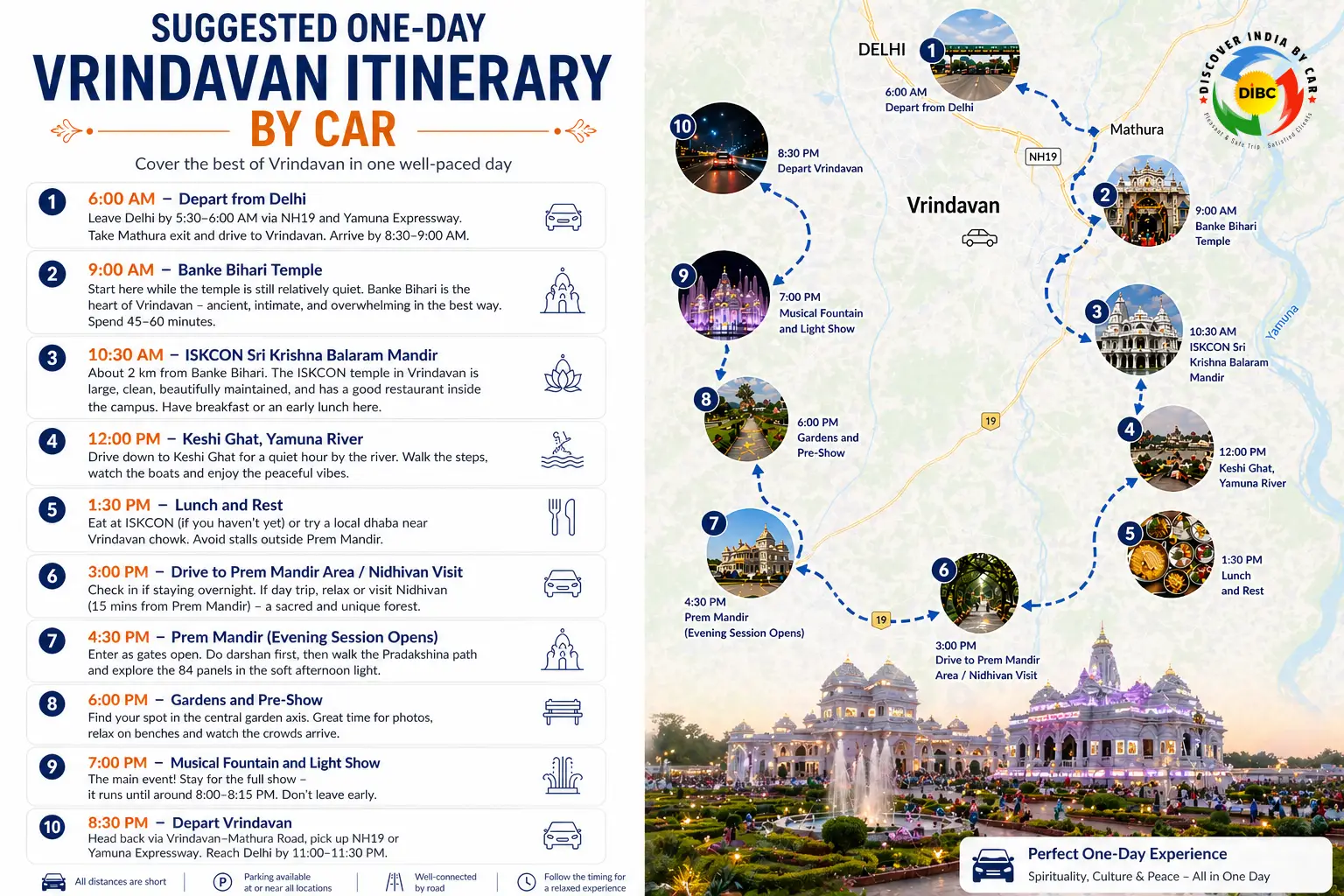
This is the itinerary I’d hand someone visiting Vrindavan for the first time by car. It covers the main sites, flows logically, and ends with Prem Mandir in the evening the way it should.
- 6:00 AM — Depart from Delhi (or arrive from overnight stay) Leave Delhi by 5:30–6:00 AM via NH19 and the Yamuna Expressway. Take the Mathura exit and drive to Vrindavan. You should arrive by 8:30–9:00 AM with normal traffic.
- 9:00 AM — Banke Bihari Temple Start here while the temple is still relatively quiet. Banke Bihari is the heart of Vrindavan — ancient, intimate, and overwhelming in the best way. The darshan here is unlike any other temple in India. Spend 45–60 minutes. Park near the outer road and walk in; the lanes close to the temple are too narrow for cars.
- 10:30 AM — ISKCON Sri Krishna Balaram Mandir About 2 km from Banke Bihari. The ISKCON temple in Vrindavan is large, clean, beautifully maintained, and has a good restaurant inside the campus. Have breakfast or an early lunch here. Budget 1–1.5 hours.
- 12:00 PM — Keshi Ghat, Yamuna River Drive down to Keshi Ghat for a quiet hour by the river. Vrindavan’s ghats are peaceful in the early afternoon when most tourists are eating or resting. Walk the steps, watch the boats. If you want to sit and do nothing for 30 minutes, this is the right place.
- 1:30 PM — Lunch and Rest Either eat at ISKCON (if you haven’t yet) or find one of the small dhabas near the main Vrindavan chowk. Avoid eating at the stalls immediately outside Prem Mandir — the food options are better a few streets back.
- 3:00 PM — Drive back toward Prem Mandir area, check in if staying overnight If you’re staying in Vrindavan, check in now. If you’re doing a day trip, this is a good time to relax in the car, drive slowly around the town, or visit Nidhivan — a small but deeply interesting sacred forest nearby. It’s 15 minutes from Prem Mandir and worth a brief stop.
- 4:30 PM — Prem Mandir (Evening Session Opens) Enter as soon as the gates open. Do the inner sanctum first while queues are shorter. Then walk the Pradakshina path in the softening afternoon light. Take your time with the 84 panels.
- 6:00 PM — Gardens and Pre-Show Find your spot in the central garden axis. The light is still good for photography at this hour. Sit on one of the garden benches, watch the crowds arrive, and let the pace slow down.
- 7:00 PM — Musical Fountain and Light Show The main event. Stay for the full show — it runs until around 8:00–8:15 PM. Don’t leave early.
- 8:30 PM — Depart Vrindavan Head back via the Vrindavan-Mathura Road, pick up NH19 or the Yamuna Expressway at Mathura, and drive back to Delhi. You should reach Delhi by 11:00–11:30 PM under normal highway conditions.
This itinerary covers the essential Vrindavan in one well-paced day. It’s not rushed if you stick to the timings. And it ends the right way.
Frequently Asked Questions
Where exactly is Prem Mandir located?
Vrindavan, Mathura district, Uttar Pradesh. The address is: Jagadguru Kripalu Dham, Bhaktivedanta Swami Marg, Raman Reti, Vrindavan — 281121.
Is Prem Mandir entry really free?
Yes. No tickets, no mandatory donation, no paid darshan queue. Walk in, stay as long as you like.
What time does Prem Mandir open?
5:30 AM for the morning session. 4:30 PM for the evening session. The temple closes between noon and 4:30 PM daily.
How far is Prem Mandir from Mathura?
About 10–12 km. Roughly 20–30 minutes by car depending on traffic.
Can you do Delhi to Prem Mandir as a day trip by car?
Yes, comfortably. It’s about 160 km via the Yamuna Expressway. Leave by 5:30–6:00 AM, have the full day in Vrindavan, catch the evening light show, and drive back. Expect to be home by 11 PM.
Is there parking at Prem Mandir?
Yes — free, paved, supervised, and large enough for SUVs and bigger vehicles. Vehicle entry is via a dedicated lane on Bhaktivedanta Swami Marg.
Who built Prem Mandir?
Jagadguru Shri Kripalu Maharaj. Construction ran from 2001 to 2012, with over a thousand artisans working on the marble carvings.
What is the best time to visit Prem Mandir?
Evening, specifically for the light show between 7:00–8:00 PM. For a quieter visit, early weekday mornings between 6:00–8:00 AM are ideal. October to March is the best season overall.
Final Thoughts
Prem Mandir is one of those places that’s easy to underestimate from photographs. It looks like a lot of temples look — white, ornate, big. The photos don’t capture the scale of the craftsmanship, or the quiet of the circumambulation path in the early morning, or what it actually feels like to be standing in front of it when the lights come on.
Drive to Vrindavan. Park the car. Give it a full evening.
You won’t regret it.