- Private car and driver in Delhi / India
- +91-8447445445
- info@discoverindiabycar.com sugar.ankit@yahoo.com
 +91-9818434712
- Follow us:




Is Indian Street Food Safe for Tourists? What to Eat & What to Avoid
Ankit Sugar
Founder of Discover India by Car
Private car-and-driver tours across Delhi, Agra, Jaipur and Rajasthan for foreign travellers.
You didn’t come to India to skip the food. Here’s how to eat brilliantly on the street without spending your trip near a bathroom.
So, is Indian street food safe for tourists? Mostly, yes, as long as you know which stalls to trust and which dishes to leave for another day. I’ve spent 14 years driving foreign guests between Delhi, Agra and Jaipur, and the first question on day one is nearly always some version of “can tourists eat street food in India, or will I regret it?” The honest answer on India food safety for tourists isn’t “never touch it,” and it isn’t “eat everything.” It sits in between. It’s also a lot easier to manage than the forums make it sound.
This guide is my honest answer to how to avoid food poisoning in India without missing the good stuff. You’ll get the rules we give our own guests, the dishes I’d happily hand to my mother, the ones I’d ask you to wait on, and what to do if your stomach complains anyway.
Is Street Food in India Actually Safe?
Short Answer: Yes, Indian street food is generally safe for tourists when it is cooked hot, served fresh and bought from busy stalls with high turnover. Most stomach trouble comes from contaminated water, ice, raw salads and uncooked chutneys, not from spice or the street setting itself.
Let’s start with the thing everyone calls “Delhi belly.” It’s travellers’ diarrhoea, and it isn’t special to India. It happens wherever your gut meets bacteria it hasn’t met before. Depending on the destination, somewhere between 10% and 70% of international travellers get it, and bacteria cause most cases (StatPearls, citing CDC). That range is wide because it depends on where you go and how you eat, and how you eat is the part you control.
Spice isn’t the problem, though people often assume it is. A fiery chole bhature might leave your mouth burning, but chilli doesn’t make you ill. Germs do, and in India they mostly arrive through water: the water used to rinse a plate, wash a coriander leaf, make ice or top up a chutney. Local people eat the same food every day without trouble because their bodies are used to it. Yours isn’t yet, and that’s fine.
Something surprised me over the years. Plenty of guests eat their way happily through Old Delhi, and then the trouble starts after a hotel buffet salad or a fruit platter that sat out too long. Calling a place a “street stall” or a “restaurant” tells you very little. What matters is whether the food was cooked hot, served fresh and touched by clean water.
Two things help before you even land:
- The CDC recommends hepatitis A and typhoid vaccines for most travellers to India, and both diseases spread through food and water. See a travel clinic at least four weeks before you fly so the vaccines have time to work (CDC).
- Certified food streets. India’s food regulator, FSSAI, runs a “Clean Street Food Hub” programme. A cluster of stalls earns certification by passing hygiene audits, and food handlers are trained under the FoSTAC scheme (Vikaspedia). The food street near the Golden Temple in Amritsar is one of the certified hubs (Outlook India). If you see the certificate on display, that’s a good sign.
Last winter I drove a retired couple from Manchester who had read so many horror stories online that they’d packed a carrier bag full of crackers for the trip. On their first morning in Old Delhi, I took them to a paratha shop in Chandni Chowk where they could watch each one go straight from the hot pan onto their plates, and after a lot of nervous glances at each other they shared a potato paratha, then ordered a second one stuffed with paneer. The next morning the husband rang me before breakfast, not to complain, but to ask if we could go back.
The Golden Rules (Hot, Fresh, Busy Stalls)
If you only remember one line from this article, make it this one: hot, fresh, busy. Most medical advice on preventing traveler’s diarrhea comes down to the same idea, and 14 years on the road have only convinced me further. Food that comes straight out of boiling oil or off a blazing tandoor, at a stall with a queue, is about as safe as street food anywhere in the world. The rest of the rules just add to that.
Watch it being cooked
The safest plate is the one you watched come out of the kadhai (the deep iron wok). A samosa fried as you wait is a very different thing from one that’s been sitting in a glass case since breakfast. If it’s sizzling when it reaches your hand, most germs didn’t survive the trip.
Follow the crowd, especially families
A busy stall means food doesn’t sit around. When you see office workers in a lunchtime queue, or Indian parents buying for their children, that stall has earned local trust over years. An empty stall at 4 pm, with a tray of something that’s been out since noon, is the one to walk past.
Look at the water, not just the food
Before you order, take a quick look around the stall. Is there a bucket for rinsing plates? Is the water cloudy? Does the vendor handle money and food with the same hand? Stalls that serve on disposable leaf plates (pattal) or paper avoid the rinse-water problem completely, which is one reason I like them.
Ease in for the first few days
Don’t make your first meal in India a twelve-dish street crawl. Give your stomach two or three days of cooked, simple food, then slowly get more adventurous. By the time you reach Jaipur, you’ll be ordering like a local.
Clean your hands before you eat
A lot of Indian food is eaten by hand, and that’s part of the fun. Carry a small hand sanitiser and use it every time, including right after you’ve handed over cash.
The stay-healthy rulebook at a glance
8 Practical Rules for Eating Indian Street Food Safely
Simple hygiene and stall-selection habits to keep your stomach safe while enjoying local food.
| Rule | What it means in practice |
|---|---|
| Hot | Fried, boiled, griddled or tandoor-cooked in front of you |
| Fresh | Made to order, not sitting on display |
| Busy | A queue of locals means high turnover |
| Dry over wet | Skip raw chutneys, raw salads and anything topped with water |
| Peel it yourself | Bananas, oranges and mangoes you peel are fine; pre-cut fruit isn't |
| Sealed drinks | Bottled water with an intact cap, canned or bottled soft drinks |
| Clean hands | Sanitiser before every meal |
| Go slow | Simple food for the first two or three days |
What’s Usually Safe to Eat
Here’s the good news: most of North India’s best street food is fried, boiled or baked at high heat. That means the safe list is long, and it’s delicious.

Safest Indian Street Foods to Try (and Where to Find Them)
Freshly cooked, high-heat dishes that are easy on a traveller's stomach across India.
| Dish | What it is | Why it's usually safe | Where to try it |
|---|---|---|---|
| Jalebi | Spirals of batter fried and soaked in hot syrup | Fried in hot oil, then dipped in sugar syrup | Old Delhi, any busy sweet shop |
| Samosa & kachori | Fried pastry stuffed with spiced potato or lentils | Served straight from the oil | Everywhere; Jaipur's pyaaz kachori is famous |
| Stuffed paratha | Flatbread filled and fried on a griddle | Cooked hot, made to order | Paranthe Wali Gali, Chandni Chowk |
| Chole bhature | Spiced chickpeas with puffed fried bread | Long-simmered curry, fresh-fried bread | Delhi breakfast spots |
| Tandoori roti & kebabs | Breads and meat from a clay oven | Very high heat, cooked in front of you | Busy places with fast turnover |
| Masala dosa | Crisp rice-lentil crepe with potato filling | Griddle-cooked to order | South Indian stalls in any city |
| Amritsari kulcha | Stuffed bread baked in a tandoor | Baked hot, served at once | Amritsar, near the Golden Temple |
| Bedai & jalebi | Agra's fried bread breakfast with potato curry | Fried and simmered | Agra, early morning |
| Petha | Agra's translucent sweet made from ash gourd | Cooked and preserved in sugar | Agra, sealed boxes from big shops |
| Masala chai | Tea boiled with milk and spices | Boiled hard, served steaming | Literally every corner |
| Bhutta | Corn roasted over charcoal, rubbed with lime and salt | Cooked over open flame | Roadside carts, especially in winter |
A few notes from the passenger seat. Chai is one of the safest things you can drink in India because it’s boiled, sometimes twice, so don’t be shy about it. With aloo tikki (fried potato patties), the patty itself is fine, but it often comes with cold yoghurt and green chutney on top. If you’re early in your trip, ask for it plain, “bina chutney.” The vendor won’t mind.
On the vegetarian question, a lot of our guests find North India’s vegetarian street food the easiest place to start. That’s not because meat is bad. Vegetarian stalls tend to have huge turnover, and you sidestep the risks of keeping raw meat in the heat. When you do want meat, choose a busy place where kebabs go straight from the skewer onto your plate.
For a full list of where we take guests in the capital, including the stalls I’d point you to for hygienic street food in Delhi, see our Delhi street food guide.
What to Be Careful With
You don’t need to avoid any of these forever. Think of this as a “not yet” list, or a “choose the right place” list. Many guests try everything here by the end of their trip. They just do it smartly.
Risky Indian Street Foods & Safer Alternatives
Common street items that cause stomach trouble and smarter ways to eat them safely.
| Food | Why it's risky | Safer way to enjoy it |
|---|---|---|
| Pani puri / golgappa | The tangy "pani" is cold, uncooked flavoured water | Try it at a reputable restaurant that uses filtered water, or wait until later in your trip |
| Raw salads & sliced onions | Usually rinsed in tap water | Ask for no salad; stick to cooked vegetables |
| Green chutney & raw raita | Uncooked, often made in bulk and kept unrefrigerated | Ask "bina chutney"; tamarind chutney is usually cooked |
| Pre-cut fruit | Cut with an unknown knife, washed in unknown water, sitting in the open | Buy whole fruit and peel it yourself |
| Roadside lassi & dahi | Dairy that may have sat warm for hours | Busy dairy shops with high turnover, or sealed packs |
| Kulfi & ice cream from carts | May have melted and refrozen in the heat | Sealed, branded ice cream, or well-known kulfi shops |
| Meat at quiet stalls | Raw meat stored in the heat | Busy kebab shops cooking to order |
| Seafood in Delhi, Agra or Jaipur | These cities are a long way from the sea | Save seafood for Goa or Kerala |
| Fresh juice & sugarcane juice | Ice, added water and machine hygiene | Coconut water opened in front of you |
| Momos with mayo dips | Mayonnaise and heat don't mix | Ask for the cooked red chilli sauce only |

Let me be fair about pani puri, because it’s the one everyone asks about. It’s one of the great joys of Indian street food: a crisp hollow shell, a bite of spiced potato, a splash of sour-spicy water, all in one mouthful. Plenty of tourists eat it and feel perfectly fine. It’s also, hand on heart, the single most common dish guests blame when they feel rough the next day, because the water is never boiled. My advice is to have your first one somewhere that tells you it uses filtered or bottled water, and to save it for the second half of your trip.
In Delhi and Agra, a lot of our guests have their first plate at Haldiram’s, the big Indian snack chain. The counters are busy and clean, the turnover is constant, and you can ask the staff how the pani is made before you order.
Water, Ice & Drinks
Short Answer: In India, drink only sealed bottled water that carries the ISI mark, and use it for brushing your teeth too, never tap water.
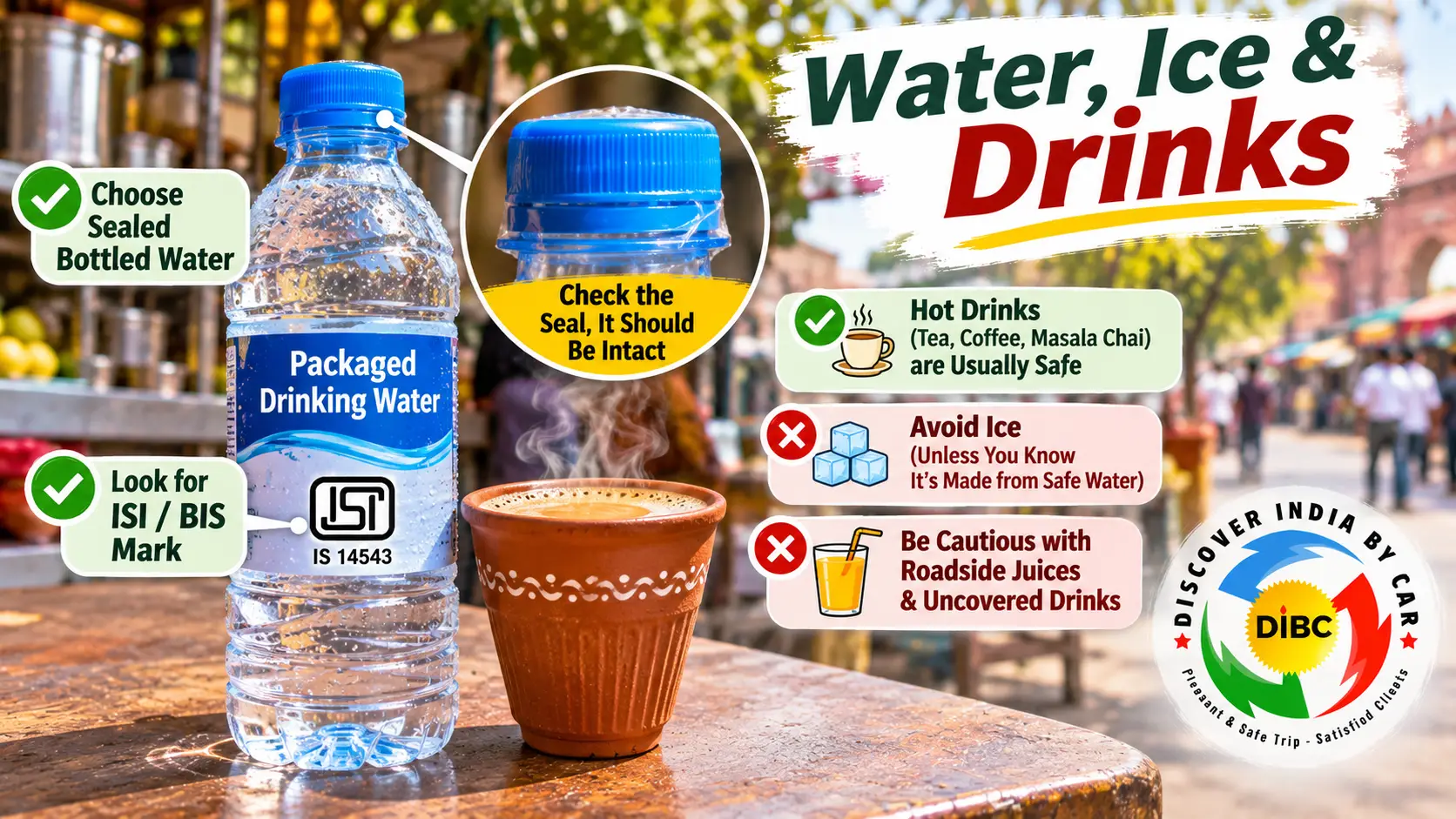
This is the section that actually keeps people healthy, so I’ll be direct. Don’t drink the tap water in India, not even in a five-star hotel bathroom. The CDC advises travellers to avoid tap water and drink only boiled, bottled or filtered water (CDC Yellow Book).
Bottled water is everywhere and it’s cheap. Two quick checks: make sure the cap seal clicks when you open it, and look for the ISI mark on the label. Indian law says packaged drinking water can only be made and sold under the Bureau of Indian Standards certification mark (BIS), so a bottle without one is a red flag.
The sneaky ways water gets you:
- Good hotels and proper restaurants generally make ice from filtered water. At a roadside stall, assume it isn’t, and say “no ice.”
- Brushing your teeth. Use bottled water, and don’t rinse your toothbrush under the tap. Contaminated toothbrush water is a classic route for travellers’ diarrhoea (Merck Manual).
- The shower. Keep your mouth closed. It sounds silly, but it works.
- Washed glasses. If a drink comes in a glass that’s still wet, drink from the bottle instead.
Safe & Unsafe Drinks in India: Quick Guide for Travellers
What you can sip worry-free and which roadside drinks to skip or check carefully.
| Drink | Safe? | Notes |
|---|---|---|
| Sealed bottled water (ISI mark) | Yes | Check the cap seal clicks |
| Masala chai / hot coffee | Yes | Boiled, so very low risk |
| Canned or bottled soft drinks | Yes | Drink from the can or bottle |
| Fresh coconut water | Usually | Only if cut open in front of you |
| Tap water | No | Not even for brushing teeth |
| Ice at street stalls | Avoid | Assume it's made from tap water |
| Roadside juice & sugarcane juice | Be careful | Ice and added water are common |
| Lassi | Depends | Busy, trusted shops only |
On every tour, our drivers keep sealed bottled water in the car, so you’re never stuck buying from an unknown cart in the middle of the highway.
If You Do Get Sick: What to Do
Even careful travellers sometimes catch a bug. If it happens to you, it doesn’t mean you did anything wrong. It just means you’re travelling.
Symptoms usually show up 12 to 72 hours after the food that caused them, and most mild cases settle on their own within three to five days (MSD Manual). The real danger isn’t the bug. It’s dehydration (Harvard Health).
Here’s the plan:
- Rehydrate first. Buy oral rehydration salts (ORS) at any chemist. Electral is the brand you’ll see most in India. Mix it with bottled water and sip slowly and often.
- Eat bland. Plain rice, khichdi (a soft rice-and-lentil dish), bananas, toast and curd rice from your hotel kitchen. Skip the spice, dairy-heavy dishes and alcohol for a day or two.
- Tell your driver. A good tour is flexible enough to push the sightseeing back a day.
- Use anti-diarrhoea tablets carefully. Adults can take something like loperamide for short-term relief, but it isn’t recommended if you have a fever or blood in your stool (Mayo Clinic). Don’t give it to children without a doctor’s advice.
- Know when to see a doctor. See the table below.
When to Seek Medical Help in India
Warning signs that mean you should consult a doctor instead of waiting it out.
| See a doctor if you have... |
|---|
| A fever |
| Blood or mucus in your stool |
| Vomiting so bad you can't keep fluids down |
| Signs of dehydration: dizziness, a racing heart, very little urine |
| No improvement after two or three days, or severe stomach pain |
| A sick child, an older traveller or a pregnant traveller with symptoms (go sooner) |
Most hotels in Delhi, Agra and Jaipur can call a doctor to your room, and all three cities have good private hospitals. If you’re on the road with us, your driver knows where the nearest reliable clinic and pharmacy are. Make sure you have travel insurance that covers medical care before you leave home.
This section is general travel guidance, not medical advice. Speak to your doctor or a travel clinic about your own health.
How a Driver Helps You Find the Good Stalls
This is the part guidebooks can’t really do for you. A blog post can tell you “hot, fresh, busy.” A local driver can stand you in front of the exact stall where he’s eaten since he was a boy.
Here’s what that looks like on our tours. Your driver knows which paratha shop in Old Delhi his own family goes to, and he’ll get you there in the morning, when the oil is fresh and the lanes aren’t packed yet. He knows the safe places to eat in the Golden Triangle, right down to which highway food stops on the Delhi–Agra and Agra–Jaipur routes have clean kitchens and proper toilets, and which ones to drive straight past. He’ll tell you, politely and honestly, if a place has gone downhill. If you want to try pani puri, he’ll take you somewhere he trusts.

There’s a practical side too. With a private car, you’re never stuck. You can stop for chai whenever you like, head back to the hotel if your stomach needs a break, or reshuffle the day without losing money on a group tour that won’t wait for you. If someone in your family feels unwell, your driver can take you to a pharmacy or clinic in minutes instead of leaving you to work out a city you’ve never seen before.
For families especially, that flexibility makes all the difference. Kids get hungry at odd times, and having someone who knows where the clean, safe options are can save your day.
Raj, one of our drivers, had a family with two young boys in the car on the Agra–Jaipur highway, and about two hours in, the kids had run out of games and patience. Raj pulled in at a small family-run dhaba he’s trusted for years, where the owner boiled a fresh pot of chai and fried a plate of hot pakoras while the boys watched. Twenty minutes later everyone was back in the car, fed and happy, and the parents told us later it was one of their favourite stops of the whole trip.
Frequently Asked Questions
Q1. Is Indian street food safe for tourists?
Yes, for the most part. Freshly cooked, hot food from busy stalls is generally safe. The main risks come from water, ice, raw salads and uncooked chutneys rather than the food itself.
Q2. Can tourists eat pani puri in India?
Many do, but the flavoured water isn’t boiled, so it’s one of the riskier dishes. Try it at a reputable place that uses filtered water, ideally later in your trip.
Q3. How do I avoid Delhi belly?
Eat hot, freshly cooked food from busy stalls. Drink sealed bottled water, avoid ice and raw salads, peel your own fruit, sanitise your hands before eating and take it easy for the first few days.
Q4. Is it safe to eat street food in Delhi?
Yes, if you choose well. Old Delhi has some of the country’s best street food. Stick to stalls with high turnover and food cooked in front of you.
Q5. Is tap water safe to drink in India?
No. Use sealed bottled water with the ISI mark for drinking and brushing your teeth, or boiled or filtered water.
Q6. Are ice cubes safe in India?
In good hotels and established restaurants, ice is usually made from filtered water. At street stalls and small juice shops, avoid it.
Q7. Is vegetarian food safer in India?
Often, yes, for travellers. Vegetarian street food in North India has high turnover, and you avoid the risk of raw meat stored in the heat.
Q8. Can children eat Indian street food?
Yes, with extra care. Stick to the hot, fried and baked items, skip water-based snacks and raw toppings, and carry ORS sachets just in case. Talk to your doctor about children’s medicines before you travel.
Q9. Should I take antibiotics before travelling to India?
Don’t take antibiotics to prevent diarrhoea unless your doctor tells you to. Ask your travel clinic what to pack for emergencies.
Q10. Which vaccines help with food safety in India?
The CDC recommends hepatitis A and typhoid vaccines for most travellers to India. Book a travel clinic visit at least four weeks before you fly.
Plan a Food-Friendly Trip Through North India
The best food in India is rarely in the fanciest places, and finding it safely is much easier with someone local beside you. That’s the whole reason we do this. You get a private car, a driver who knows the roads and the right stalls, the freedom to stop for chai whenever you like, and a plan that bends if your stomach (or your kids) need a slower day.
Discover India by Car has been running private car-and-driver tours across North India for foreign travellers for 14 years. Our drivers are licensed and experienced, our pricing is fixed and transparent with no hidden extras, and every tour is 100% private, just you and the people you’re travelling with.
Discover India By Car
Contact Information
C-51, First Floor, Kiran Garden, Uttam Nagar, New Delhi - 110059