- Private car and driver in Delhi / India
- +91-8447445445
- info@discoverindiabycar.com sugar.ankit@yahoo.com
 +91-9818434712
- Follow us:




Capitol Complex Chandigarh – UNESCO Marvel by Le Corbusier
There are some places that photos just can’t prepare you for. You see the pictures, you read the history, but then you arrive, and the sheer scale and audacity of it all just hits you. The Capitol Complex Chandigarh is one of those places. Stepping onto its sprawling, sun-baked plaza feels like walking onto a stage for giants. The air itself feels different, charged with the weight of the raw concrete structures that dominate the skyline.
This isn’t just the administrative home of two Indian states; it’s a jaw-droppingly bold idea made real, an architectural manifesto you can walk through. It’s the life’s work of the legendary, and often controversial, architect Le Corbusier.
For anyone charting a course across India by car, I have to say, this is an essential detour. It’s a shock to the system, a powerful palette cleanser from ancient temples and Mughal forts, and a deep dive into the story of a modern nation defining itself on its own terms.
My goal here is to give you more than just the facts. I want to try and convey the feeling of this place—its history, its soul, and its incredible design. We’ll explore monuments like the famous Open Hand Monument, and get a real understanding of the groundbreaking Chandigarh architecture.
I’ll also give you the lowdown on the practical stuff, like the Capitol Complex Chandigarh timings, so you can plan a visit that will, believe me, stick with you for a long, long time.
History & Significance of Capitol Complex
To really get Chandigarh, you have to rewind the clock to a raw and painful moment. It’s 1947, and the line of Partition has just been drawn across the Punjab province. In a stroke, the historic capital, Lahore, is now in another country, Pakistan.
A capital city vanished overnight, leaving a gaping wound and a huge administrative problem for the new Indian state of Punjab. But in that moment of crisis, India’s first Prime Minister, Jawaharlal Nehru, saw a chance for something truly radical. His vision wasn’t just to build a replacement city; it was to build a new kind of city.
He famously wanted a place “unfettered by the traditions of the past, a symbol of the nation’s faith in the future.” This wasn’t just about pouring concrete; it was about pouring a nation’s hopes into a new mold.
And the brain of this new city, its very heart and mind, was to be the Capitol Complex. For a project this wildly ambitious, you needed an architect with an equally audacious vision, and they found him in Le Corbusier. He and his team, including his brilliant cousin Pierre Jeanneret and a group of remarkable young Indian architects, were tasked with creating more than just buildings.
They were tasked with creating a legacy. On a vast, 100-acre site, they orchestrated a powerful architectural dialogue. Three colossal structures, representing the three pillars of democracy—the legislature, the executive, and the judiciary—were set in a dynamic relationship with each other, forever in conversation across the massive plaza.
It took some time, but eventually, the rest of the world officially acknowledged what a singular achievement this was. In 2016, the complex earned its spot on the UNESCO World Heritage list. This wasn’t just a nice accolade; it was a global recognition that this corner of Chandigarh is a site of “outstanding universal value,” a masterpiece of human creative genius to be protected at all costs.
Le Corbusier’s iconic design
When you walk through the grounds, you start to notice the signatures of Le Corbusier’s Chandigarh everywhere. It’s a design language that was revolutionary at the time and remains incredibly powerful today.
Let’s talk about the concrete first, because you can’t ignore it. It’s not the smooth, sleek concrete of many modern buildings. This is béton brut—raw concrete. It’s rough. You can feel the grain of the wood forms it was poured into. It wears its imperfections like a badge of honor.
To me, it feels honest and incredibly strong. And the way it interacts with the harsh Indian sun is a spectacle in itself. The deep shadows it creates give the buildings a dynamic, almost living quality that changes with every passing hour. This powerful aesthetic is the absolute soul of Chandigarh architecture.
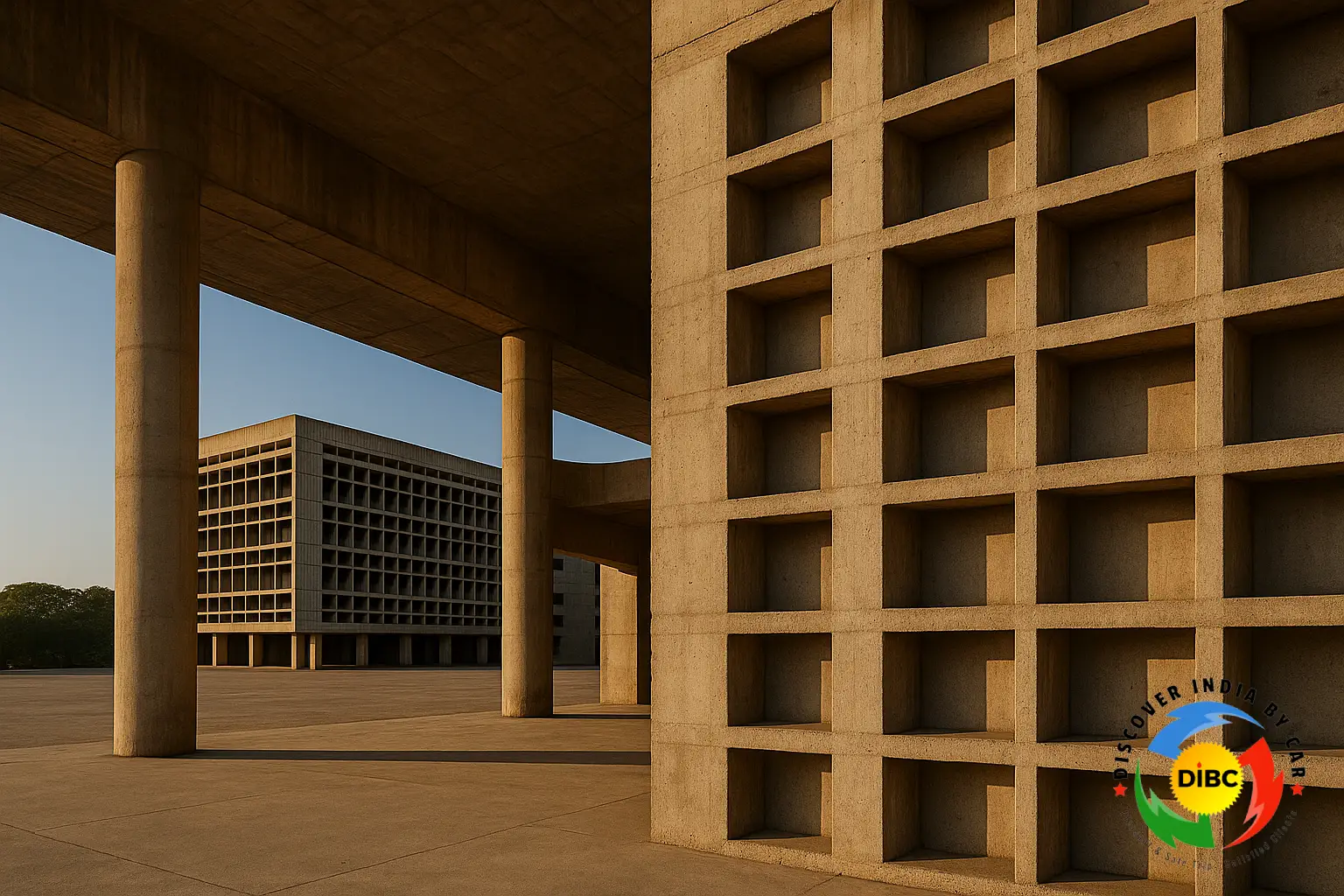
Then you’ll notice the facades. They’re not flat; they’re covered in a deep, grid-like pattern of concrete projections. These are his famous brise-soleils, or sun-breakers. Think of them as the building’s built-in sunglasses. This isn’t just for looks; it’s a brilliant, non-mechanical form of air conditioning.
The deep overhangs block the high summer sun from hitting the glass, keeping the interiors surprisingly cool. It’s a brilliant piece of climate-conscious design that also happens to look incredible, creating a rhythm and texture that are just mesmerizing.
Now, for all their massive, almost intimidating scale, these buildings don’t make you feel small in a bad way. There’s a strange and beautiful harmony to it all. That’s the secret ingredient: Le Corbusier’s “Modulor” system. He developed a whole system of proportion and scale based on the measurements of the human body.
He built these spaces around the human form, and even if you can’t put your finger on why, you can feel it. It’s what keeps these giants from feeling monstrous and instead gives them a sense of profound, right-sized grace.
Attractions inside Capitol Complex
The real magic of the Capitol Complex Chandigarh happens when you start exploring its individual components. Each structure tells its own story.
High Court
The first thing that will probably grab your attention, from a distance, is the roof of the High Court, the Palace of Justice. It’s wild. A massive, arching double-roof that swoops upwards like a giant set of wings. This isn’t just for drama; the design ingeniously protects the main structure from the sun and monsoon rains while letting air circulate.
But then you get closer, and against all that sober grey concrete, you see the main entrance pillars. They’re painted in a shock of primary colors—bold yellows, reds, and blues. It’s an electrifying visual statement about the life and energy of the law.
Secretariat
This building is just… massive. It’s a horizontal skyscraper, an enormous slab that houses the day-to-day workings of two state governments. Frankly, its scale is hard to comprehend until you’re standing before it. The long, repetitive facade of sun-breakers and windows seems to stretch on forever.
You have to imagine the sheer human energy buzzing inside those thousands of windows. Keep an eye out for the huge, sculptural ramps that climb the building’s exterior. Le Corbusier loved ramps. He saw them as being more dynamic and forward-moving than stairs, a perfect symbol for the endless work of progress and governance.
Legislative Assembly
The Assembly is the showstopper. It’s pure architectural theatre. The base is a grand, square hall, but what erupts from its roof is what takes your breath away—a colossal, curving shape that looks almost like the cooling tower of a power plant. Inside this incredible structure is the main assembly chamber.
It was a deliberately industrial and shockingly modern shape for a seat of government. And then there’s the door. The main entrance door is a work of art in itself, a giant, pivoting enamel canvas covered in colorful, abstract symbols of modern India. It’s a magnificent welcome to the people’s house.
Open Hand Monument
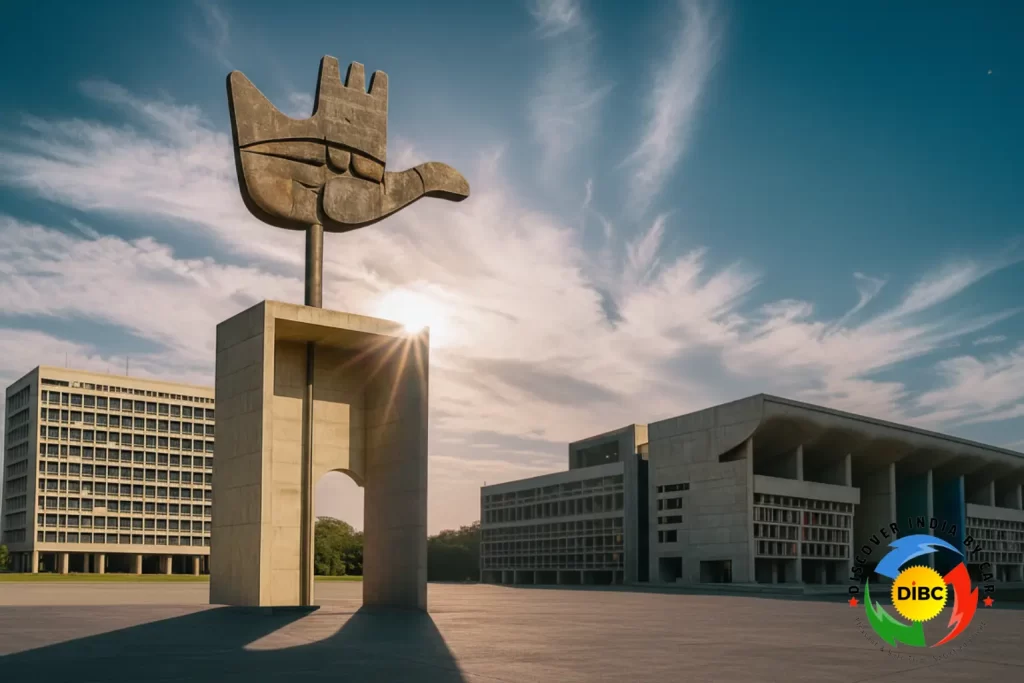
After the intimidating scale of the main buildings, you find a moment of grace at the Open Hand Monument. This, for me, is the true heart of the entire complex. Standing tall and elegant, this huge metal hand is designed to turn in the wind, a symbol of constant change and responsiveness.
Le Corbusier’s message with this sculpture was simple and beautiful: it’s a hand that is “open to give and open to receive.” It’s a profound statement about peace, about listening, about putting aside conflict. It’s a deceptively simple idea, but a deeply powerful one, and it has rightly become the emblem of Chandigarh itself.
Visiting Information & Timings
So, you want to go? Fantastic. Here’s the deal on visiting the Capitol Complex Chandigarh. Because it’s a real, working government complex, you can’t just stroll in.
- Capitol Complex Chandigarh Timings: You can get in on guided tours, which are generally available between 10:00 AM and 5:00 PM. Do remember, it’s usually closed on Sundays and other official holidays.
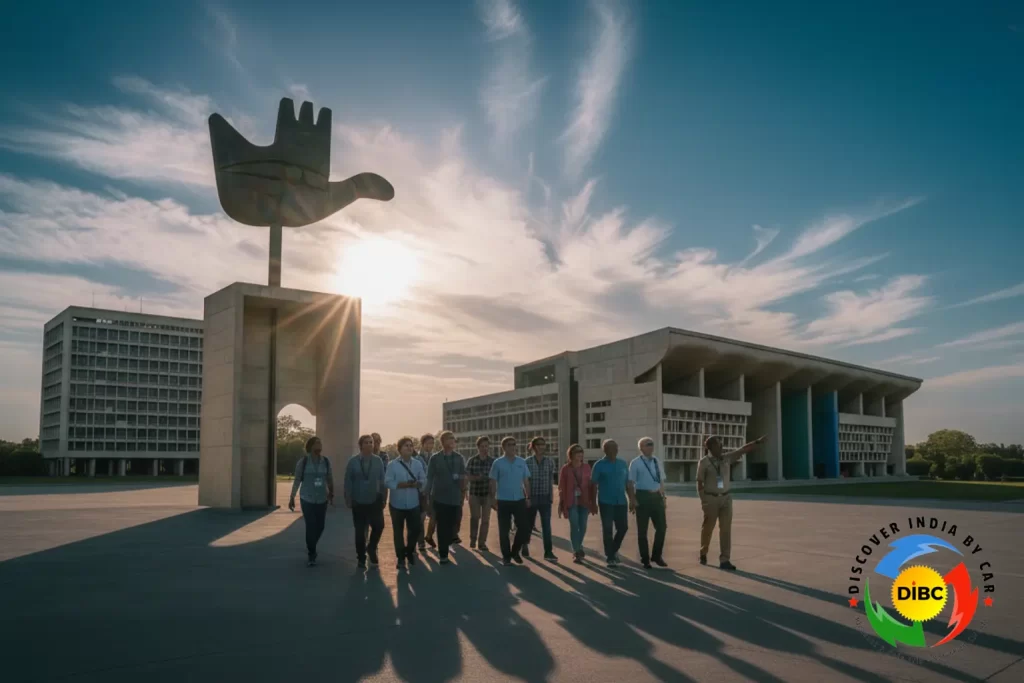
- A Tour Is Your Only Way In: I can’t stress this enough. All visits are done as part of an official guided tour. The good news? These tours are completely free.
- What time is the Capitol complex tour? They run like clockwork. The three standard times for the tours are 10:00 AM, 12:00 PM, and 3:00 PM. My advice is to get to the tourist registration center (it’s in Sector 1, near the complex) a good 30 minutes ahead of time to get your name down.
- Your ID Is Non-Negotiable: Every single visitor must have a valid photo ID. This is a strict security rule, no exceptions.
Why Foreign Tourists Love Capitol Complex?
So what’s the big deal for international travelers? Why does this place resonate so strongly?
- A Real-Life Textbook: For anyone who’s ever studied architecture or modern design, this place is basically a pilgrimage site. It’s one of the few places on the planet where you can see a master’s complete vision—from the city grid down to the doorknobs—fully realized.
- It’s Not the ‘Usual’ India: Many visitors come to India expecting ancient wonders. And they are wonderful! But Chandigarh offers something else. It tells the story of the 20th century—of a democratic, secular, and incredibly hopeful new nation. It’s a vital part of the complete Indian story.
- The Sheer Ambition Is Inspiring: People are often just blown away by the fact that this place even exists. The idea that a whole city could be built from scratch based on a single, powerful, artistic idea is a testament to what’s possible.
- You Don’t Need to be an Expert to Be Wowed: Honestly, you can forget all the history and theory. The place is just visually stunning. The play of light, the power of the forms, the massive open spaces—it’s an experience that hits you on a gut level.
Conclusion
A visit to the Capitol Complex Chandigarh is the kind of experience that sticks with you. It’s more than just looking at impressive buildings; it’s a journey into an idea. It makes you think about politics, art, and what it means for a society to build its own future. Walking among these concrete titans, from the relentless rhythm of the Secretariat to the poetic form of the Assembly, and finishing with the simple, human gesture of the Open Hand Monument, is a remarkable experience. What Le Corbusier created here, and what India embraced, wasn’t just groundbreaking Chandigarh architecture. It’s a lasting and powerful statement of hope. For my money, it’s one of the most powerful and uniquely moving stops you can make on any journey through this incredible country.
FAQs
Here are the clear, straightforward answers to the questions provided.
Q1. How to visit Capitol Complex Chandigarh?
A. To visit the Capitol Complex Chandigarh, joining one of the official guided tours is mandatory. It’s not possible to wander around independently due to it being a high-security governmental area. The first step is to go to the Capitol Complex Tourist Centre in Sector 1. A valid form of photo identification must be presented there for registration. The good news is that these official tours are provided at no cost to visitors.
Q2. Which site of Chandigarh is a world heritage site?
A. The specific site in Chandigarh that holds the prestigious title of a UNESCO World Heritage site is the Capitol Complex. It was inscribed on the list in 2016. It is part of a larger, transnational collection of seventeen works by Le Corbusier, collectively recognized for their “Outstanding Contribution to the Modern Movement.”
Q3. What time is the Capitol complex tour?
A. The guided tours of the Capitol Complex Chandigarh operate on a fixed schedule. Typically, there are three tour slots available each day. These are scheduled for 10:00 AM, 12:00 PM, and 3:00 PM. It is always a wise idea to confirm these timings directly with the official Chandigarh Tourism authorities before a planned visit, as schedules can occasionally be subject to change.
Q4. Why is Le Corbusier famous?
A. Le Corbusier is famous for being one of the most important and influential architects of the entire 20th century. He was a true pioneer of Modernism. His fame comes not just from designing iconic buildings, but from developing revolutionary theories about urban planning and modern life. He championed the use of modern materials like reinforced concrete, and his visionary work, especially the master plan for the city of Chandigarh and the design of its Capitol Complex, fundamentally altered the course of architecture across the world.
Q5. What is a unique fact about Chandigarh?
A. A truly unique fact about Chandigarh is that its entire master plan, conceived by Le Corbusier, is based on a direct analogy to the human body. The Capitol Complex was designed to function as the ‘head’ or the brain. The city’s commercial center in Sector 17 serves as its ‘heart.’ The sprawling network of parks and green corridors, known as the Leisure Valley, act as the city’s ‘lungs,’ allowing it to breathe. The industrial area represents the ‘hands,’ and the university and other educational institutions are the ‘limbs.’ It is a complete, holistic vision of a living city.


