- Private car and driver in Delhi / India
- +91-8447445445
- info@discoverindiabycar.com sugar.ankit@yahoo.com
 +91-9818434712
- Follow us:




Red Fort Delhi: Latest Timings and Tickets Prices August 2026
So, you’re planning a trip to the Red Fort Delhi. Good choice. But let’s get something straight right now—forget every postcard you’ve ever seen. No picture can prepare you for the moment you first lay eyes on its colossal, red-rock walls rising out of the glorious chaos of Old Delhi.
It’s not just a building; it’s a feeling. They call it Lal Qila, and for centuries, this giant has been the silent witness to an India of emperors, rebels, and dreamers. If you’re touring India by car, consider this your non-negotiable anchor point. It’s where the story begins.
This guide isn’t going to just throw facts at you. I want to give you a genuine feel for the place. We’ll get into the gritty, epic Red Fort history, peek into its architectural secrets, and sort out all the practical stuff that matters—the actual Red Fort opening time, when they kick you out at Red Fort closing time, and how not to get ripped off on the Red Fort ticket price. Let’s do this right.
About Red Fort Delhi
The Red Fort is so much more than a pile of old stones. It’s the stage for modern India. You really get a sense of this on August 15th, India’s Independence Day. The Prime Minister gets up on those ancient ramparts and addresses the whole country.
In that moment, this fortress of kings becomes a symbol for the common person, a place that ties India’s complicated past to its noisy, vibrant present. It’s pretty powerful stuff to think about as you’re walking through its gates.
The Legacy and Significance of the Red Fort
Get this: way back in 1639, Emperor Shah Jahan—the guy who gave us the Taj Mahal—basically decided his capital in Agra was old news. He wanted something bigger, better, and more ridiculously grand. So he built a whole new city, Shahjahanabad, with this fort as its heart.
For 200 years, this was the center of the Mughal universe. Every major decision, every celebrated poem, every bit of courtly drama… it all went down right here. The place just buzzes with that energy.
Why Red Fort is a UNESCO World Heritage Site
In 2007, UNESCO put a ring on it, officially calling the Red Fort a World Heritage Site. They didn’t just do it because it looks good on Instagram. They recognized it as the high point of Mughal genius, a mash-up of Persian, Indian, and Islamic ideas that created a totally unique style.
What was built here went on to inspire countless other forts and palaces across the land. It was a trendsetter, an icon of its time.

Red Fort Delhi History
The Red Fort history reads like a wild, epic movie script full of crazy highs and devastating lows.
Construction and Design by Emperor Shah Jahan
So Shah Jahan picks his spot on the riverbank and gets his rockstar architect, Ustad Ahmad Lahori, on the job. For a solid decade, thousands of people—masons, artists, laborers—poured their sweat into this project. They weren’t just slapping up walls; they were engineering a paradise on Earth, a city within a city, with gardens, palaces, and markets, all protected by walls that could withstand just about anything.
The Mughal Era and British Occupation
For two centuries, life here was pretty sweet if you were a Mughal emperor. But things got messy. In 1739, a Persian ruler named Nadir Shah stormed in and took off with a shocking amount of treasure, including the priceless Peacock Throne. But the real gut punch came after the Indian Rebellion of 1857. When the British took over, they did a number on the place. They tore down many of the delicate marble palaces inside to build ugly army barracks. It was a calculated move to break the spirit of the place, and it left a permanent scar.
Red Fort’s Role in India’s Independence
But a place like this doesn’t stay down for long. It became a powerful symbol for Indians fighting for freedom. The British holding trials of captured Indian National Army officers here in 1945 backfired spectacularly, making the fort a rallying point for independence. The ultimate poetic justice happened at midnight on August 15, 1947, when Jawaharlal Nehru, India’s first Prime Minister, raised the independent Indian flag right here. A place of imperial conquest became a beacon of freedom. How amazing is that?
Architecture of Red Fort Delhi
Okay, brace yourself. The design of the Red Fort Delhi is an absolute knockout. It’s this brilliant mix of fortress-like toughness on the outside and unbelievably delicate beauty on the inside, all spread over 250 acres.
The Majestic Red Sandstone Walls
The name doesn’t lie. The walls are red, and they are massive. We’re talking two kilometers of them, and in some spots, they’re as tall as a modern 11-story building. Walking alongside them, you feel tiny. They were built to intimidate, and even after almost 400 years, they still do the job.
Key Monuments Inside the Fort – Diwan-i-Aam, Diwan-i-Khas, Rang Mahal
Once you get past the massive gates, it’s a whole different world. You have to check these out:
- Diwan-i-Aam (Hall of Public Audience): This is where the emperor held open court. It’s a huge hall with rows of columns, but your eyes are immediately drawn to the marble canopy at the end. This is where the emperor sat, part king, part god, listening to the problems of his people.
- Diwan-i-Khas (Hall of Private Audience): This was the inner sanctum. A smaller, unbelievably beautiful hall made of white marble, decorated with carved flowers and what used to be inlaid jewels. This is where the real power plays happened. You can almost feel the whispers in the air.
- Rang Mahal (Palace of Colors): The home of the emperor’s wives. You can see the remnants of its past glory in the carvings and the famous “Stream of Paradise,” a shallow water channel that ran right through the middle of the palace floors to cool the rooms. Pure genius.
Mughal Architectural Elements & Symbolism
The Mughals were masters of detail. You’ll see it in the web-like patterns of the jali screens that throw gorgeous shadows on the floor. You’ll see it in the floral patterns carved into marble that look so real you want to touch them. The whole design, with its gardens and water channels, was a conscious attempt to build a heaven on Earth.

Red Fort Delhi Timings & Entry Fee
Let’s talk logistics. Knowing this stuff will make your visit a breeze.
Red Fort Opening and Closing Time
The gates swing open at 9:30 AM and they stop letting people in at 4:30 PM. The big thing to remember: It is CLOSED on Mondays. Don’t get caught out. Plan your visit for any other day of the week.
Red Fort Ticket Price (Indian & Foreign Tourists)
Here’s the deal with the Red Fort ticket price:
- For Indians: ₹35. That’s it.
- For Foreigners: It’s ₹500.
- Folks from SAARC/BIMSTEC countries: You pay the Indian price, ₹35.
- Bringing a video camera? That’s another ₹25.
Great news if you’re traveling with little ones: kids under 15 are totally free. Seriously, buy your ticket online before you go. It will save you from standing in a very, very long line under the sun.
Best Time to Visit Red Fort Delhi
Come to Delhi between late October and March. The weather is fantastic—cool, dry, and sunny. You couldn’t ask for a better time to be walking around the Red Fort Delhi. And if you can, go on a weekday morning, right when it opens. You’ll get to enjoy it with far fewer people elbowing you for a photo.
Red Fort Delhi Sound & Light Show
After dark, the fort puts on a whole new show. And you’ve got to see it.
Show Timings, Ticket Booking, and Highlights
This isn’t some cheesy light show. It’s a full-on production called “Jai Hind” that uses wild visuals and sound to tell the story of the fort and of India. The timings shift with the seasons, so you need to check the official tourism website for the day you plan to visit. It’s a separate ticket, and well worth the extra cash.
Why You Shouldn’t Miss the Evening Light Show
Sitting there in the dark, watching the history of this place projected onto the walls where it all happened, is just something else. It connects you to the past in a way that just walking around in the daytime can’t. It’s moving, it’s dramatic, and it’s a fantastic end to your day.

How to Reach Red Fort Delhi
Getting there is part of the fun. Here’s the easiest way.
Nearest Metro Station
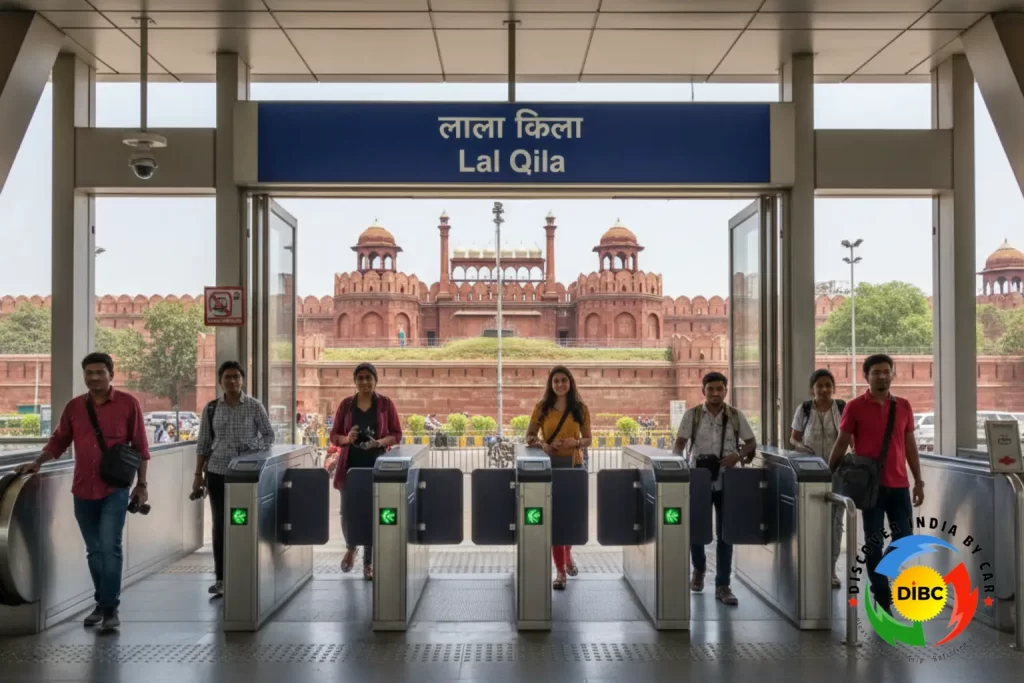
The Delhi Metro is your savior. It’s clean, it’s cheap, and it bypasses all the traffic. Take the Violet Line to the Lal Qila station. One of the exits literally puts you right across the street from the entrance. It’s foolproof.
Distance from Major Landmarks (Connaught Place, India Gate)
- From Connaught Place: About a 20-minute ride in a taxi or auto, traffic willing.
- From India Gate: Probably closer to 30 minutes.
Parking and Travel Tips
If you’re driving… well, good luck. There is a parking lot, but the roads are a mess. I’m serious, just take the metro. Your blood pressure will thank you.
Tips for Visiting Red Fort Delhi
Just a few last words of advice from me to you.
Photography & Drone Guidelines
Snap away with your phone or camera. No one will bother you. But if you show up with a giant tripod and pro gear, you might get asked for a permit. As for drones? Absolutely not. This is a high-security area.
Security Rules and Entry Restrictions
You’ll be searched on the way in. Travel light. They don’t allow big bags, snacks, or drinks other than water. Wear your most comfortable walking shoes. I mean it. This place is huge, and you’ll easily rack up your daily steps.
Nearby Attractions You Can Explore
After you’re done, you’re in the heart of Old Delhi. The adventure has just begun!
- Jama Masjid: Go see one of India’s biggest and most stunning mosques. It’s a short walk away.
- Chandni Chowk: Throw yourself into the madness of this ancient market. Eat everything. It’s a rite of passage.
- Raj Ghat: Need a moment of peace? Head to this simple, beautiful memorial for Mahatma Gandhi.
- India Gate: A short drive away, this iconic monument is a must-see in Delhi.
- Humayun’s Tomb: Explore this magnificent Mughal-era tomb, known for its beautiful architecture and gardens.
Conclusion
Red Fort Delhi is not just a monument — it’s a living reminder of India’s royal Mughal legacy and freedom. Every traveler exploring Delhi must witness this architectural marvel that still echoes the grandeur of the past. You don’t just see the Red Fort; you feel it. It’s a conversation with history, and it’s a conversation you won’t soon forget.
Frequently Asked Questions (FAQs)
Q1. What is the history of Red Fort Delhi?
A. In a nutshell, the Red Fort Delhi was the headquarters of the Mughal Empire for 200 years after Emperor Shah Jahan built it in the 1600s. It saw incredible wealth, was conquered by the British, and ultimately became the very spot where India celebrated its freedom in 1947.
Q2. Is it worth going inside Red Fort Delhi?
A. YES. The outside walls are impressive, but the real soul of the place is inside. The audience halls, the private palaces, the gardens… that’s where you truly understand the scale and beauty of the Mughals’ vision. It’s a no-brainer.
Q3. What is the entry fee for Red Fort Delhi?
A. The entry fee for Red Fort Delhi is ₹35 for Indians. For foreign nationals, it’s ₹500. Kids under 15 are free.
Q4. What is the timing of Lal Qila?
A. The timing of Lal Qila is 9:30 AM to 4:30 PM, Tuesday through Sunday. Don’t forget, it’s always closed on Mondays.
Q5. Is a phone allowed in Red Fort?
A. Yep, your phone is fine. Take all the photos you want. Just be respectful and silent it when you’re inside the on-site museums.


