- Private car and driver in Delhi / India
- +91-8447445445
- info@discoverindiabycar.com sugar.ankit@yahoo.com
 +91-9818434712
- Follow us:



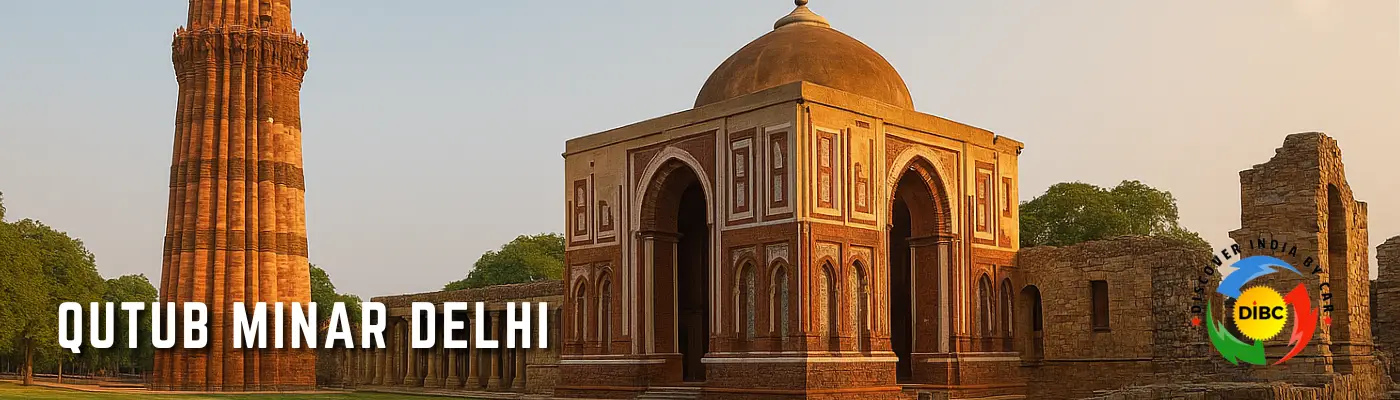
Qutub Minar Delhi: Latest Timings and Tickets 2026-27
As an expert with over 15 years in travel content, I know that monuments are not just stones and mortar; they are whispers of an ancient past. The Qutub Minar, towering majestically in Delhi, embodies this sentiment perfectly.
It is a timeless masterpiece that effortlessly blends diverse architectural traditions and boasts a silent, compelling narrative of medieval power shifts. This monument is an essential destination for anyone driving through the capital, primarily because of its imposing beauty and the incredible stories etched into its foundation.
Short intro: The Qutub Minar belongs on every Delhi traveler’s must-visit list. Standing tall as the world’s highest brick minaret, its architectural splendour and deep-rooted history provide an unparalleled experience, making it a pivotal site for cultural immersion.
If you’re planning to visit Qutub Minar, this guide covers everything—from its complex qutub minar history to the updated qutub minar timing, the magnificent qutub minar light show timings, and current entry qutub minar tickets. We ensure your visit is seamless, insightful, and memorable.
Quick Facts Table: Qutub Minar at a Glance
Feature | Detail |
Primary Keyword | Qutub Minar |
Height | 72.5 meters (237.8 ft) |
Built By | Qutb-ud-din Aibak (Started), Iltutmish (Completed) |
Construction Year | Began 1192 CE |
Architectural Style | Indo-Islamic (Mamluk Dynasty) |
Location | Mehrauli, South Delhi |
UNESCO Status | World Heritage Site (1993) |
Stairs (Currently closed) | 379 |
Qutub Minar History: The Legacy That Touches the Sky
The history of the Qutub Minar is a rich tapestry woven with ambition, power, and architectural evolution. It is not just one story, but a confluence of reigns and restorations, making the Qutub Minar complex one of the most fascinating historical sites in India. Understanding the layers of this monument significantly enhances the travel experience.
Who Built Qutub Minar and Why?
The origin of the tower can be traced back to 1192 CE, when it was initiated by Qutb-ud-din Aibak, the founder of the Mamluk (or Slave) Dynasty and the first Sultan of Delhi.
The Purpose: The Qutub Minar was primarily constructed to serve two monumental purposes:
- A Victory Tower (Minar-e-Zafar): To symbolise the Mamluk Dynasty’s military prowess and the establishment of Muslim rule in Delhi, following the defeat of the last Hindu kingdom.
- Muezzin’s Call: While also intended as a victory tower, its functional use was for the Muezzin (the mosque official) to call the faithful to prayer at the adjacent Quwwat-ul-Islam Mosque.
However, Qutb-ud-din Aibak only managed to complete the first storey before his untimely death. It was his successor and son-in-law, Shams-ud-din Iltutmish, who took the initiative to complete the subsequent three storeys in 1220 CE.
Architectural Style & Material Used
The Minar itself is a testament to the nascent fusion of indigenous Indian craftsmanship with Central Asian Islamic designs, giving birth to the classic Indo-Islamic architectural style.
- Structure: It’s a spectacular tapering shaft with five distinct storeys, each marked by a projecting balcony and featuring an increasingly refined texture of fluting (alternating angular and rounded flutings on the first three storeys).
- Material: The lower three storeys are constructed primarily of deep-red and buff sandstone. The two upper storeys, which were damaged and rebuilt after a lightning strike, were completed later by Sultan Firoz Shah Tughlaq in 1369. He chose marble and a whiter sandstone, which visually distinguishes the higher levels from the foundational structure, creating a striking contrast.
- Inscriptions: One of the Minar’s most magnificent features is the intricate bands of Arabic and Nagari inscriptions. These historical texts detail the construction, the Minar’s history, the Quranic verses, and the praise of the sultans responsible for its creation. These inscriptions are key historical documents for piecing together the true qutub minar history.
Historical Importance & Restoration Work
The Qutub Minar’s history is also one of resilience. Throughout the centuries, it faced the wrath of nature, particularly lightning.
- Firuz Shah Tughlaq (1368-1369): Repaired severe lightning damage to the fourth storey and added a fifth one, differentiating its materials (marble and white sandstone).
- Sikandar Lodi (1503): Undertook further repair and restoration work, primarily focusing on reinforcing the upper floors.
- Major Repairs: In the early 19th century, a British major, Major Robert Smith, conducted a restoration project after an earthquake in 1803. While structurally vital, the Major’s additions were later considered architecturally incorrect and removed, yet his efforts saved the monument from significant disrepair.
The site, along with the adjacent ruins, stands as a UNESCO World Heritage Site, recognising its Outstanding Universal Value as a beacon of Islamic art and architecture in India.
Interesting Facts About Qutub Minar’s Complex
Beyond the towering minaret, the complex holds relics that further enrich its history:
- The Tallest Brick Minaret: It remains the tallest surviving brick minaret in the world, a colossal feat of 12th-century engineering.
- The Unfinished Cousin: Directly next to the Qutub Minar, stands the partially constructed Alai Minar. Alauddin Khilji, an ambitious Sultan of the Khalji Dynasty, sought to build a minaret twice the size of the Qutub Minar, a goal tragically cut short by his death.
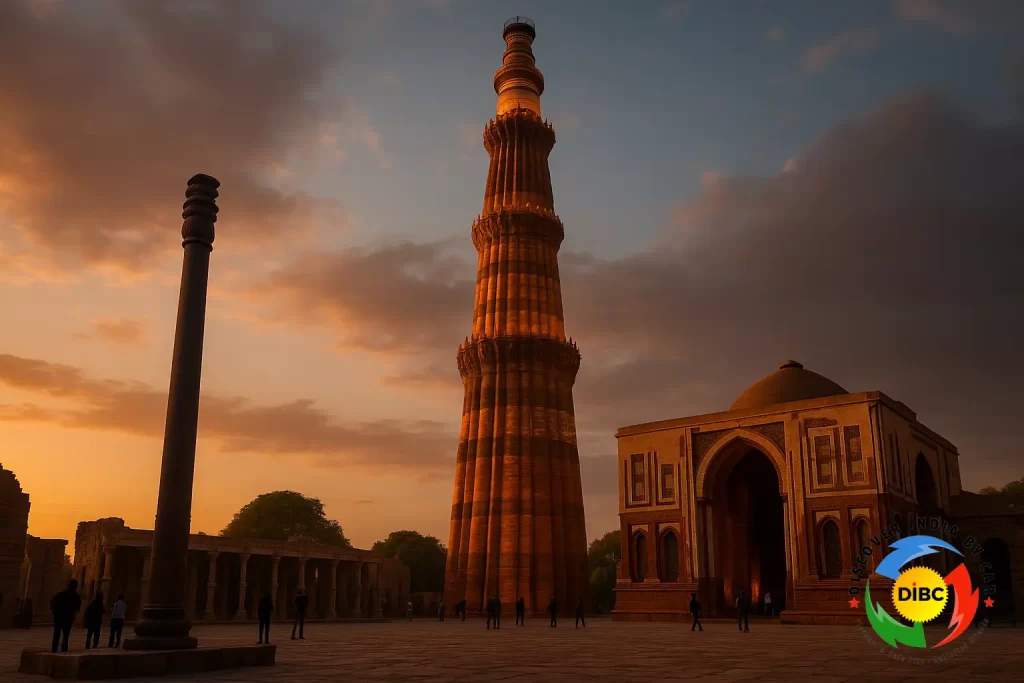
- The Enigmatic Iron Pillar: Situated in the complex, the famous 4th-century Iron Pillar of Delhi, originally erected by the Hindu King Chandragupta II Vikramaditya, holds a mysterious resistance to corrosion—it hasn’t rusted in 1600 years. This pre-Islamic structure showcases the continuity of civilisation at the site.
Qutub Minar Timings
For a traveller planning an itinerary via Discover India By Car, having the exact operational hours is essential. One of the most common search queries is related to the exact qutub minar timing. The operational schedule is designed to accommodate various activities, from the early morning tourist rush to the evening light show viewers.
Day | Qutub Minar Opening Time | Qutub Minar Close Time | Note |
Monday–Sunday | 7:00 AM | 9:00 PM (Typically) | Last ticket sale/entry around 8:30 PM (varies seasonally for the show). |
Note: The official qutub minar close time is frequently listed on tourist sites as ‘sunset,’ which generally corresponds to 6:00 PM to 6:30 PM for the core complex areas. However, for those planning on visiting for the light and sound show, the complex remains accessible until 9:00 PM, subject to seasonal variation and ongoing public safety rules. Always reconfirm the exact qutub minar close time on the ASI (Archaeological Survey of India) official portal closest to your visit date.
Best Time to Visit (Season-wise & Photography Tips)
Season-wise:
- Winter (October to March): This is the undisputed best season. The weather is cool and pleasant for exploring the vast complex. Early morning offers the best soft light.
- Summer (April to June): The intense heat of the Delhi summer makes midday visits uncomfortable. Plan your visit strictly during the qutub minar opening time (7:00 AM) or late evening.
Photography Tips:
- Golden Hour: The ideal time for stunning photography is immediately after the qutub minar opening time (7:00 AM to 8:30 AM). The warm morning sun bathes the red sandstone in a rich, photogenic hue.
- Evening/Night: Arrive just before sunset (approx. 5:30 PM). You can capture the shifting colours of the twilight sky and secure a spot for the subsequent light show.
Special Notes for Your Visit:
- Weekend Crowd: Weekends, national holidays, and festivals naturally see higher footfall. Plan an early weekday visit if you want to experience the site crowd-free and capture serene pictures of the monument.
- Light: Early mornings offer directional, clear light; evenings (post-4:00 PM) provide diffused, gentle light, ideal for portraits against the grand structure.
Qutub Minar Light Show Timings & Experience
One of the modern additions to the timeless beauty of the monument is the spectacular sound and light show, which transforms the historical grounds into an engaging multimedia spectacle. The light show perfectly leverages the structure’s grandeur to tell the rich qutub minar history.
The Mesmerizing Show Experience
The Qutub Minar complex, particularly the walls and surrounding monuments, become the canvas for an illumination show where historical narration intertwines with strategic lighting effects. The story details the monument’s conception, its many historical battles, its significance to the various rulers, and the architectural journey spanning centuries.
Qutub Minar Light Show Timings
The light and sound show timings are highly subject to change, mainly due to the changing daylight hours across the year and government regulations. The shows are typically held in two sessions on most operational days.
Season | Show Duration | Approx. Light Show Timings (English) | Approx. Light Show Timings (Hindi) |
Winter (Oct–Feb) | Approx. 45–60 mins | 6:30 PM – 7:30 PM | 7:45 PM – 8:45 PM |
Summer (Mar–Sep) | Approx. 45–60 mins | 7:30 PM – 8:30 PM | 8:45 PM – 9:45 PM |
Crucial Advice: While these are standard historical estimates, visitors are strongly advised to check the current schedule upon arrival at the Qutub Minar tickets counter, or better yet, on the official ASI/Ministry of Culture website, as precise qutub minar light show timings are officially finalised close to the visit.
What Makes the Light Show Special?
- Historical Storytelling: It uses vibrant visual projections and clear audio narration (in both English and Hindi) to demystify complex history for the general public, fulfilling an educational purpose.
- Ambience: The illuminated monument under the night sky provides a unique and majestic backdrop. The lighting highlights the different coloured materials (red sandstone and white marble), which is invisible in the daytime.
- Tickets: Typically, there is no separate qutub minar tickets needed for the Light Show; it’s included within the monument’s late closing time, though any last-minute separate charge should be noted at the entry gate.
Tips for Photography at Night:
Night photography demands stability. Use a tripod or place your camera/phone on a stable surface (like a bench or low wall). Use manual settings: long exposure (2–5 seconds) and a low ISO (100–400) will help capture the light, movement, and the clarity of the starry/twilight sky.

Qutub Minar Tickets & Entry Fee
Planning your finances for a smooth entrance is key. Fortunately, the entry process for Qutub Minar is streamlined by the Archaeological Survey of India (ASI), with robust online and counter-purchase options available for qutub minar tickets.
Current Entry Fee Structure
Visitor Category | Current Ticket Price (Approx.) |
Indian Citizens | ₹50 per person |
SAARC & BIMSTEC | ₹50 per person |
Foreign Visitors | ₹600 per person (Approx. $7–8) |
Children (Below 15 Years) | FREE Entry |
Student/Educational Groups | Concessional rates apply, subject to verification |
Where to Buy Qutub Minar Tickets:
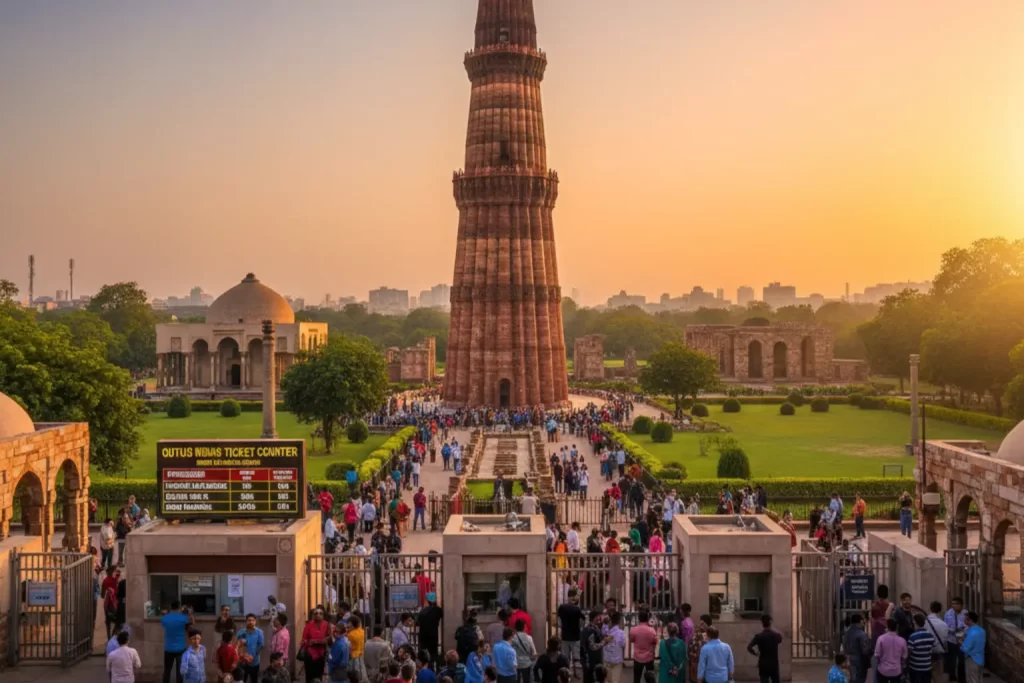
- Online (Recommended): The safest and quickest way to purchase qutub minar tickets is via the official Archaeological Survey of India (ASI) website (e.g., asi.payumoney.com or official government portals). This method allows you to bypass potential queues at the physical counter. (CTA: Book your Qutub Minar tickets online now for priority entry!)
- Counter Purchase: Tickets can still be purchased at the physical ticket window located at the main entrance gate. Be warned: this queue can be substantial during peak seasons and on weekends.
Best Combo Tickets (A Car Traveler’s Benefit)
Since you are traveling by car with discoverindiabycar.com, consider integrating your visit with other nearby sites that are part of Delhi’s extended historical geography.
- Mehrauli Archaeological Park: While often free to walk in the public area, accessing specific monuments sometimes requires a local entry fee. No formal Qutub Minar combo tickets exist for the broader park, but your car can swiftly transport you to the neighbouring, historically intertwined sites like the Balban’s Tomb or the Jamali Kamali Mosque nearby, all within the wider Mehrauli Complex.
Online Booking Process Tip:
Always carry a printout or the digital copy (on your smartphone) of the confirmed e-ticket and a valid Photo ID proof for all adult members in your group, as verification at the main entrance is strict, especially for children whose entry is free.
How to Reach Qutub Minar: Location & Travel Tips
The excellent connectivity of Delhi’s public transport and road network makes reaching the Qutub Minar straightforward, irrespective of whether you are driving yourself or using a service.
The Nearest Metro Station
The most efficient and universally recommended way for public transit users is the Delhi Metro:
- Station Name: Qutub Minar Metro Station
- Metro Line: Yellow Line (running from Samaypur Badli to HUDA City Centre, Gurugram).
The station is approximately 1.5 to 2 kilometres from the monument complex’s main entry gate. From the station, you can easily take an auto-rickshaw (about ₹30–₹50) or the local feeder electric rickshaws (e-rickshaws).
Distance from Major Spots (Approximation)
- From Connaught Place (CP): Approximately 15–18 km (45–60 minutes driving).
- From Indira Gandhi International Airport (Terminal 3): Approximately 12–15 km (30–40 minutes driving).
- From New Delhi Railway Station: Approximately 18 km (45–60 minutes driving).
- From Gurugram/DLF Cyber Hub: Approximately 15–20 km (30–45 minutes driving).
Transport Options for a Seamless Visit
Option | Pros | Cons/Notes |
Car/Taxi/Self-Drive | Door-to-door convenience, comfortable for groups. | Parking availability (see below) can be challenging/paid. Delhi traffic during rush hour. |
Metro | Cheapest, fastest way to avoid traffic. | Requires a short transfer (e-rickshaw/walk) from the Qutub Minar Metro Station. |
Auto/Taxi App (Uber/Ola) | Easily available, drops you right at the gate. | Traffic delays possible; slightly costlier than Metro. |
While the monument area is heavily restricted for security and historical preservation, dedicated paid parking lots are usually available just outside the main complex boundary. Since parking space can be limited, especially on high-traffic days and if you arrive much after the qutub minar opening time, it’s advisable to reach early if you are self-driving. Look for authorised MCD (Municipal Corporation of Delhi) parking sites nearby.
Insider Travel Tips for Visitors
From my years of experience covering major historical sites, these are the indispensable tips to truly elevate your experience at the Qutub Minar complex:
Ideal Time for Crowd-Free Visit:
Aim to arrive right at the qutub minar opening time (7:00 AM). You get cooler temperatures, perfect golden light for photography, and critically, a serene environment to absorb the historical gravitas before the crowds start trickling in around 10:00 AM.
Essentials to Carry:
- ID Proof: Absolutely essential, especially if you have booked discounted or Indian/SAARC tickets. Digital copies usually suffice, but having the original on hand is safer.
- Water: Even in winter, walking the expansive grounds can be tiring. Carry a reusable bottle to refill.
- Camera: For stunning shots—early morning or twilight light are exceptional.
- Comfortable Shoes: The entire complex has vast stretches of paved pathways and some rough stone sections; flats or sneakers are a must.
Food & Café Nearby:
There are no elaborate cafés within the immediate monument premises (a few stalls offer basic refreshments/water). For quality dining or coffee, explore the numerous quaint restaurants and cafes located slightly further down the Mehrauli Road, especially around the Mehrauli Village area and the Qutub Minar market strip.
Photography Permissions & Drone Rule:
Standard phone and DSLR cameras are allowed for personal use. For professional photography/video (pre-wedding, commercial), a formal written permission must be obtained in advance from the ASI, and fees are charged. Drones are strictly prohibited around all central Delhi heritage sites due to security regulations.
Safety & Cleanliness:
Be mindful of where you sit; maintain the cleanliness of the UNESCO site. Be respectful of the staff; their job includes guiding and protecting this global treasure. Watch out for petty vendors selling low-quality memorabilia near the exit.
Nearby Attractions You Shouldn’t Miss
A car itinerary is never about a single destination. Since you’ve planned to drive here, a half-day can easily become a full historical exploration with these nearby sites:
Inside the Complex:
- The Iron Pillar of Delhi: Marvel at the rust-proof metalwork.
- Alai Darwaza: The main gateway to the Quwwat-ul-Islam Mosque.
- Quwwat-ul-Islam Mosque: One of the earliest surviving mosques in India, whose original materials are visibly repurposed from 27 dismantled Hindu and Jain temples.
- Tomb of Iltutmish: An important structure marking the fusion of Islamic style with local design elements.
Just Minutes Away:
- Mehrauli Archaeological Park: A beautiful urban forest featuring several forgotten monuments like Balban’s Tomb, Quli Khan’s Tomb, and the Jamali Kamali Mosque and Tomb. Easily accessible by car, it’s a tranquil and historically significant counterpart to the popular Qutub Minar.
- Adham Khan’s Tomb: (Less than 1 km).
Within a Short Drive (15-20 mins):
- Lotus Temple: (Baha’i House of Worship, stunning architecture).
- Hauz Khas Village & Fort: (Ruins surrounding an ancient reservoir, famous for dining/nightlife).
Final Thoughts: Why Qutub Minar is More Than Just a Monument
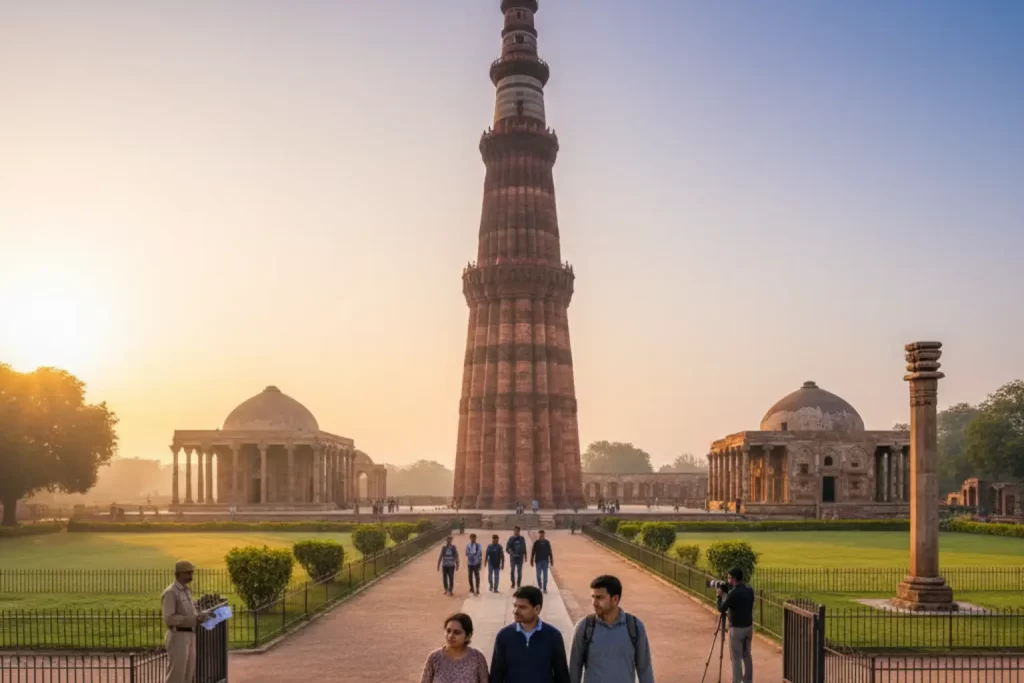
To visit the Qutub Minar is to walk through 800 years of Delhi’s narrative in stone. It is not merely the tallest brick minaret, nor just a collection of beautiful ruins; it is a profound monument to cultural fusion, engineering brilliance, and historical persistence. From the stunning architecture detailed in its qutub minar history to the strategic clarity required in mastering the qutub minar timing, every aspect contributes to its enduring mystique.
For a nation as diverse as India, the complex stands as a powerful symbol—a structure where elements of various beliefs, materials, and dynasties coalesced into a unified, magnificent whole. I urge every traveler to take a moment not just to look up, but to read the calligraphic bands, touch the cold iron, and absorb the history under the morning sun or the shimmering light of the qutub minar light show timings.
Plan your Delhi trip today and witness the heritage of India’s tallest victory tower, making sure you leverage your journey by car for the ultimate exploration!
FAQs About Qutub Minar
Q1. Can I visit Qutub Minar at night?
A. Yes, you can visit the complex up until the late closing time. The general closure for sightseeing is often around sunset (6:30 PM), but the area typically remains open for those attending the Qutub Minar Light Show. The qutub minar close time is extended, usually until 9:00 PM (season dependent) for this specific evening experience. However, actual entry into the interior of the tower itself has been permanently closed for decades due to safety reasons.
Q2. Why is entry into the interior of Qutub Minar closed?
A. Entry into the interior of the Qutub Minar has been prohibited since 1981 following a tragic stampede. Due to the narrowness of the spiralling, internal 379-step staircase, insufficient light, and increasing visitor numbers, the government sealed the internal entry. While the internal tower is closed, the surrounding monument complex, with all its ruins and structures, is fully open during the specified qutub minar opening time (7:00 AM) until closing.
Q3. Who constructed the Qutb Minar?
A. The construction of the Qutub Minar began in 1192 CE by Qutb-ud-din Aibak, the founder of the Mamluk Dynasty. He completed only the first storey. The structure was subsequently completed by his successor, Shams-ud-din Iltutmish, who added the next three storeys. Later, Sultan Firoz Shah Tughlaq rebuilt and added the fifth storey following lightning damage. This tiered approach is an important part of qutub minar history.
Q4. Is the Qutub Minar Light Show still active?
A. Yes, the evening sound and light show remains an active and popular feature, especially during the peak tourist season. To find the current, accurate qutub minar light show timings, visitors must check the latest announcements from the ASI at the counter or their official website. Remember that the qutub minar tickets cover the complex access and sometimes the show, but double-check if a specific additional light show tickets fee is in place.
Q5. Is photography allowed at Qutub Minar?
A. Yes, photography for personal use is fully allowed, encouraged, and FREE. Tripods for simple personal use are also usually fine, but commercial and professional filming (including using significant gear, models, etc.) requires obtaining special permissions and potentially paying fees from the Archaeological Survey of India (ASI). Drones are strictly not allowed.
Q6. What is Qutub Minar most famous for?
A. The Qutub Minar is most famous for two main things:
- Tallest Brick Minaret in the World: Its stunning height of 72.5 metres makes it an incredible example of early Indo-Islamic architecture.
- Symbol of Victory and Foundation: It symbolises the dawn of Muslim rule in India. Its adjacent structures, including the Iron Pillar and the Quwwat-ul-Islam Mosque, together represent a significant moment of political and religious transition documented vividly in its rich qutub minar history.


