- Private car and driver in Delhi / India
- +91-8447445445
- info@discoverindiabycar.com sugar.ankit@yahoo.com
 +91-9818434712
- Follow us:



Banke Bihari Mandir Timing Today: Darshan, Aarti & Tips
The Complete Guide to Banke Bihari Mandir Timing, Rituals, and Darshan
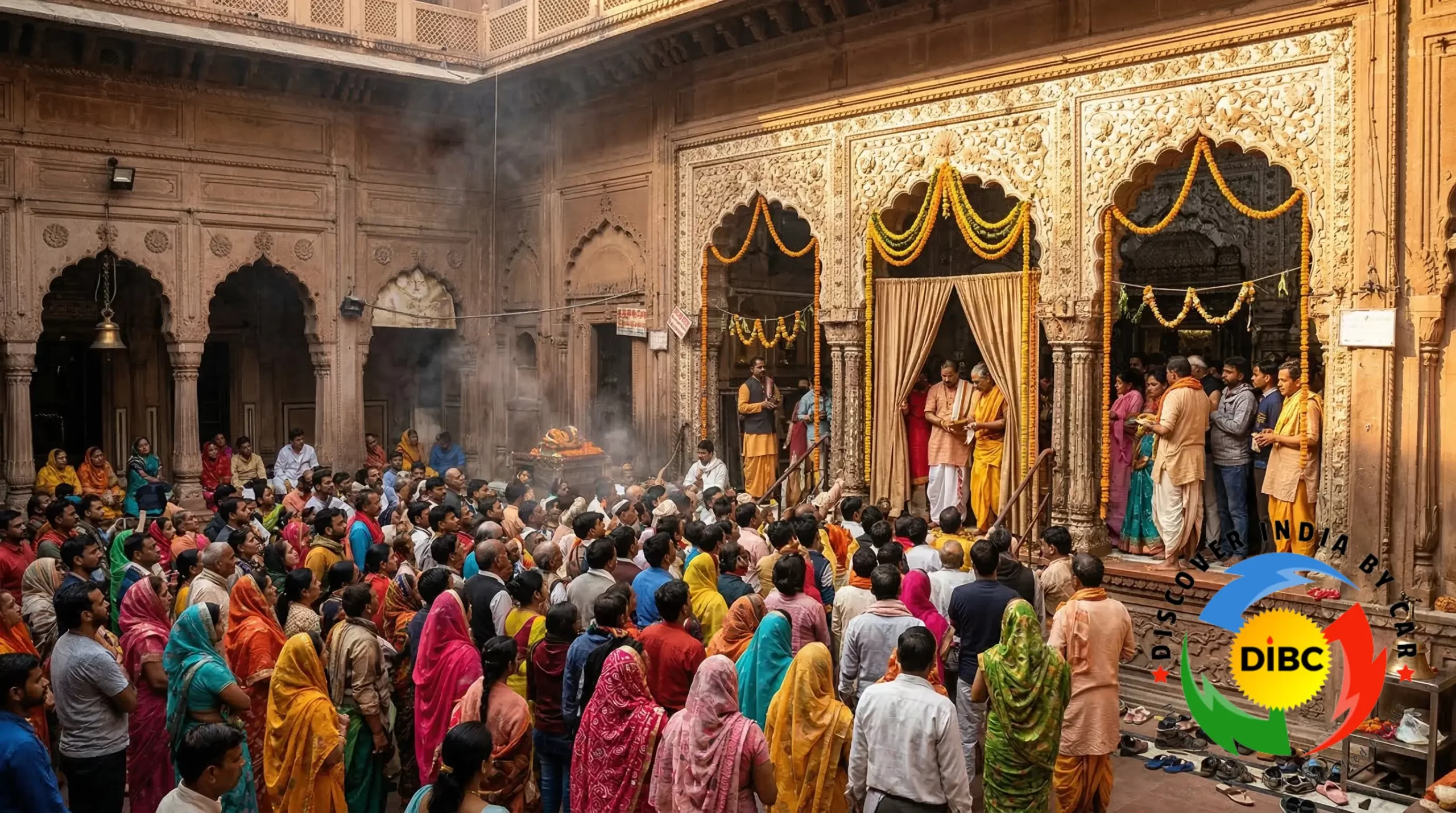
Our local guides have spent countless hours navigating the narrow, incense-filled alleys of Vrindavan. We wrote this guide based on firsthand observations to help you experience Thakur Ji without the stress of confusing schedules or overwhelming crowds.
Instant Answer: Banke Bihari Mandir Timing
The banke bihari mandir timing changes with the seasons. During summer, morning darshan is from 7:45 AM to 12:00 PM, and evening darshan runs 5:30 PM to 9:30 PM. Winter morning hours are 8:45 AM to 1:00 PM, with evening access from 4:30 PM to 8:30 PM.
Forget what you know about standard temple visits. The Banke Bihari Temple in Vrindavan does not operate like any other spiritual site in India. There are no loud bells. There is no early morning wake-up call for the deity. The rules here are entirely dictated by one core belief: Lord Krishna is living here as a small, beloved child.
If you are an international traveler, a travel blogger, or a first-time spiritual seeker planning a trip with Discover India By Car, getting your schedule wrong guarantees frustration. Let us break down exactly how to time your visit, avoid the crushing crowds, and experience the divine energy of Vrindavan.
Banke Bihari Mandir Timing Today
If you are looking for the exact banke bihari temple timing today, you must first look at the Hindu calendar. The temple administration officially shifts the clock twice a year, pivoting entirely on two major festivals: Holi (Spring) and Diwali (Autumn).
If you are visiting during the transitional months (like early March, right before Holi, or late October, before Diwali), the temple timings might fluctuate. Always check the exact date of Holi and Diwali for the current year, as the summer and winter schedules begin exactly two days after these respective festivals.
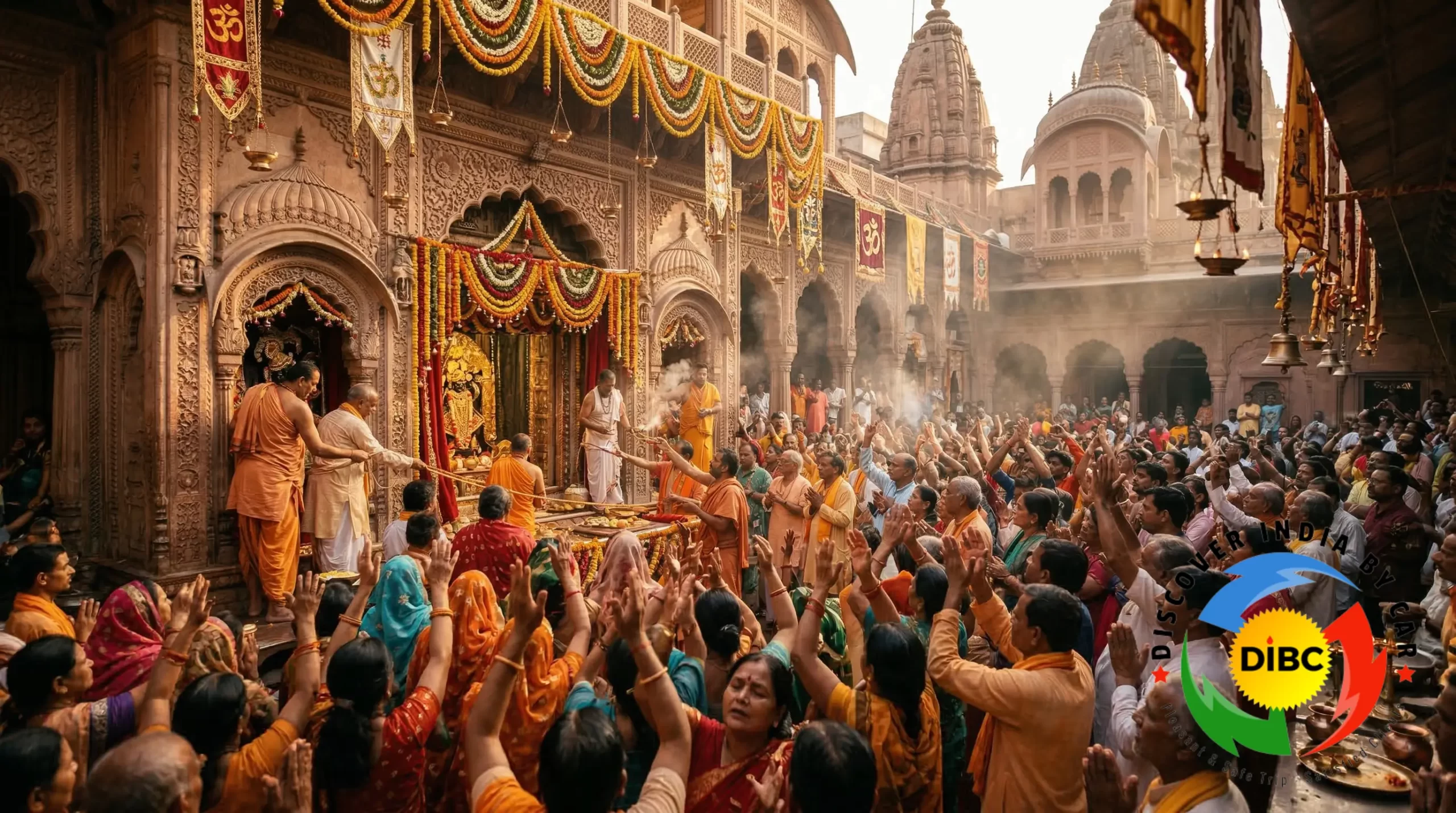
Complete Banke Bihari Temple Vrindavan Timing
To protect both the deity and the devotees from extreme weather, the banke bihari temple vrindavan timing adjusts drastically between the scorching summers and the freezing, foggy winters of North India.
Summer Timings (Starts 2 Days After Holi)
Vrindavan summers are famously brutal, frequently crossing 40°C (104°F). The priests establish the banke bihari temple opening time earlier in the morning to beat the midday sun.
Temple Event / Ritual | Morning Schedule | Evening Schedule |
Temple Doors Open (Darshan Begins) | 7:45 AM | 5:30 PM |
Shringar Aarti (Dressing the Deity) | 8:00 AM | N/A |
Rajbhog / Shayan Bhog (Royal Feast) | 11:00 AM – 11:30 AM | 8:30 PM – 9:00 PM |
Darshan Resumes | 11:30 AM – 12:00 PM | 9:00 PM – 9:30 PM |
Final Aarti & Temple Closing | 12:00 PM | 9:30 PM |
Note: During the 30-minute Bhog (feeding) intervals, the main curtain is drawn closed. You cannot see the deity, though you can remain inside the temple courtyard.
Winter Timings (Starts 2 Days After Diwali)
To protect the child deity from the biting morning chill, the banke bihari mandir vrindavan timing is delayed by a full hour.
Temple Event / Ritual | Morning Schedule | Evening Schedule |
Temple Doors Open (Darshan Begins) | 8:45 AM | 4:30 PM |
Shringar Aarti (Dressing the Deity) | 9:00 AM | N/A |
Rajbhog / Shayan Bhog (Royal Feast) | 12:00 PM – 12:30 PM | 7:30 PM – 8:00 PM |
Darshan Resumes | 12:30 PM – 1:00 PM | 8:00 PM – 8:30 PM |
Final Aarti & Temple Closing | 1:00 PM | 8:30 PM |
Banke Bihari Temple Aarti Timing
Understanding the open hours is only half the battle. To truly experience the spiritual gravity of this location, you must track the banke bihari mandir aarti timing. Unlike other massive pilgrimage sites that host five or six public aartis a day, Banke Bihari keeps it intimate.
- Shringar Aarti (The Morning Dressing): The priests bathe and dress Thakur Ji in seasonally appropriate clothing. Catching this early morning ritual is highly recommended for first-time visitors because the energy is fresh and optimistic.
- Rajbhog (The Afternoon Feast): Occurring right before the temple closes for the afternoon. Devotees wait in the courtyard, singing softly while the deity eats behind closed curtains.
- Shayan Aarti (The Bedtime Ritual): The final aarti of the day. The atmosphere becomes heavier and more emotional as devotees know the deity is about to sleep for the night.
Expert Pro-Tip: Banke Bihari does not have a daily pre-dawn Mangala Aarti (4:30 AM) like ISKCON. Waking a child at 4:00 AM is considered cruel here. The only day Mangala Aarti happens is on Krishna Janmashtami.
History of Banke Bihari Temple
You cannot fully appreciate the temple without knowing its origins. The deity of Banke Bihari was discovered by the great mystic and musician, Swami Haridas, in the 16th century. Swami Haridas was the guru of Tansen, the legendary musician in Emperor Akbar’s court.
According to local records, Swami Haridas would sing so passionately in the dense forests of Nidhivan that Lord Krishna and Radha physically appeared before him, eventually merging into the single black wooden idol you see today. The current temple structure was built much later, in 1862, reflecting Rajasthani architectural styles with intricate stonework and archways.
Why Banke Bihari Temple Operates Differently
Most ancient temples in India follow a rigid, militaristic schedule. Banke Bihari is the exact opposite because the deity is worshipped purely with Vatsalya Bhaav—the attitude of a parent loving a child. You do not startle them with crashing bells. You let them sleep in.
The Reality of the “Jhaanki” Curtain System
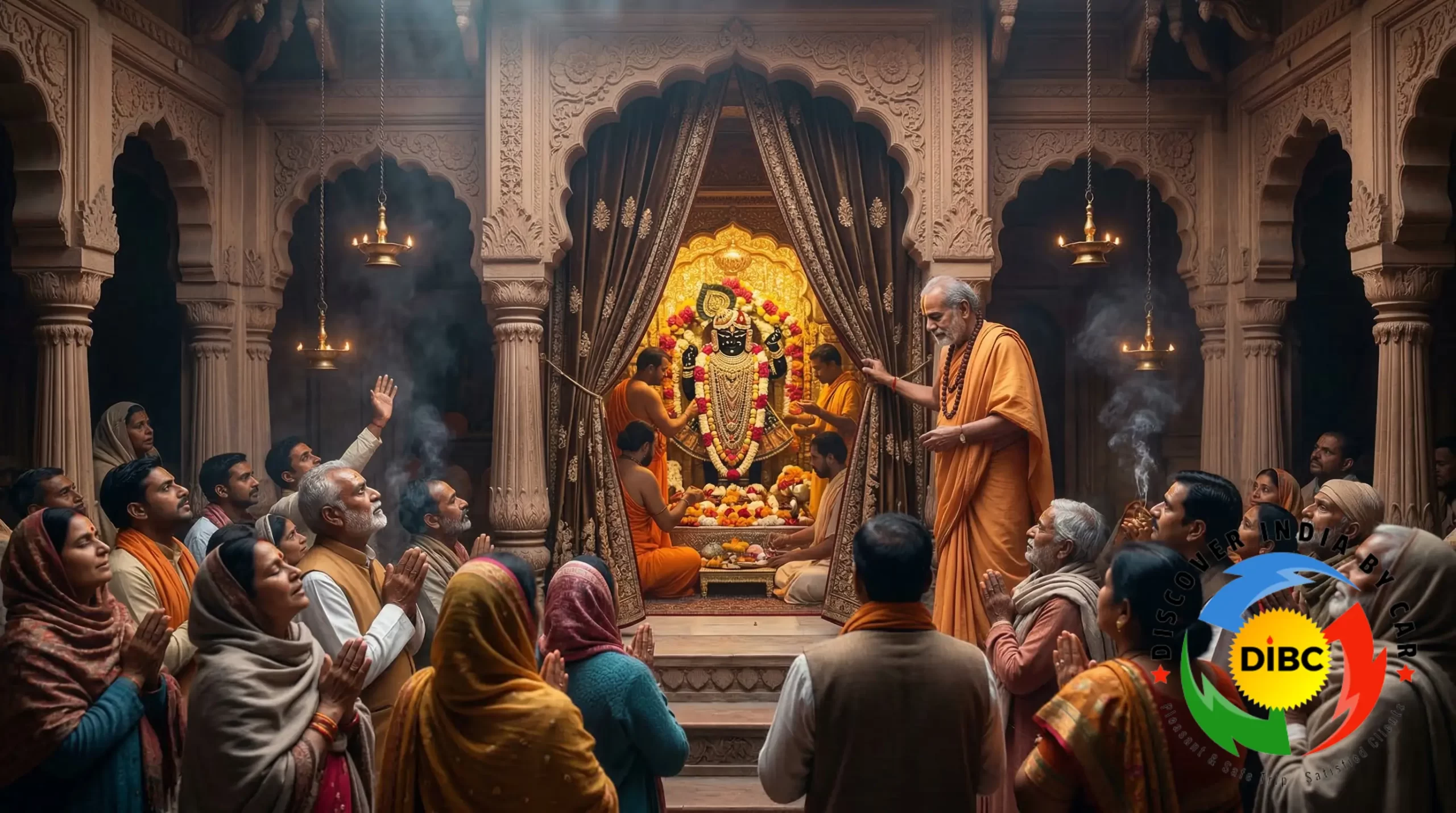
When you step inside the courtyard, you will notice the priests constantly pull a curtain open and closed in front of the deity. Open for five seconds. Closed for three seconds. This is the Jhaanki (glimpse) system.
Theological reasoning dictates that the eyes of Banke Bihari are so magnetically powerful that if a devotee stares uninterrupted, they will lose earthly consciousness. To protect devotees from fainting out of sheer spiritual ecstasy, the priests deliberately break eye contact by snapping the curtain shut. Practically, this creates a surging, wave-like rhythm in the crowd that you must physically brace yourself for.
Best Time to Visit Banke Bihari Temple
Vrindavan crowd dynamics are intense. For a peaceful experience, your timing matters just as much as the temple’s timing.
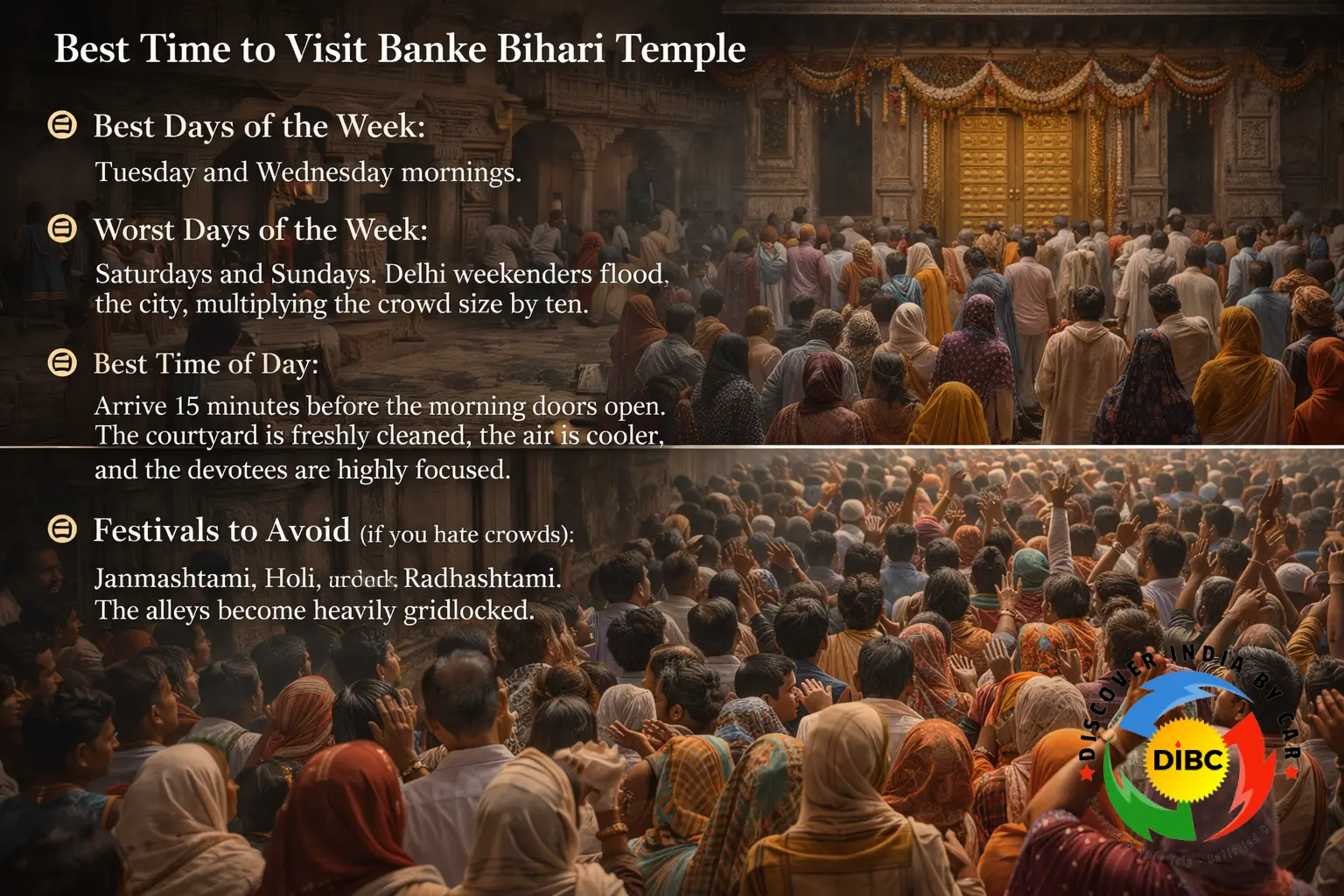
- Best Days of the Week: Tuesday and Wednesday mornings.
- Worst Days of the Week: Saturdays and Sundays. Delhi weekenders flood the city, multiplying the crowd size by ten.
- Best Time of Day: Arrive 15 minutes before the morning doors open. The courtyard is freshly cleaned, the air is cooler, and the devotees are highly focused.
- Festivals to Avoid (if you hate crowds): Janmashtami, Holi, and Radhashtami. The alleys become heavily gridlocked.
Banke Bihari Temple Entry Rules
There is no strictly enforced, written rulebook, but extreme modesty and situational awareness are required to survive the alleys.
- The Myth of “VIP Darshan”: There is no official VIP ticket at Banke Bihari Temple. A billionaire and a street sweeper stand shoulder-to-shoulder in the exact same crowd. Ignore local touts offering to sneak you in for a fee; it is a scam.
- Dress Code: Men should wear long trousers and shirts with sleeves. Women should wear long skirts, pants, or traditional Indian kurtas. Shoulders and knees must be covered.
- Footwear: You cannot wear shoes inside. The alleyways leading to the temple are often wet. Wear cheap flip-flops that you can safely leave at a designated shoe stall near the entrance.
- No Mobile Phones / Photography: Security guards will reprimand you if you pull your phone out in the main courtyard. Keep it deep in your pocket.
Expert Pro-Tip (The Monkey Menace): The rhesus macaques surrounding the temple are highly intelligent thieves. Take off your prescription glasses and sunglasses before walking the alleys. They will snatch them off your face and hold them hostage on a rooftop until a local throws them food as a ransom payment.
Banke Bihari Temple Location and How to Reach
Banke Bihari Temple is located in the heart of Vrindavan town in Mathura district of Uttar Pradesh, one of the most important pilgrimage centers in India.
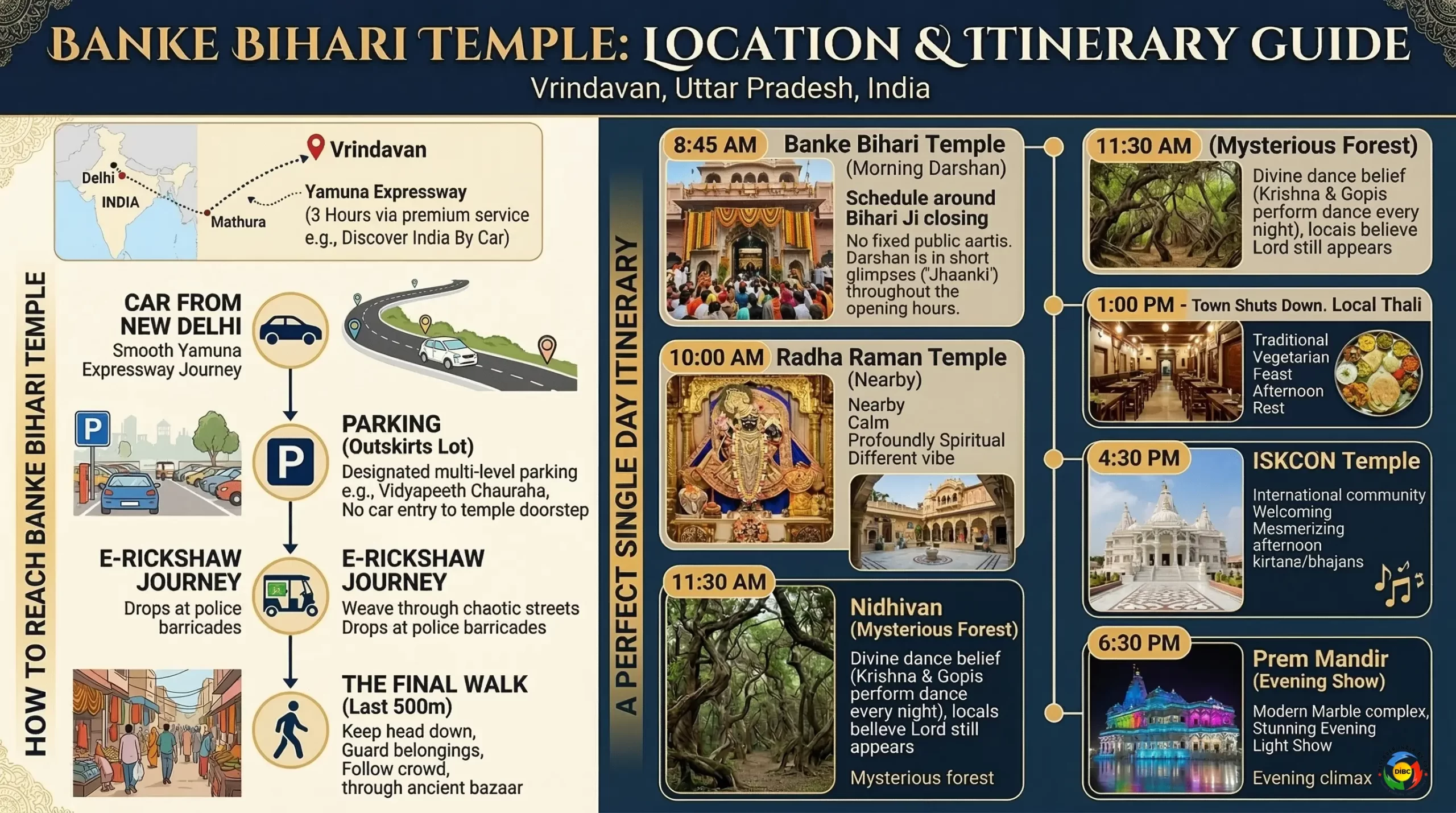
Vrindavan is located in Uttar Pradesh, roughly 160 kilometers (100 miles) south of New Delhi. A premium service like Discover India By Car makes the 3-hour journey via the Yamuna Expressway smooth. However, your car cannot take you to the temple doorstep.
- Parking: Your driver will park at a designated lot on the outskirts of the old city (like the multi-level parking near Vidyapeeth Chauraha).
- E-Rickshaws: Hire a battery-operated e-rickshaw to weave through the chaotic streets, dropping you at the police barricades.
- The Final Walk: You must walk the last 500 meters through the ancient bazaar. Keep your head down, guard your belongings, and follow the flow of the crowd.
Planning Your Vrindavan Temple Itinerary
Vrindavan has over 5,000 temples. Because Banke Bihari closes entirely in the afternoon, structure your day around its schedule.
A Perfect Single-Day Itinerary:
- 8:45 AM: Arrive at Banke Bihari for morning darshan.
- 10:00 AM: Walk to the nearby Radha Raman Temple, which offers a much calmer, profoundly spiritual atmosphere.
- 11:30 AM: Visit Nidhivan, the mysterious forest where locals believe Lord Krishna still performs his divine dance every night.
- 1:00 PM – 4:00 PM: The entire town shuts down for the afternoon. Retreat to a local restaurant for a traditional vegetarian thali.
- 4:30 PM: Head to the ISKCON Temple. The international community here is incredibly welcoming, and the afternoon kirtans are mesmerizing.
- 6:30 PM: End your day at Prem Mandir. This modern white-marble temple complex is famous for its stunning evening light show.
The Last Word on the Banke Bihari Experience
A trip to Vrindavan is not a standard sightseeing tour. It is a plunge into raw, unfiltered devotion. The confusing alleyways, the strict seasonal timings, the sudden closing of the curtains, and the sheer press of the crowd all serve a purpose. They strip away your ego and force you to be entirely present.
When you finally stand in that courtyard, sandwiched between chanting devotees, and the curtain flies open to reveal the smiling face of Banke Bihari, the logistics fade away. Plan your timing right, respect the child-deity’s schedule, and let Vrindavan do the rest.
Frequently Asked Questions (FAQs)
Q1. What are the Banke Bihari Temple timings today?
A: If you visit between mid-March (post-Holi) and late October (pre-Diwali), summer timings apply: 7:45 AM to 12:00 PM, and 5:30 PM to 9:30 PM. From November to early March (winter), the temple is open from 8:45 AM to 1:00 PM, and 4:30 PM to 8:30 PM.
Q2. What is the banke bihari mandir aarti timing?
A: In summer, Shringar Aarti is at 8:00 AM, Rajbhog is offered between 11:00 AM and 11:30 AM, and Shayan Bhog is from 8:30 PM to 9:00 PM. Winter aartis are delayed by one hour.
Q3. Is there a VIP Darshan ticket for Banke Bihari Temple?
A: No. There are absolutely no official VIP tickets, fast-track queues, or paid entry passes for Banke Bihari Temple. Anyone in the streets offering VIP entry for a fee is running a scam.
Q4. Why does the curtain keep closing during darshan?
A: The temple uses the Jhaanki (glimpse) system. According to local theology, the deity’s eyes are so powerful that uninterrupted eye contact would cause devotees to lose their worldly consciousness.
Q5. What is the best time of day to visit to avoid crowds?
A: To experience the least amount of pushing, visit on a Tuesday or Wednesday morning, arriving right when the temple doors open (7:45 AM in summer, 8:45 AM in winter). Avoid weekends and festival days.