- Private car and driver in Delhi / India
- +91-8447445445
- info@discoverindiabycar.com sugar.ankit@yahoo.com
 +91-9818434712
- Follow us:




Goa Travel Guide for Foreigners: Beaches & Safety Tips
✍️ Written by Ankit Sugar | North India Road Trip Expert & Founder, Discover India By Car
Having navigated tens of thousands of kilometres across India’s most iconic routes — from the fog-heavy winter highways of the Golden Triangle to the sun-baked stretches of the Thar Desert — I created this ground-reality guide to save you from the most common seasonal blunders. I haven’t just researched India’s travel seasons; I have driven through them. From surviving the brutal May heat in Agra to chasing the perfect post-monsoon greenery in Rajasthan, everything in this guide is born from my own lived experience behind the wheel and alongside travellers just like you.
Goa Travel Guide for Foreigners 2026: Beaches, Food, Safety & Insider Tips
Let me say something that almost every travel blog gets wrong about Goa.
It is not one place. It never has been. Separated by the Mandovi River, Goa is essentially two destinations wearing the same name — and picking the wrong one can quietly ruin your holiday before it even gets started.
I’ve been bringing foreign tourists to India for fourteen years. Not guiding them on package tours. Actually planning their trips, troubleshooting their scooter breakdowns, recommending the right beach shack, and watching their faces the first time they taste proper Goan Fish Curry. I’ve seen what works and what doesn’t. And Goa, without fail, surprises every single person I send there.
Solo Israeli backpackers who planned a four-day stopover end up renting a villa for six weeks. Quiet Scandinavian couples who came for clean beaches find themselves at midnight drum circles on Arambol sand. British families on their first-ever India trip land in Goa to get their bearings — and leave wondering why they didn’t stay longer.
This guide is my attempt to give you what most online resources won’t: the honest, practical, sometimes uncomfortable truth about visiting Goa as a foreigner in 2026. No stock-photo cliches. No ‘top 10 must-see attractions’ copy-paste content. Just the stuff that actually matters when you are standing at the airport with a rucksack and no idea which direction to point a taxi.
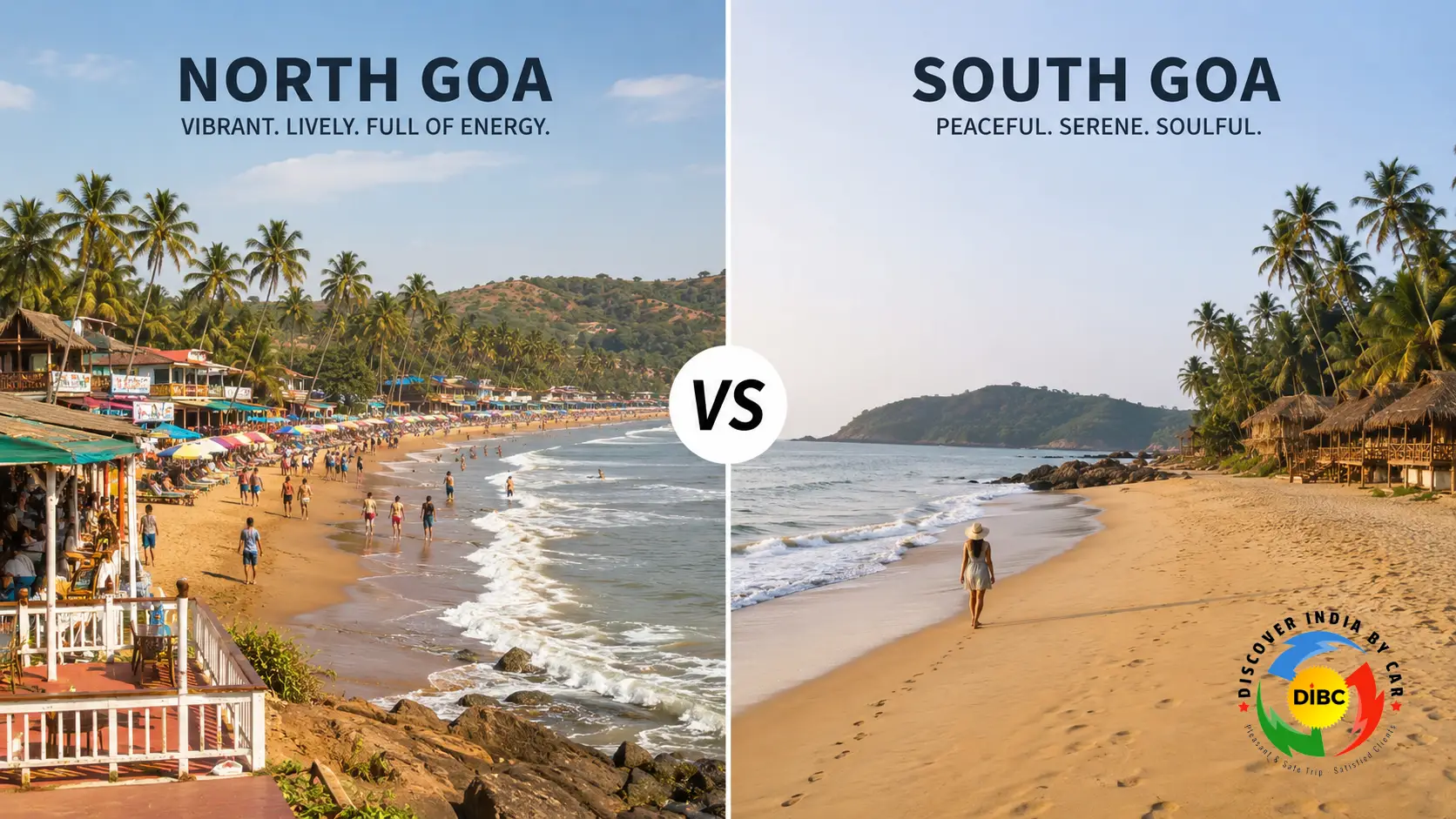
North Goa vs South Goa: Which One Is Right for You?
This is the question. Get it wrong and you will spend your whole trip feeling slightly out of place — either craving quiet when you’re surrounded by techno, or desperately wanting company when you’re sitting alone on an empty beach at 9 PM.
The Mandovi River is the dividing line. Not just geographically. Culturally, atmospherically, energetically. The two sides of Goa attract genuinely different types of travelers, and understanding that before you book is worth more than any hotel review.
North Goa — The One You’ve Seen on Instagram
North Goa is electric. There is no other word for it. The streets are narrow and smell of incense and motorcycle exhaust. The cafes are world-class — I’m talking proper wood-fired Italian pizza and matcha lattes at places tucked down palm-fringed lanes that you’d never find without a local tip. The hostels are full of twenty-somethings from Tel Aviv, Berlin, and London who are three weeks into a six-month trip.
Mornings here have this wonderful, slow energy. You wake up, rent a scooter, and spend two hours just getting happily lost between Anjuna and Assagao. You stumble into a yoga studio, stay for a class, end up having breakfast at the cafe next door with a French woman and a Canadian guy who both turn out to be digital nomads living here for the season. That’s just a normal Tuesday in North Goa.
By late afternoon, the energy shifts entirely. The cliff at Vagator fills with people. Arambol beach fires up its sunset drum circle. The hostels in Anjuna start buzzing. If your version of a perfect holiday involves dancing, conversation, exploration, and a social scene that runs from sunrise yoga to 3 AM ocean parties — base yourself in the North. Simple as that.
INSIDER TIP | The villages of Assagao and Siolim in North Goa have quietly become some of the most interesting culinary and creative neighborhoods in all of India. Spend at least one full day just wandering them on a scooter.
South Goa — The One the Brochures Can’t Really Capture
Drive south past the airport, cross the Zuari Bridge, and something actually changes in your body. The road widens. The traffic thins out. Dense jungle closes in from both sides. You breathe differently.
South Goa is for people who are genuinely tired. Not holiday-tired. Life-tired. The kind of burned-out where you need a week of doing absolutely nothing to remember who you actually are. The accommodation here leans toward boutique eco-cottages and quiet beach resorts. Nightlife, where it exists at all, means acoustic guitar around a fire on the sand, not laser lights.
The beaches are also objectively cleaner and less crowded. Turtle conservation programs mean that noise restrictions are enforced here in ways that naturally repel the party crowd. Which is exactly the point.
Choose the South if your goal is peace. Real peace. The kind where you finish three books in five days and feel human again.
Best Beaches in Goa — With Honest Insider Ratings
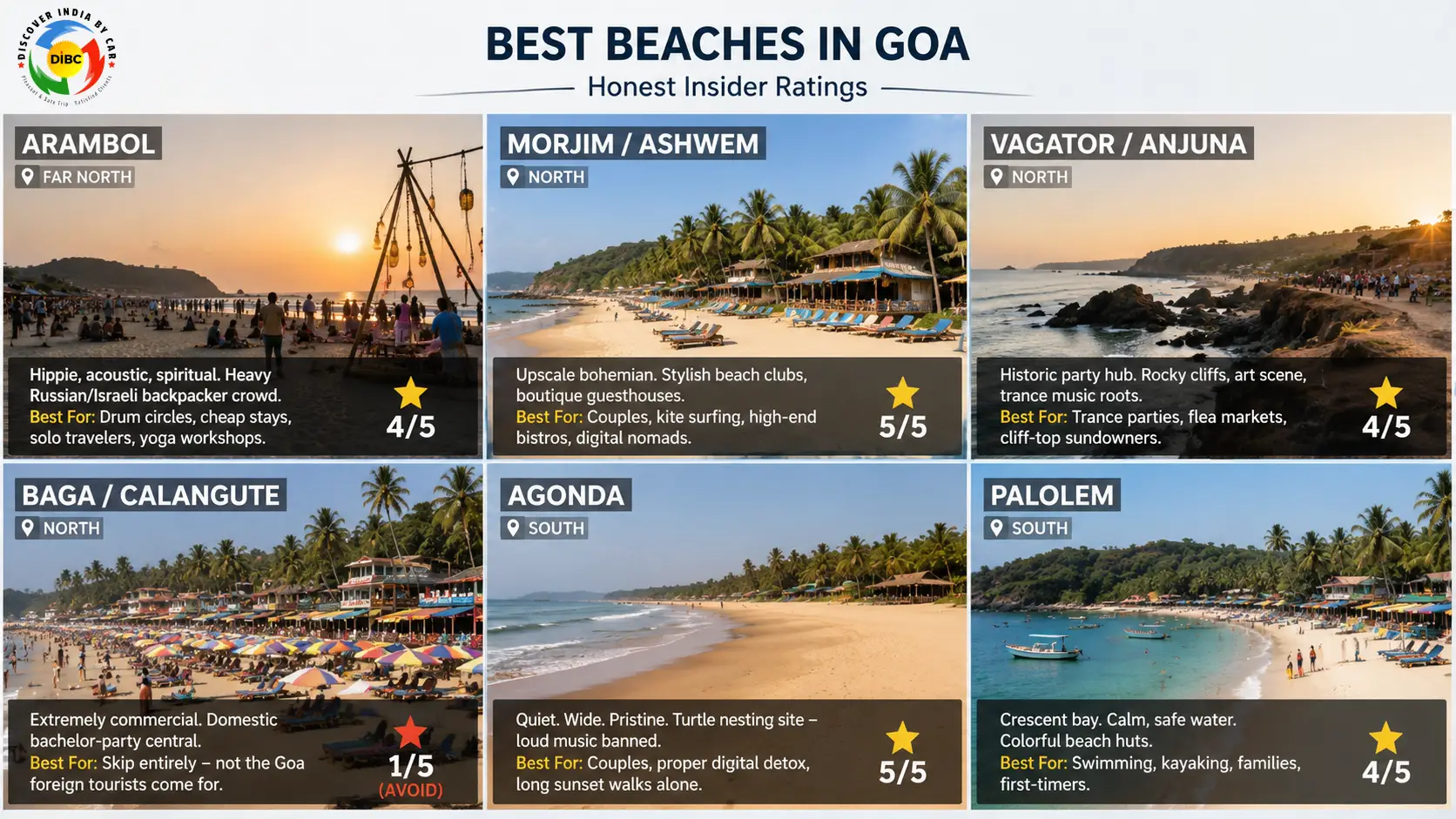
Every beach in Goa has its own distinct personality. Here is my unfiltered breakdown — including a frank assessment of the ones you should skip entirely.
Beach | Region | Real Vibe | Best For | Rating |
Arambol | Far North | Hippie, acoustic, spiritual. Heavy Russian/Israeli backpacker crowd. | Drum circles, cheap stays, solo travelers, yoga workshops. | 4/5 |
Morjim / Ashwem | North | Upscale bohemian. Stylish beach clubs, boutique guesthouses. | Couples, kite surfing, high-end bistros, digital nomads. | 5/5 |
Vagator / Anjuna | North | Historic party hub. Rocky cliffs, art scene, trance music roots. | Trance parties, flea markets, cliff-top sundowners. | 4/5 |
Baga / Calangute | North | Extremely commercial. Domestic bachelor-party central. | Skip entirely — not the Goa foreign tourists come for. | 1/5 (Avoid) |
Agonda | South | Quiet. Wide. Pristine. Turtle nesting site — loud music banned. | Couples, proper digital detox, long sunset walks alone. | 5/5 |
Palolem | South | Crescent bay. Calm, safe water. Colorful beach huts. | Swimming, kayaking, families, first-timers. | 4/5 |
The Northern Beaches in Detail
Arambol sits at the very top of the North, and it still carries the original 1970s hippie energy that put Goa on the backpacker map in the first place. Every evening, without announcement or organization, dozens of people gather on the sand and start playing. Drums, guitars, didgeridoos. It builds into something genuinely beautiful. It’s free. It’s spontaneous. It’s the kind of thing you can’t manufacture and can’t put on a poster.
Vagator and Anjuna are the spiritual home of Goa trance. The beaches themselves are rocky — not great for swimming — but the views from the red-laterite cliffs are spectacular. Don’t miss the Wednesday Anjuna Flea Market. It’s chaotic, colorful, full of textiles and handmade jewelry and people, and completely unmissable.
Morjim and Ashwem are where you go if you want the social energy of the North without the hostel-dorm atmosphere. The sand is wider. The water is cleaner. The restaurants are genuinely excellent — European-quality food at Indian prices, which still feels like a small miracle every time.
The Southern Beaches in Detail
Palolem is the beach on every Goa brochure, and for once the photos aren’t lying. The crescent-shaped bay creates naturally calm water inside it, making it the safest and most enjoyable beach for actually swimming. The temporary beach huts are rebuilt fresh every season after the monsoon — simple, colorful, right on the sand. Book early in peak season. They go fast.
Agonda is my personal top pick for international travelers who want genuine peace. It’s a designated turtle nesting site, which means late-night noise is prohibited by law. The beach is impossibly wide and flat. On a quiet morning, you can walk for forty minutes in either direction and not see another soul. There are very few places left in Goa where that’s possible.
INSIDER TIP | If you are an international traveler, I strongly recommend skipping Baga and Calangute entirely. They are overwhelmed with domestic bachelor parties and simply do not offer the peaceful, exploratory experience that most foreigners travel to Goa for.

Best Time to Visit Goa — An Honest Season Breakdown
Timing changes everything in Goa. Not just the weather — the prices, the crowds, which restaurants are even open. Here is the real breakdown.
Peak Season: November to February
This is when Goa is at its best. Full stop. The humidity drops, the skies go deep blue, and daytime temperatures settle around 28 to 30 degrees Celsius. Cool enough in the evenings that you’ll want a light jacket on a scooter. Every shack is open. The markets are buzzing. The energy across the whole state is electric.
The catch: prices triple. A guesthouse that costs 800 rupees a night in October costs 2,500 in December. Book your accommodation two to three months in advance, minimum, for December and January travel. Otherwise you’re paying luxury rates for very average rooms.
Shoulder Season: October and March to May
October is genuinely underrated. The monsoon has just ended, the entire state is an impossible shade of neon green, the air smells clean, and prices haven’t climbed yet. March is still very enjoyable — ocean breezes balance the rising heat, and the crowds thin meaningfully.
April and May get seriously hot and humid. Long-stay digital nomads often choose this window precisely because they can negotiate rock-bottom monthly rents and essentially have the beaches to themselves. But confirm your accommodation has a heavy-duty generator before you commit. Power cuts in May are brutal and frequent.
Monsoon Season: June to September
Goa in the monsoon is a different universe. Most beach shacks are dismantled before the storms arrive. Swimming is genuinely dangerous — violent undercurrents, and authorities actively prohibit it. The tourist infrastructure largely shuts down.
But here is what nobody talks about: Goa in the monsoon is hauntingly beautiful. The jungle comes alive overnight. Waterfalls appear on roadsides that were dry dust two weeks earlier. The heritage Portuguese houses in the villages look impossibly atmospheric in the rain. If your ideal holiday involves a covered veranda, a cup of chai, heavy rain battering palm trees, and significant discounts on everything — the monsoon has a very specific, very real appeal.

Getting Around Goa — What Nobody Warns You About
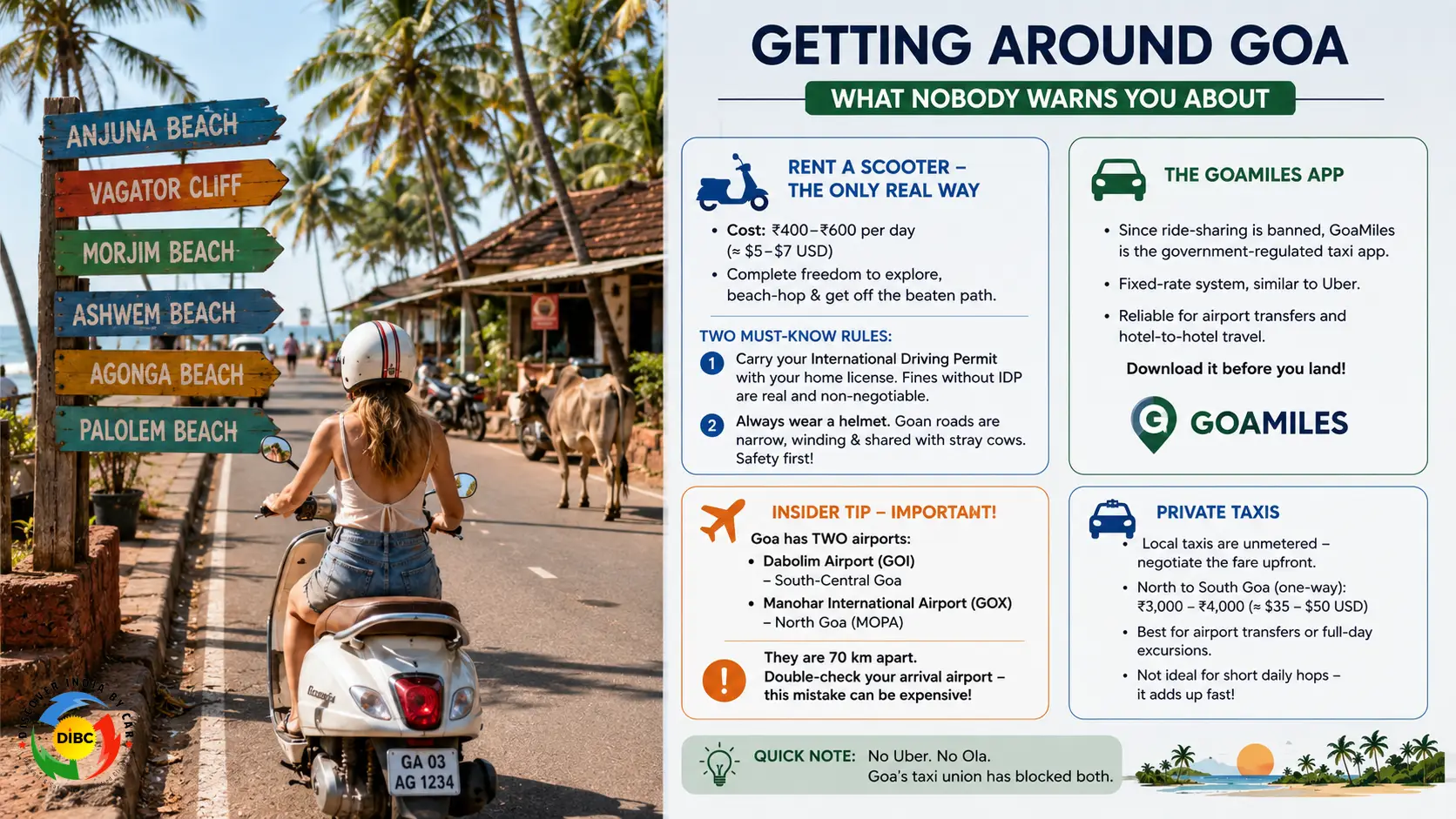
Transport in Goa runs on its own logic. There is no Uber here. No Ola. The local taxi union has blocked both, and is powerful enough to keep them out. Here is what actually works.
Rent a Scooter — The Only Real Way to Experience Goa
For about 90 percent of foreign travelers, renting a scooter is the move. Usually a Honda Activa or a Vespa. It costs between 400 and 600 rupees a day — roughly five to seven US dollars — and gives you complete freedom to beach-hop, get lost down unmarked lanes, and stop anywhere on a whim.
Two things you absolutely must know. First: carry your International Driving Permit alongside your home country license. Traffic police in Goa run checkpoints that specifically target foreign tourists, and the fines for riding without an IDP are real and non-negotiable. Second: always wear the helmet. Not just because the police will stop you if you don’t — because Goan roads are narrow, winding, shared with stray cows, and genuinely unforgiving if something goes wrong.
The GoaMiles App
Since ride-sharing is banned, the state government launched GoaMiles — a regulated taxi app that works on a fixed-rate system, similar to Uber. It is reliable for airport transfers and hotel-to-hotel travel. Download it before you land.
INSIDER TIP | Critical note for 2026: Goa now has two operating airports. The older Dabolim (GOI) sits in the south-central area. The newer Manohar International Airport (GOX) is in the far north near MOPA. They are 70 kilometers apart. Double-check which one your flight actually arrives at — this mistake has cost people a lot of money in taxi fares.
Private Taxis
Local taxis are unmetered, meaning you negotiate the fare upfront. A one-way trip from North to South Goa typically costs 3,000 to 4,000 rupees — that’s 35 to 50 US dollars. Use them for full-day excursions or airport transfers. Relying on them for short daily hops will drain your budget very quickly.
Goa Food Guide — What to Eat and Where to Find It
Goan cuisine is genuinely one of the most distinctive food cultures in India, and it is criminally underrated on the global stage. What you get here is 450 years of Portuguese colonial influence colliding headlong with deep Konkani coastal tradition. The results are extraordinary.
Dishes You Cannot Leave Without Trying
Goan Fish Curry with Rice is the daily staple. Tangy, coconut-based, made with the day’s catch — usually Kingfish. It looks simple. It is not simple. It is one of those dishes where every family has a slightly different recipe that has been argued about for three generations.
Pork Vindaloo — not the British version you know from takeaway menus. The authentic Goan recipe is built on vinegar, garlic, and dried Kashmiri chilies. It is complex, fiery, deeply aromatic, and completely different from anything you’ve tried under that name before.
Chicken Xacuti — pronounced sha-kuti, not za-cuti — is made with a blend of roasted whole spices and freshly grated coconut. Rich, fragrant, best eaten with fresh-baked pao bread from a local bakery.
Bebinca for dessert. A traditional layered Indo-Portuguese pudding baked one layer at a time, which takes hours. Dense, eggy, slightly sweet. The kind of thing that becomes a genuine obsession.
Feni is the local cashew spirit. Drink it straight and it is pungent and an acquired taste. Mix it with fresh lime soda and a lot of ice and it becomes genuinely refreshing. Try both. Form your own opinion.
Where to Eat in North Goa
The North Goa dining scene in 2026 is honestly ridiculous in the best possible way. You are not just getting local curries. You are getting proper wood-fired Italian, legit Japanese, hyper-aesthetic vegan cafes that would fit comfortably in Bali or Berlin.
- Artjuna in Anjuna — Mediterranean breakfasts, great coffee, a garden setting that makes you not want to leave.
- Gunpowder in Assagao — Spectacular South Indian coastal food inside a heritage house. One of the finest meals you will have in India.
- Thalassa in Vagator — Greek food with an unobstructed sunset ocean view. Book ahead.
Where to Eat in South Goa
South Goa dining is more rustic and all the better for it. The emphasis is on fresh seafood, candlelit tables on the sand, and simplicity done with real quality.
- Dropadi in Palolem — Brilliant fresh seafood, genuinely local crowd, right on the beach.
- The village stalls near Agonda — Fresh catch cooked simply with local spices. No menu. Just whatever came off the boat that morning. Magnificent.

Is Goa Safe? An Honest Answer for Solo Travelers and Foreigners
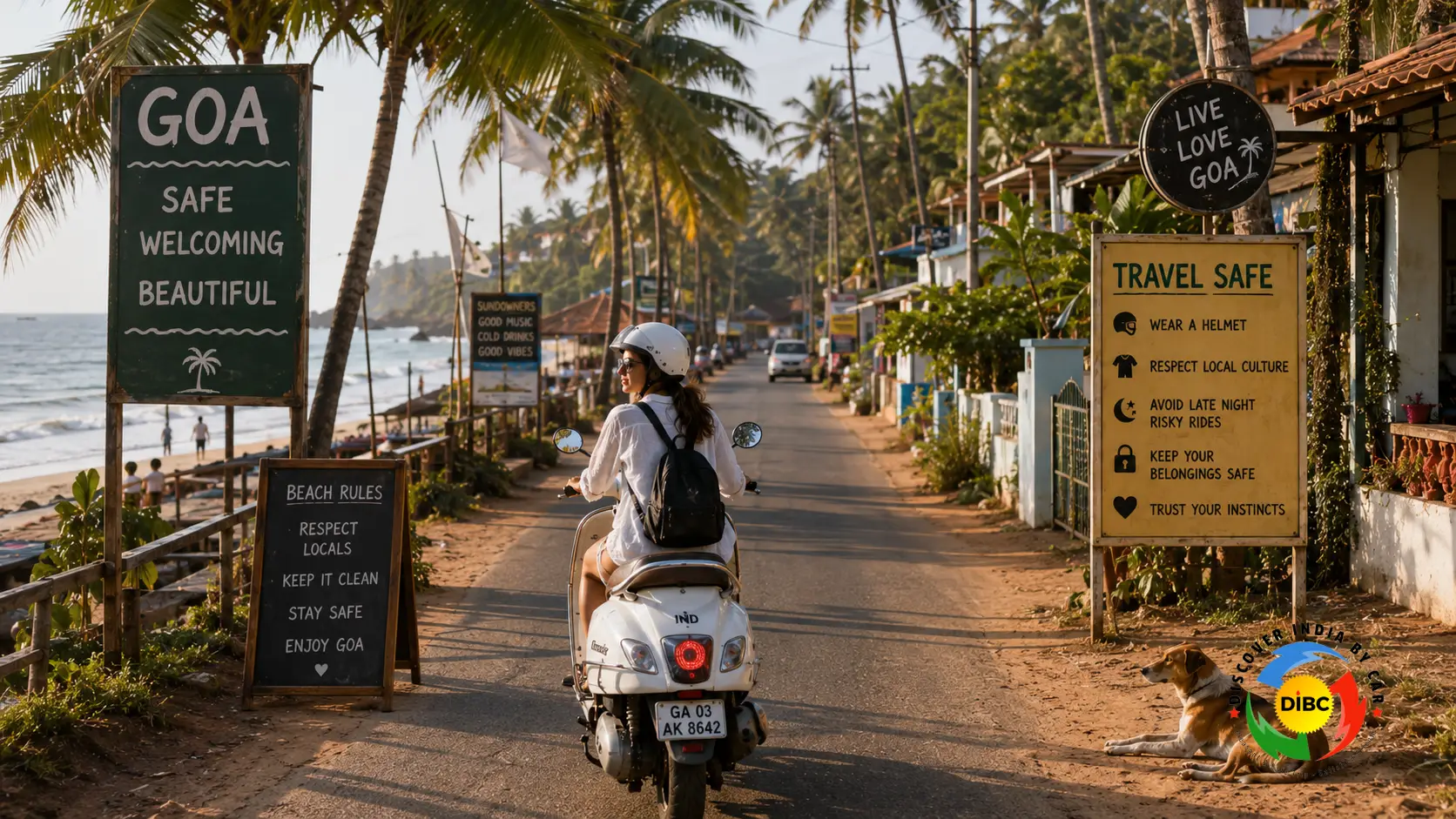
Goa is genuinely one of the safest, most internationally accustomed states in all of India. Locals here have been living alongside foreign tourists for decades. The culture is relaxed, tolerant, and largely welcoming. That said, relaxed does not mean risk-free.
The Real Safety Picture — No Sugar-Coating
Late-night scooter riding is your single biggest risk in Goa. This is not a small thing. Roads are unlit past 10 PM. Stray dogs sleep on the warm tarmac. Alcohol is involved in the majority of road accidents. If you are drinking, pre-book a GoaMiles taxi. Do not negotiate with yourself on this one.
Beach dogs at night deserve a mention. During the day, Goa’s stray dogs are completely harmless — borderline therapeutic in their laziness. At night they can form territorial packs on isolated stretches of sand. Stick to lit areas after dark and you will have no issues.
Traffic police will fine you for riding without a helmet, riding shirtless, or presenting an expired IDP. Be polite. Ask for the official challan — the printed receipt. Pay the fixed fine and move on. Do not offer money informally. Do not argue.
Dress code awareness matters when you leave the beach. Bikinis and board shorts are completely normal on any Goa beach. But Panaji city, the historic churches of Old Goa, local markets, and temples all require you to cover your shoulders and knees. This is basic respect, and it meaningfully changes how people interact with you.
For Solo Female Travelers Specifically
Goa is widely considered the most accessible and welcoming destination in India for women traveling alone. The backpacker hostels in Anjuna, Vagator, and Arambol are excellent places to meet other travelers and naturally form groups. Standard travel instincts apply everywhere — trust your gut, keep an eye on your drink at beach clubs, avoid isolated beaches alone after dark. Follow those basics and you will find Goa to be a genuinely liberating, welcoming, and remarkable place to be.
Goa and North India — The Trip That Changes Everything
Here is the mistake I see constantly. Foreign travelers treat Goa as their entire India experience. And honestly? You could spend a month in Morjim and leave deeply happy. But you would be missing the architectural, historical, and sensory magnitude that makes India unlike anywhere else on earth.
The combination — Goa’s beaches followed by a North India road trip through the Golden Triangle — is, in my honest professional opinion, the finest two-week travel itinerary available anywhere in the world right now. I say that having helped people plan trips across six continents.
Why Goa Works Perfectly as an India Gateway
Landing directly in Delhi or Mumbai as a first-time India visitor can be genuinely overwhelming. The traffic, the noise, the heat, the scale, the sensory intensity — all of it hits at once. Goa is different. English is widely spoken. The food, while extraordinary, is not aggressively spicy. People are used to confused tourists and are patient with them. You find your rhythm in Goa, and by the time you fly north, you are ready. Actually ready, not just think-I’m-ready.
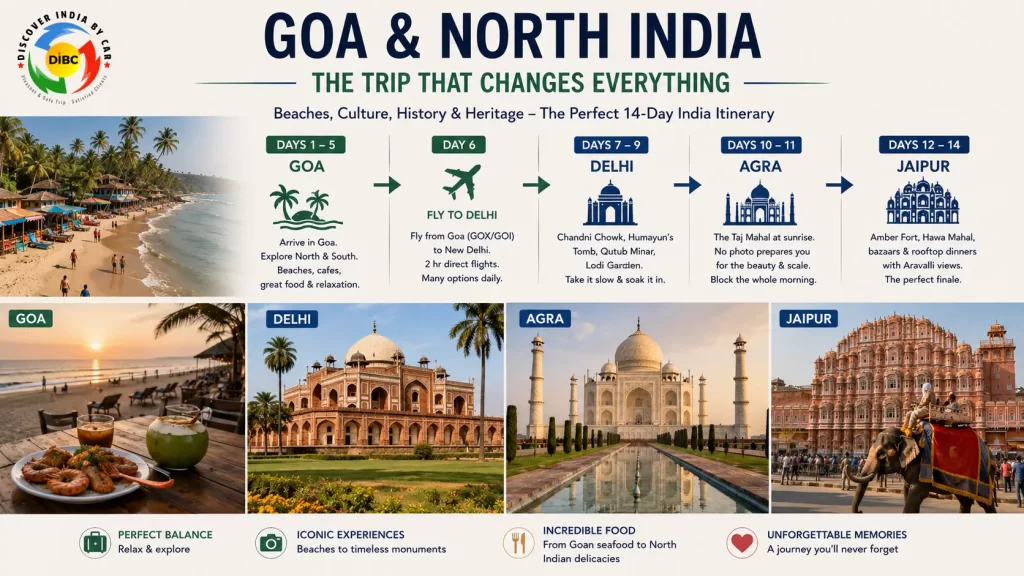
A Practical 14-Day India Itinerary
- Days 1 to 5 — Arrive in Goa. Split your time between the cafes and social scene of the North and the peaceful beaches of the South. Eat. Rest. Adjust to the time zone. Get your bearings.
- Day 6 — Fly from Goa (GOX or GOI) to New Delhi. Dozens of direct two-hour flights daily. Budget airlines make this route genuinely affordable.
- Days 7 to 9 — Delhi. Chandni Chowk in Old Delhi, Humayun’s Tomb, the Qutub Minar, Lodi Garden. Don’t try to rush it. Delhi rewards the traveler who slows down.
- Days 10 to 11 — Agra. The Taj Mahal at sunrise. No photograph — not one — prepares you for the actual scale and beauty of it. Block off the whole morning.
- Days 12 to 14 — Jaipur. The Amber Fort, Hawa Mahal, the old city bazaars, and rooftop dinner with views of the Aravalli hills.
The Transition: How to Do It Without the Stress
Landing in Delhi after Goa’s beach pace can feel jarring if you’re navigating it alone — unfamiliar train stations, the language shift, the noise, the chaos, the sheer scale of it. The experience is entirely different when there is a private, English-speaking driver waiting for you as you walk out of the terminal. Your name on a sign. A clean, air-conditioned car. No haggling, no queues, no confusion.
You drive toward the Taj Mahal. You stop when you want — at a hidden stepwell along the highway, at a roadside dhaba for chai. You arrive at your hotel feeling genuinely relaxed. That gap between exhausted and excited? A good driver fills it entirely.
At Discover India By Car, we have been running private car tours across North India for 14 years. Our drivers know every shortcut, every hidden stop, every heritage hotel worth choosing between Delhi, Agra, and Jaipur. Whether you want a classic five-day Golden Triangle circuit, a longer Rajasthan heritage route, or simply a safe and reliable pickup from Delhi airport after your Goa flight — we take care of the ground realities so you can focus on what actually matters: being fully present in one of the most extraordinary places on earth.
Call or WhatsApp: +91-9818434712
Email: info@discoverindiabycar.com
Heading North After Goa? Explore the Golden Triangle Stress-Free
Landing in Delhi after the relaxed beaches of Goa can be overwhelming. Skip the taxi aggregators and culture shock. Step into a private, air-conditioned car directly from the airport and experience India's most famous historical route at your own pace.
Seamless Airport Pickup — We wait for you at Delhi arrivals with a name sign.
Premium AC Fleet — Transition comfortably from the heat in our Sedans & SUVs.
100% Flexible Routing — Dictate your pace across Delhi, Agra, and Jaipur.
FAQ: Goa for First-Time International Travelers
Q: What is the nightlife actually like for foreign visitors?
A: Tito’s Lane in Baga is famous but draws an almost entirely domestic crowd. The real international nightlife is in Vagator — HillTop for trance, Raeeth for techno — and Morjim at Marbela Beach Resort. The scene peaks Wednesday through Sunday during peak season. If trance is your thing specifically, Vagator is non-negotiable.
Q: Five days vs two weeks in Goa — what is the real difference?
A: With five days, commit to one region only. North or South. Trying to cover both means spending most of your trip sitting in taxis and feeling rushed. With two weeks, spend the first week in the North — cafes, social scene, exploring on a scooter — and the second week completely unplugged in a beach hut in Agonda. That two-week version is genuinely transformative.
Q: Do cards work, or do I need cash?
A: India runs primarily on UPI digital payments, which foreigners currently cannot easily access without an Indian SIM card. Bring a travel card like Revolut or Monzo for ATM withdrawals. High-end restaurants accept credit cards. But scooter rentals, small beach shacks, flea markets, and most local transport require physical rupees. Withdraw a reasonable amount on arrival.
Q: Can I actually work remotely from Goa?
A: Yes, easily — in North Goa specifically. The cafe Wi-Fi in established spots is fast enough for video calls. The real challenge is power cuts, which hit hardest in April and May before the monsoon. Before booking any long-stay guesthouse, confirm they have a heavy-duty generator. Not a small UPS. A generator. Otherwise your calls will drop daily and your frustration will climb quickly.
Q: How much does a day in Goa actually cost?
A: Budget travelers managing carefully can live well on 2,000 to 3,000 rupees per day — roughly 25 to 35 US dollars — covering a basic beach hut, local food, and a rented scooter. Mid-range travelers staying at boutique guesthouses and eating at proper restaurants should budget 6,000 to 10,000 rupees. High-end South Goa resort stays start at 15,000 rupees per night and go well beyond that.
Q: Is tap water safe to drink?
A: No. Drink only sealed bottled water or use the filtered water refill stations common throughout North Goa — much cheaper than buying bottles and better for the environment. Most established guesthouses provide filtered drinking water. Avoid ice at very small roadside stalls if you are not sure of the source.
Goa will not disappoint you. What it might do — and this is the experience I have watched play out across hundreds of trips over fourteen years — is surprise you. The beach you expected to be too touristy turns out to be exactly your speed. The local restaurant you almost walked past becomes the best meal of the trip. The hour-long scooter ride to a waterfall becomes the story you tell when you get home.
Go slow. Stay curious. India rewards the patient traveler. And Goa is one of the finest places on earth to practice exactly that.