- Private car and driver in Delhi / India
- +91-8447445445
- info@discoverindiabycar.com sugar.ankit@yahoo.com
 +91-9818434712
- Follow us:




Hampi Travel Guide 2026: Ruins, Timings & 2-Day Itinerary
Hampi Travel Guide 2026: UNESCO World Heritage Ruins, Timings, Tips & How to Reach
Hampi is one of the largest open-air museums in the world — and most tourists have never heard of it.
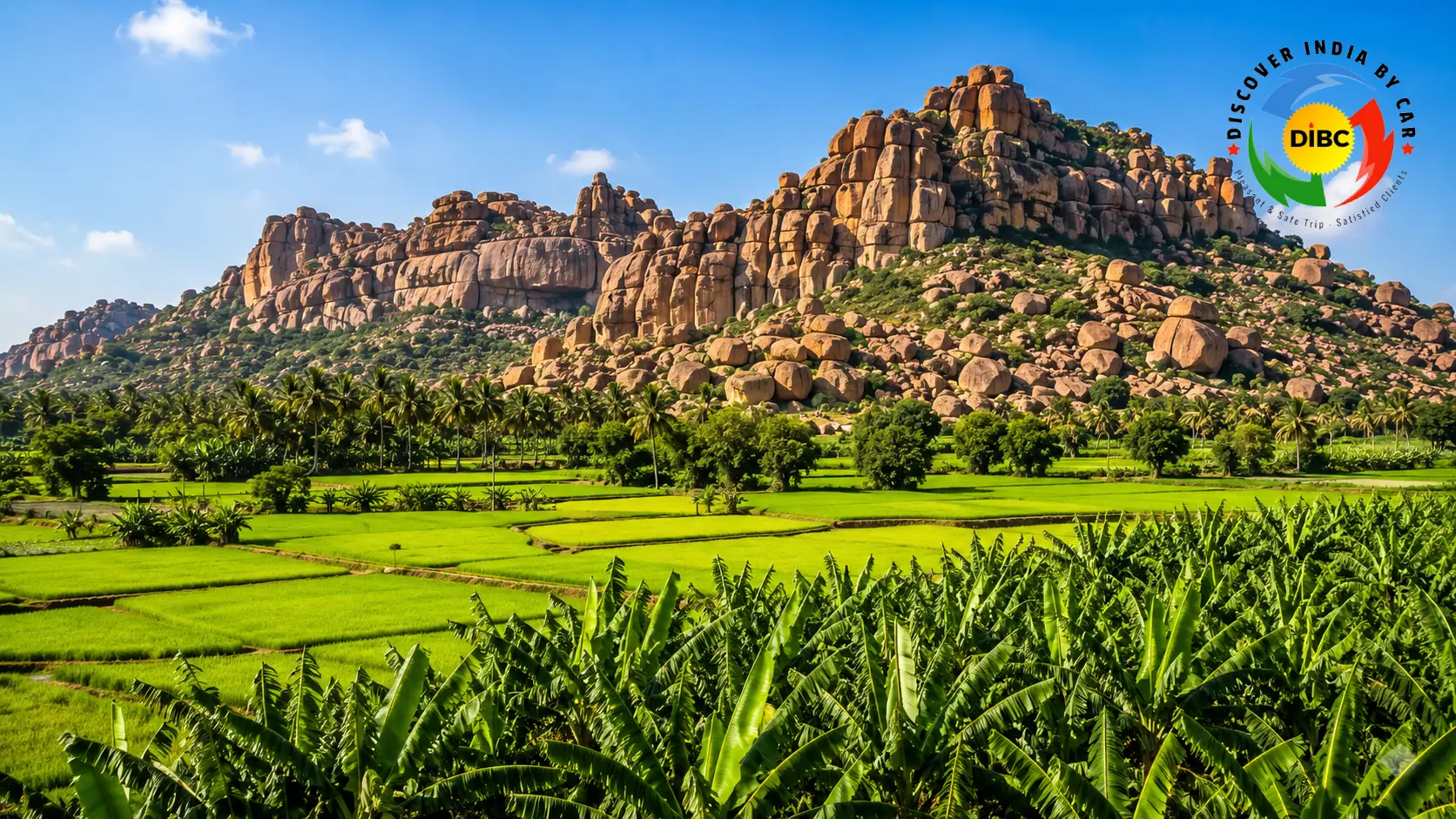
I remember the first time I came around the bend on the road from Hospet and saw it. Boulders the size of houses, balanced on top of one another as though some giant had been stacking them and walked away mid-thought. And scattered among them, for as far as I could see, the stone bones of a city. Temple towers. Carved pavilions. A river threading through it all. I had been working in Indian tourism for years by then, had seen the Taj Mahal a hundred times, and Hampi still stopped me in my tracks.
Most foreign travellers who make it to Hampi do so almost by accident — a backpacker mentions it on the Goa-to-Bengaluru trail, or a guidebook footnote catches the eye. And then they spend two days here and spend the rest of their trip telling everyone they meet to go.
This is the guide I wish I could hand to every guest before they arrive. What Hampi actually is, what to see, how to get here, when to come, and how to fit it into a larger India trip. Let’s start with the part nobody tells you.
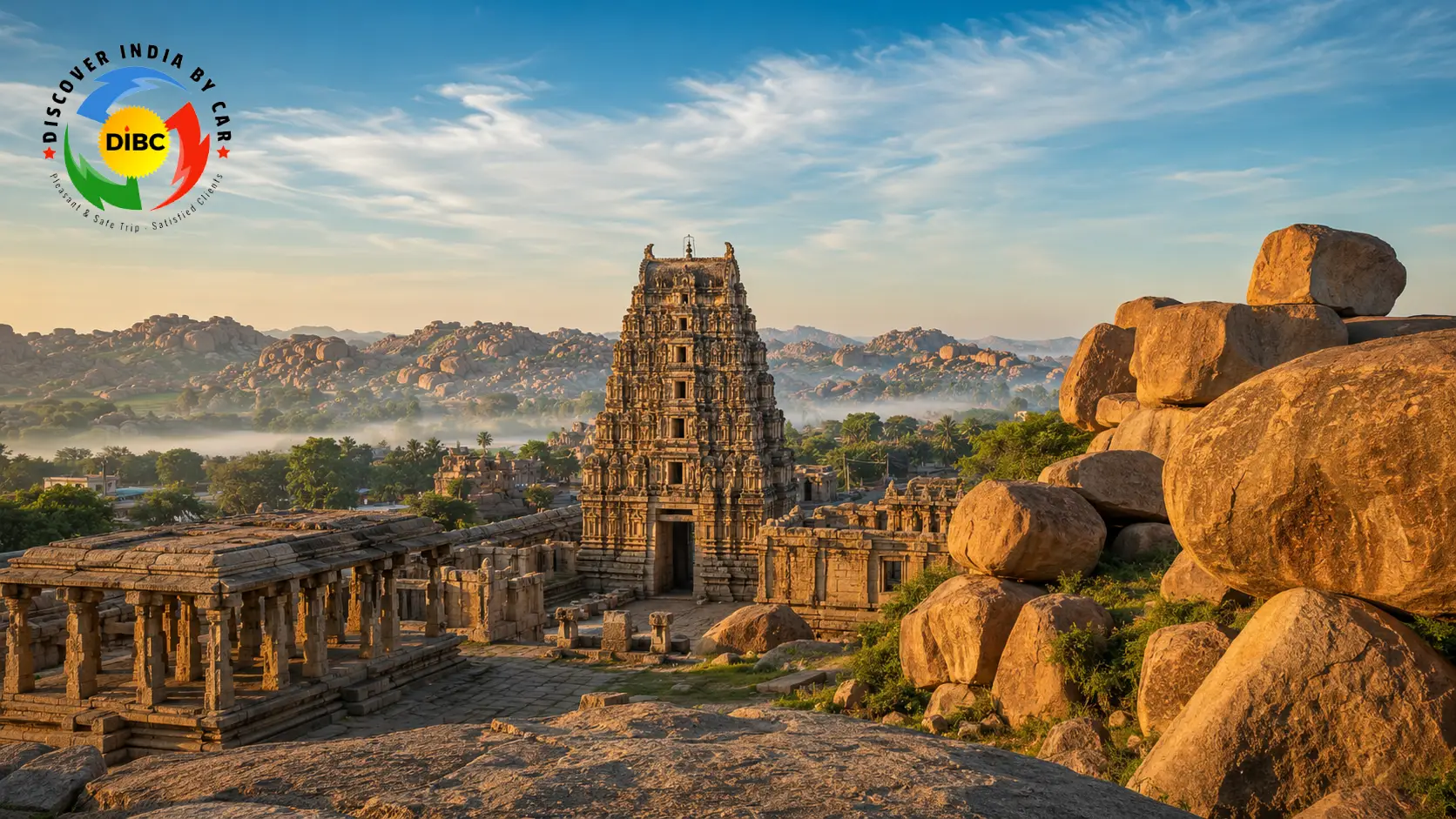
What Is Hampi? The Forgotten Empire That Was Bigger Than Rome
Here is the thing that genuinely surprises people. Hampi is not “ancient ruins” in the vague way that phrase usually means. Hampi is the remains of a specific, named, extraordinarily wealthy city — the capital of the Vijayanagara Empire — and at its peak in the early 1500s, it was one of the largest and richest cities on the entire planet.
The empire was founded in 1336 by two brothers, Harihara and Bukka, and over the next two centuries it grew into the dominant power of southern India. Its greatest ruler, Krishnadevaraya, who reigned from 1509 to 1529, presided over a city that foreign visitors struggled to describe without sounding like they were exaggerating.
A Persian ambassador named Abdur Razzaq came in the 1440s and wrote that the city was such that “the eye had not seen, nor ear heard, of any place resembling it upon the whole earth.” A Portuguese horse trader named Domingo Paes visited around 1520 and estimated the population at half a million — which would have made it larger than Paris or Lisbon at the time. The markets, he wrote, overflowed with diamonds, rubies, pearls, and silks. The bazaars sold gems by the cupful.
And then, in January 1565, it ended. A coalition of neighbouring Deccan Sultanates defeated the Vijayanagara army at the Battle of Talikota, and the victorious forces marched into the undefended capital. For roughly six months, they systematically looted and burned it. The city that had taken two hundred years to build was gutted in half a year and never reinhabited.
What remains today — protected as a UNESCO World Heritage Site since 1986 — is one of the most significant archaeological sites in Asia. The ruins spread across roughly 26 square kilometres of rocky, surreal landscape on the banks of the Tungabhadra River in northern Karnataka. There are over 1,600 surviving monuments: temples, palaces, market streets, royal enclosures, water tanks, gateways, and shrines.
When people compare it to other India UNESCO World Heritage sites, the closest in scale is probably the cave complexes of Ajanta and Ellora. But they are completely different things, and I’ll come back to that comparison later because travellers ask about it constantly.
💡 Crucial Insight: You are not visiting old, isolated stones. You are walking through the actual preserved skeleton of one of history’s greatest imperial urban centers.
Top 10 Must-See Sites in Hampi
The site is enormous, and you cannot see all 1,600 monuments. You wouldn’t want to. Here is what actually matters for a high-value Hampi ruins visit — arranged strategically to maximize historical context and avoid structural layout monotony.
1. Virupaksha Temple — The One That Never Died
Everything in Hampi is a ruin except this. The Virupaksha temple is dedicated to Shiva and has been in continuous worship for over seven centuries. It predates the empire itself and survived the 1565 sacking precisely because it never stopped being a living place of prayer — the conquerors burned palaces and markets, but a working temple was left standing.
The towering eastern gopuram rises around 50 metres and is the first thing you see from almost anywhere in the sacred centre. Step inside and the scale shifts — pillared halls, intricate painted mythic ceilings in the inner mandapa, and Lakshmi the temple elephant offering traditional blessings with a gentle tap of her trunk in the morning.
Stand in the main courtyard at 6:30 AM, before the day-trippers arrive, and you’ll hear the same bells, smell the same camphor, and watch the same rituals that have happened here without interruption for 700 years. There is nothing else quite like it in India.
- Timings: 6:00 AM – 12:30 PM and 3:00 PM – 9:00 PM.
- Access: Entry is a token ₹2. (Camera fees apply separately inside).
2. Vittala Temple & the Stone Chariot — Hampi’s Masterpiece
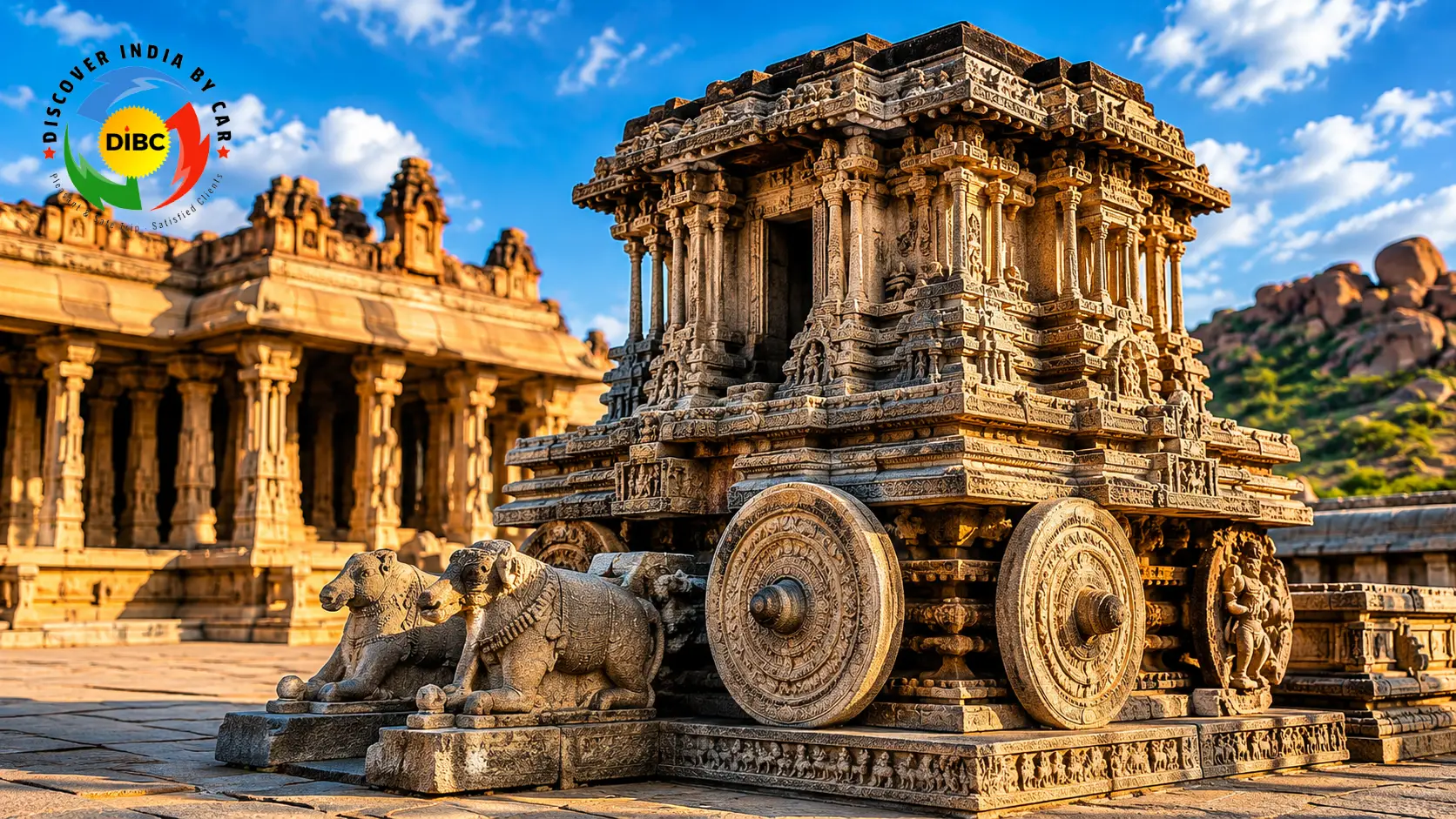
If Hampi has one signature image, it is the Stone Chariot that sits in the central courtyard of the Vittala Temple — a shrine carved entirely from massive blocks of granite in the shape of a ceremonial temple chariot, so finely worked that its wheels were once able to turn freely. They’ve since been cemented in place to prevent visitor damage. You’ve almost certainly seen it already: it is featured on the face of the Indian fifty-rupee currency note.
But the chariot is simply the famous part, not the best part. The temple’s main hall is where Vijayanagara stonework reaches its absolute historical zenith. The slender outer columns are the celebrated musical pillars — tap them gently and each produces a distinct musical tone. (Note: Tapping is now strictly prohibited by the ASI to protect the structure). Look closely at the carved bracket figures, the friezes of foreign traders, and the sheer density of detail.
- Strategic Tip: Most travellers spend ten minutes photographing the chariot and walk out. Give the main hall thirty minutes instead. The dense carvings reward slow observation in a way digital photographs cannot capture.
- Logistics: Runs on the combined ASI ticket. A battery-operated buggy covers the final stretch from the outer entry gate if you prefer to save your energy.
3. Hampi Bazaar and the Virupaksha Approach
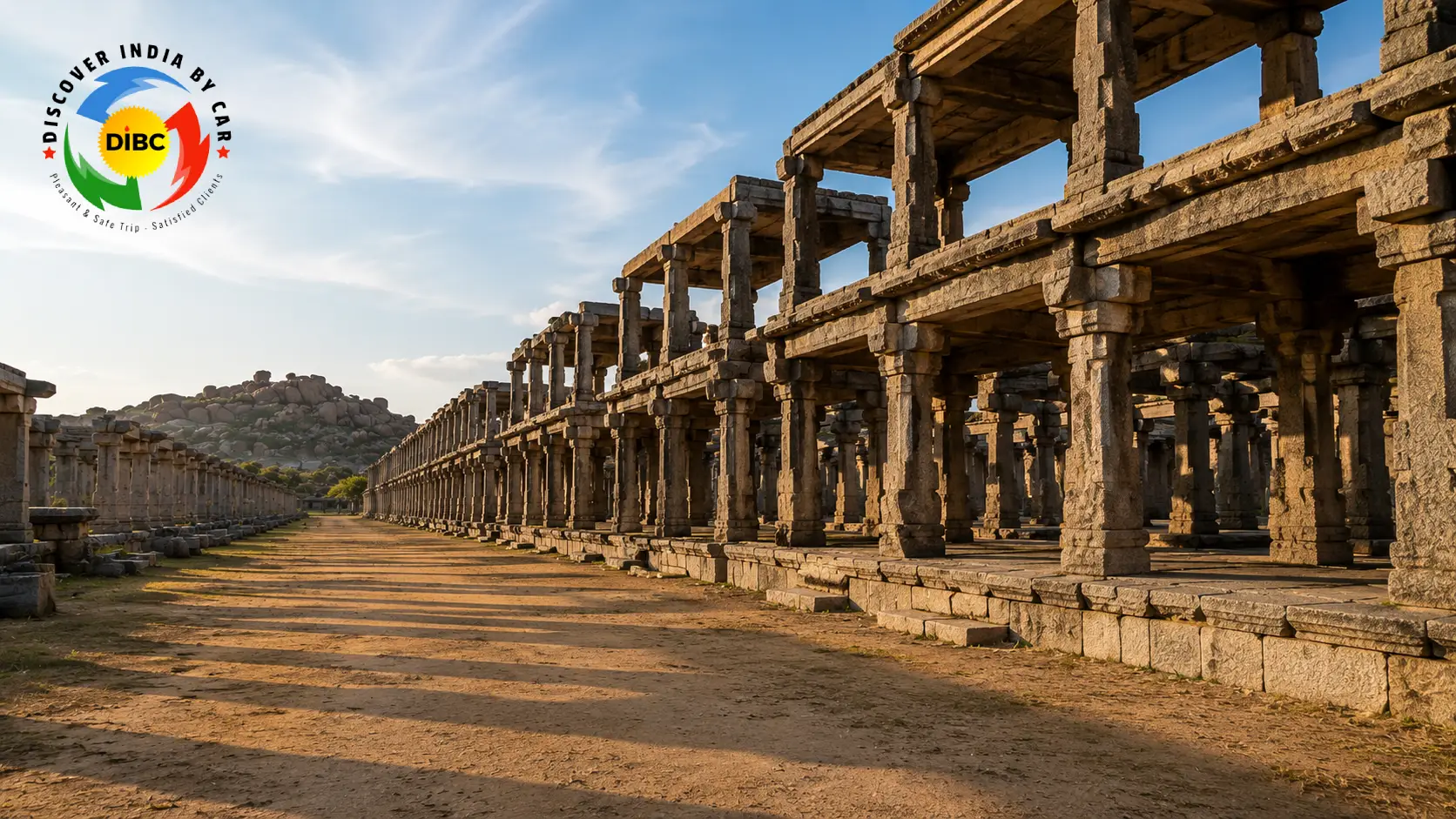
The long, ruined market street running east from the Virupaksha gateway was once a thriving, wealthy bazaar where historical Portuguese horse traders described precious stones and pearls being sold openly by the cupful.
Today, the massive double-storey colonnaded pavilions still line the ancient dirt trackway. At the far eastern end sits a magnificent, weathered monolithic Nandi bull sheltering under a stone canopy. Walk it slowly in the afternoon to truly appreciate the sheer scale of the old empire’s retail center.
4. Hemakuta Hill
A short, easy five-minute granite incline located directly above the Virupaksha complex. It is densely scattered with beautifully intact, unique triple-chambered pre-Vijayanagara shrines that feature distinct pyramid-shaped roofs.
- Best For: This is hands-down the single finest and most central spot in Hampi to sit back and watch the sunset.
- Insider Strategy: Climb up around 5:00 PM, secure a flat boulder space away from the main path, and simply watch the landscape turn deep amber.
5. Matanga Hill — The Sunrise Climb
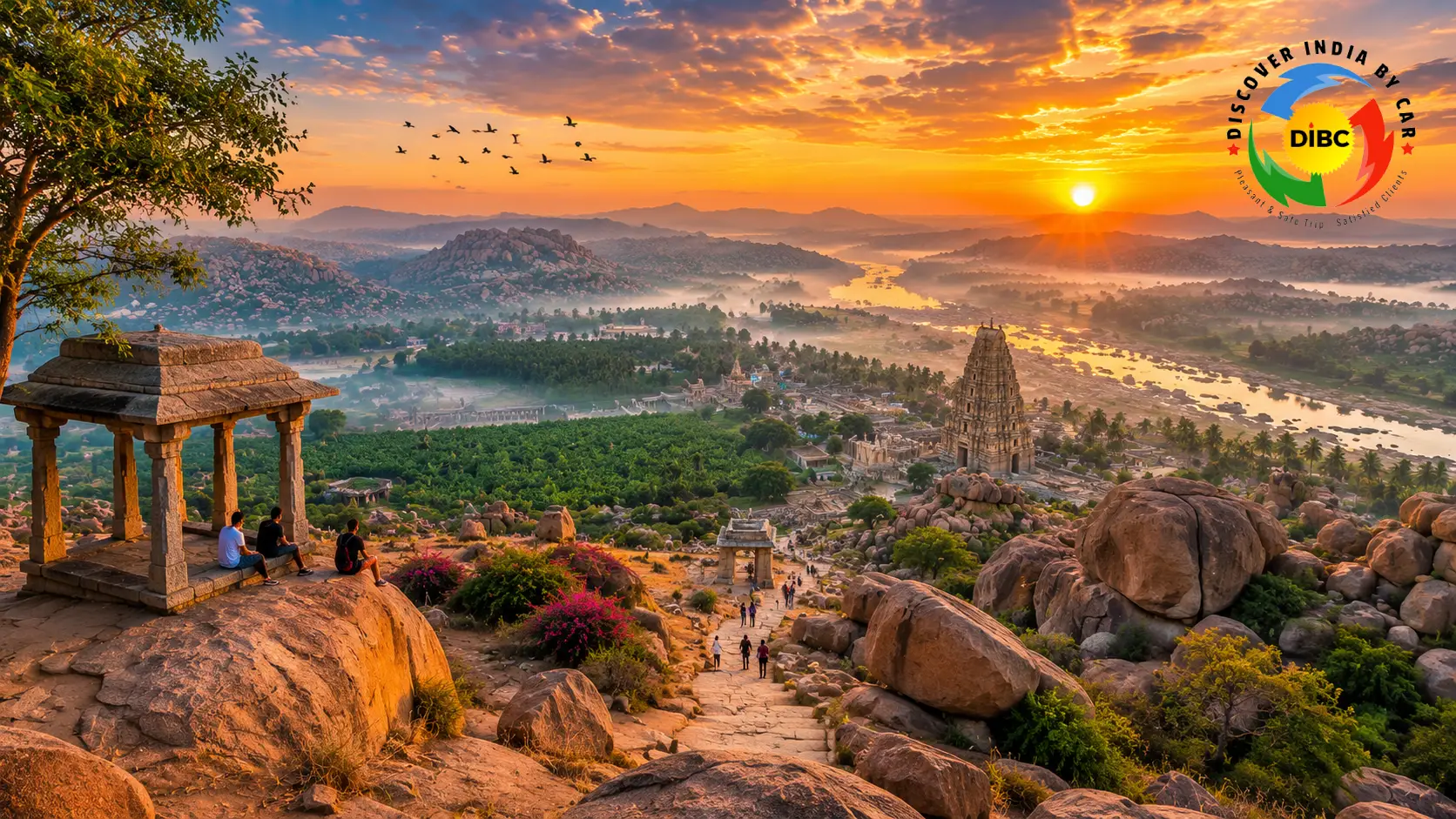
The highest geographical peak in central Hampi and the ultimate destination for landscape photographers.
- Logistics & Timing: The steep trail consists of uneven rock-cut steps and takes roughly 30–40 minutes. Because you must ascend around 5:15 AM to catch the dawn, a dependable flashlight or headlamp is absolutely non-negotiable.
- The View: A breathtaking 360-degree panoramic sweep showing the morning mist rising off the Tungabhadra River while first light kisses the countless temple towers across the valley.
6. The Royal Enclosure
The administrative and ceremonial heart of the old capital. Inside it sit the Mahanavami Dibba — a massive three-tiered stepped platform carved with processional reliefs of elephants and hunters — alongside a geometrically perfect stone stepped water tank and an underground secret council chamber. This zone, more than any temple, reveals how the city functioned as a massive, populated metropolis.
7. Lotus Mahal
A delicate, symmetric two-storey pavilion situated inside the walled quarters of the Zenana Enclosure. It beautifully fuses Hindu and Islamic architectural design profiles, featuring multi-layered arched openings, sophisticated plasterwork, and a distinct lotus-bud structural silhouette. It remains remarkably well preserved.
- Access: Covered directly under the combined single-day ASI ticket.
8. Elephant Stables
Located right next to the Lotus Mahal, this is a grand, perfectly symmetrical row of eleven monumental domed chambers that once housed the empire’s royal military elephants. When even the livestock stables are constructed with this level of architectural magnificence, you begin to grasp the sheer wealth of the civilization.
9. Lakshmi Narasimha & the Badavilinga
A short walk apart, these two massive monoliths are among Hampi’s most striking artistic pieces. The Lakshmi Narasimha is a colossal, fierce 6.7-meter seated form of Vishnu’s man-lion avatar, carved out of a single giant granite boulder. Directly beside it, the Badavilinga is a large stone Shiva lingam standing permanently inside a chamber flooded with flowing river water.
10. Hazara Rama Temple
This functioned as the compact, private chapel for the royal family. Its outer and inner walls are completely covered in dense, finely detailed carved panels narrating the structural sequences of the Ramayana epic. It is significantly quieter than the larger temple complexes, making it the perfect spot to linger over ancient artwork away from the crowds.
🎟️ Ticketing Blueprint (2026 Update): The combined ASI ticket is your master key. A single Archaeological Survey of India ticket covers the Vittala Temple, Lotus Mahal, Elephant Stables, and several other enclosed monuments. It is valid for exactly one full day across all included sites, so schedule these visits together.
Approximate 2026 rates are ₹40 for Indian nationals and ₹600 for foreign visitors. Children under 15 enter free. Virupaksha Temple is separate and charges its own nominal fee (~₹2). Always carry your physical ticket all day, as staff scan it at individual monument entry checkpoints.
Your Engineered 2-Day Hampi Itinerary
Two days is the realistic minimum required to explore Hampi. A single rushed day will leave you exhausted, with little time to absorb the history. This tested plan is structured deliberately to protect you from Hampi’s intense midday stone heat.
Day 1 — The Sacred Centre (Temple Side)
| Time Slot | Destination & Activity | Strategic Highlight & Local Tip |
|---|---|---|
| 05:45 AM – 07:00 AM | Matanga Hill Sunrise | Bring a torch for the dark ascent. Experience the best panoramic view in Hampi before the tourist buses arrive. |
| 07:30 AM – 10:00 AM | Virupaksha Temple & Bazaar | Arrive while the morning temperature is low and the rituals are active. Walk the colonnaded bazaar street afterwards. |
| 10:00 AM – 11:30 AM | Monoliths & Central Shrines | Explore Hemakuta Hill, Krishna Temple, and the giant Ganesha statues. Move steadily as shade is very scarce here. |
| 12:00 PM – 03:30 PM | 🌡️ Midday Refuge & Lunch | Mandatory Rest Block: This is for survival. Hampi's granite terrain radiates intense heat at noon. Find a shaded café and rest. |
| 03:30 PM – 05:00 PM | Vittala Temple Masterpiece | Arrive as the light turns golden on the granite structures. Dedicate proper time to the inner mandapa carvings. |
| 05:30 PM – 06:30 PM | Hemakuta Twilight | Watch the stone turn deep amber from the bare rock slopes as the sun drops below the horizon. |
Day 2 — The Royal Centre & Across the River
Day two trades the temple density of the sacred zone for the wide-open ceremonial heart of the city — and then crosses the water into a completely different landscape.
1.The Morning Royal Citadel:08:00 AM – 11:30 AM.
Start early at the Royal Enclosure while the light is soft. Explore the Mahanavami Dibba, the Stepped Tank, and the Queen’s Bath. Move quickly to the Hazara Rama Temple to view its intricate relief panels before finishing at the Lotus Mahal and Elephant Stables. Front-load this walking tour early to beat the direct heat.
2.The Midday Pause:12:00 PM – 03:30 PM.
As the sun peaks, retreat immediately to a shaded spot. Enjoy a long lunch, rehydrate, and rest through the hottest hours of the day. Hampi punishes impatient travelers who attempt to push through the afternoon sun.
3.The Tungabhadra River Crossing & Hippie Island:04:00 PM – Sunset.
Cross the river to the northern bank known locally as Virupapur Gaddi. The landscape flips completely from dry stone into rolling green rice paddies, banana plantations, and laid-back hammock cafés. Rent a scooter to explore Anegundi, an ancient rural settlement rich in mythology. Watch the light fade over the river basin from the northern rock ledges.
⚠️ URGENT — 2026 River Crossing Regulations: Do not assume the river ferry is running freely. The boat and coracle services across the Tungabhadra River remain subject to sudden official restrictions, hours of limitation, and safety suspensions driven by seasonal water releases from upstream dams. Confirm the current crossing status with your guesthouse the moment you arrive. If the direct boat service is temporarily restricted, you will need to plan for a longer road detour via the highway bridge near Anegundi.
How to Reach Hampi: From Delhi, Bengaluru & Mumbai
Hampi’s relative obscurity comes partly from its location — it’s genuinely a bit out of the way, which is also part of its charm. Here’s how to get here.
- Nearest Railway Station: Hosapete (Hospet), located roughly 13 kilometres from the core ruins. Frequent local public buses and auto-rickshaws connect Hospet to Hampi within 30 minutes.
- Nearest Airports: Hubballi (Hubli) is located 143 kilometres away. A closer domestic airstrip exists at Vidyanagar/Toranagallu but features highly limited commercial flights. For most long-distance travelers, flying into larger international hubs like Bengaluru, Hyderabad, or Goa followed by an overnight train or sleeper bus is the standard approach.
Regional Transit Options
- From Bengaluru (≈340 km): The most popular and streamlined route. The overnight Hampi Express train from Bengaluru (Yesvantpur) to Hospet is the classic choice—you sleep through the transit and step onto the ruins at dawn. Plentiful air-conditioned sleeper buses run this route nightly, and private driving takes roughly 6 to 7 hours via national highways.
- From Goa (≈300 km): Ideal for travelers pairing coastal beach destinations with deep heritage exploration. Regular long-distance overnight buses service this route daily across the scenic Western Ghats, requiring roughly 8 to 10 hours of travel time.
- From Hyderabad (≈360 km): Highly dependable air-conditioned sleeper buses and overnight express trains connect Hyderabad directly to Hospet station, making it a great option if you are touring the wider Deccan plateau.
Traveling from New Delhi
Because New Delhi is situated over 1,800 kilometres north of the site, a continuous road trip or pure rail journey is highly impractical. The practical method involves booking a 2 to 2.5-hour domestic flight from Delhi to Bengaluru or Hyderabad, followed by an overnight train connection to Hospet.
Realistically, expect an entire travel day to make the transition between North India and this specific southern archaeological hub. Because of this geographic spacing, Hampi slots most logically into the southern leg of a wider subcontinental itinerary.
On-Site Mobility: The absolute best way to traverse the 26-square-kilometer archaeological park is by hiring a local geared scooter or automatic moped (averaging ₹250–₹400 per day). If you do not ride, hiring an auto-rickshaw for a dedicated full-day tour (ranging from ₹600–₹1,200) is the most comfortable alternative. Standard pedal bicycles are available but are recommended only for individuals with peak fitness due to the extreme heat and rolling, rocky topography.
Best Time to Visit Hampi (Avoid April–June Heat)
I’ll be blunt, because choosing the wrong season is the single most common mistake travellers make here. The best time to visit Hampi is October to February. Outside that window, you need a very specific reason to visit.
- October to February (The Peak Season): Pleasant, dry weather with daytime temperatures around 22–30°C and cool, comfortable evenings. This is the optimal window for long walking tours, hill climbs, and monument exploration. The vibrant Hampi Utsav cultural festival typically takes place during November or January, filling the stone ruins with classical music and traditional dance.
- March (The Shoulder Month): Still doable, but warming up exceptionally fast. By late March, the daytime heat becomes difficult to ignore during long walking tours.
- April to June (Strictly Avoid): Summer conditions are intense, with ambient temperatures consistently scaling between 38°C and 42°C. The massive dark boulders act like thermal batteries, radiating intense heat, and natural shade across the archaeological park is virtually non-existent. Attempting mid-day hill climbs during these months carries genuine health risks like severe heat stroke. If your timing forces a summer visit, strictly limit outdoor exploration to early morning and late evening hours.
- July to September (Monsoon Phase): Periodic heavy downpours bring cooling relief and turn the surrounding scrub terrain beautifully green. However, rainfall can disrupt outdoor visibility, and high river currents frequently cause local authorities to suspend boat crossings to the northern bank.
Hampi vs Ajanta Ellora: Which Should You Visit?
Because both are prominent India UNESCO World Heritage sites, travelers frequently group them together under the assumption that they offer comparable experiences. They aren’t similar at all.
- Hampi consists of the open-air ruins of an expansive Hindu imperial capital spread across 26 square kilometres of boulder-strewn terrain in Karnataka (South India). You experience it by riding and walking among old market rows, palaces, administrative complexes, and active riverside shrines. It is focused on historic scale, landscape atmosphere, and the romance of a lost civilization.
- Ajanta and Ellora are rock-cut subterranean cave complexes carved directly into mountain cliffs in Maharashtra (Central-Western India). Ajanta features ancient Buddhist monastic chambers famous for detailed 2nd-century BCE painted fresco murals. Ellora features incredible Hindu, Jain, and Buddhist cave architecture, including the staggering Kailasa Temple—the largest single monolithic structure in the world carved downward out of solid rock. You experience them by entering dark, cool carved chambers, not by traversing an open landscape.
The comparison is essentially apples and oranges. If you love sweeping vistas, dramatic sunrises over a sprawling lost empire, and the complete freedom to roam via scooter across an ancient landscape, choose Hampi. If your primary interest lies in microscopic ancient art, deep monastic history, and structural feats of mountain-carving engineering, prioritize Ajanta and Ellora. If you wish to expand your exploration into central India, you can review our dedicated Ajanta and Ellora Caves tour guide to manage your upcoming route logistics cleanly.
Practical Tips for a Hampi Trip
- Hydration and Sun Defense: The reflected thermal load off the granite boulders is substantial. Always carry double the water volume you expect to consume, utilize wide-brimmed hats, and apply high-SPF sunscreens even during mid-winter.
- Footwear Selection: Leave flimsy flip-flops behind. Exploring the site involves continuous walking across rough rock, loose gravel paths, and steep stone staircases. Dependable trail shoes or sturdy sports sneakers are essential.
- Cash Dependability: While upscale restaurants and hotels accommodate UPI digital transactions, smaller local snack shops, auto drivers, and entry booths operate predominantly in hard cash. Maintain a supply of small-denomination currency notes.
- Cultural Respect Protocols: Many of these monuments remain actively sacred. When entering active shrines like Virupaksha, ensure your shoulders and knees are fully covered by modest clothing, and seamlessly remove your footwear at the designated outer entrances.
- The Guide Imperative: Hampi without context can look like an endless field of broken rock. Investing in a government-licensed local guide near the Virupaksha entrance for your first morning will completely transform your appreciation of the complex architecture.
- Respect the Fragile Heritage: Do not climb on fragile carvings, do not tap the historic musical pillars at Vittala Temple, and ensure you leave the archaeological park exactly as you found it.
Hampi + North India: A 3-Week India Itinerary
The most rewarding subcontinental travel itineraries integrate the distinct cultural landscapes of South India with the monumental scale of North India. Because the two zones feature entirely different architectural traditions, languages, and food profiles, pairing them offers a profound view of India.
A Strategic 3-Week Blueprint
- Week 1 (The Southern Ingress): Fly into international hubs like Bengaluru or Goa. Spend your initial days adjusting to the time zone along the coast or exploring local city hubs, before taking an overnight train directly into Hampi for a deep 3-day exploration of the ruins.
- The Mid-Trip Transition: Take a domestic flight from Bengaluru or Hyderabad up to New Delhi. This 2-hour flight serves as your logical geographic pivot, transporting you seamlessly between regions.
- Weeks 2–3 (The Northern Heritage Core): This is where India’s historic heavyweights reside—the bustling streetscapes of Old Delhi, the monumental Taj Mahal in Agra, and the pink sandstone fortresses of Jaipur. To seamlessly navigate this sector, review our tailored Delhi Agra Jaipur tour itinerary which highlights secret mid-route steps like Fatehpur Sikri and Abhaneri, before extending out to the spiritual ghats of Varanasi or the desert plains of Rajasthan.
🗺️ Logistics Solutions for Multi-Region Travel
Unlike the compact, localized layout of Hampi—where a rented scooter gives you complete freedom—the classic heritage destinations of North India are spread across massive geographical distances. Many of the most rewarding historical gems, such as Akbar’s perfectly preserved abandoned capital at Fatehpur Sikri or the intricate Chand Baori stepwell at Abhaneri, sit tucked along highway corridors completely inaccessible via regional rail networks.
Attempting to navigate the northern circuit purely via trains can lock you into rigid schedules, introduce platform delays, and force you to skip these incredible mid-route historical sites. For this specific leg of a multi-region India tour, utilizing a private car with an experienced local driver is what actually unlocks the route, providing complete schedule flexibility and air-conditioned transit between cities.
If you are planning to marry your southern archaeological trip with a seamless transition through the historic north, our dedicated service is designed to bridge the logistical gap transparently.
✍️ Meet Your Logistics Architect: Ankit Sagar
Founder, Discover India by Car & Senior Multi-Region Operations Expert
Having spent over 14 years helping thousands of international travelers navigate the chaotic maze of Indian transit logistics, I built this ground-reality guide to protect you from common multi-region itinerary blunders.
My days aren’t spent researching generic travel trails from an office desk; I manage real-world operational ground realities every single day. From decoding transit paperwork and rescuing stranded spiritual seekers at remote Himalayan hubs, to structuring precision private car transfers that seamlessly connect southern heritage circuits like Hampi with the northern Golden Triangle, everything in this blueprint is born from firsthand problem-solving experience.
When you transition your journey from the relaxed south to the high-energy corridors of the north, my team and I ensure your transit shifts from a logistical headache into a completely seamless, stress-free road experience.
🚗 Plan Your Custom North India Tour with Discover India by Car
If you are looking to pair your Hampi adventure with a seamless, private tour of the Golden Triangle or Rajasthan, we can help design your journey. Discover India by Car has been curating tailor-made private car tours across North India for over 14 years.
- Custom Itineraries: Designed entirely around your flight timings, dates, and specific interests.
- Local Expertise: Experienced English-speaking drivers who understand the routes intimately.
- Transparent Pricing: Ideal for both independent travelers and small groups looking to split costs efficiently when booking a private car and driver hire for the long highway stretches up north.
- Corporate Office: A98, 2nd Floor, Jain Park, Uttam Nagar, New Delhi – 110059
- Email Travel Desk: info@discoverindiabycar.com
- Voice / WhatsApp Support: +91-9818434712 / +91-8447445445
Planning Your Southern Loop? Connect to the North Seamlessly.
You explored the surreal landscape of Hampi to experience one of history's greatest civilizations. Don't let long-distance highway gaps, platform stress, or missed roadside monuments disrupt the northern leg of your journey. Secure a flexible, premium private car with an experienced local driver to bridge the cultural transition from Delhi Airport through the entire Golden Triangle corridor.
Remote Site Unlocking — Zero tracking constraints. We route you directly to off-rail masterpieces like Fatehpur Sikri and Abhaneri.
Flexible Custom Pacing — Your schedule remains entirely yours. Stop where you want, stay as long as you want between cities.
Premium Interstate Fleet — Recover from your flights or train journeys in immaculate, air-conditioned Sedans & SUVs.
Frequently Asked Questions
Q1. How many days do you need in Hampi?
Two full days covers the primary monuments across the Sacred and Royal centers comfortably. A third day is highly recommended to slow down, explore the rural landscapes of Anegundi across the river, and revisit your favorite structures during golden hour light.
Q2. Is Hampi safe for solo and female travellers?
Yes. Hampi maintains a highly relaxed, collaborative backpacker culture and is widely recognized as one of the safest and most easygoing destinations in India for solo female travelers. Applying standard situational travel awareness is sufficient.
Q3. Can I do Hampi as a day trip from Bengaluru?
No. Because the distance is approximately 340 kilometres each way, a single-day trip would result in 14 hours of continuous road travel, leaving virtually zero time to explore the vast 26 sq km site. Dedicate at least two nights to Hampi to make the travel time valuable.
Q4. Where should I stay in Hampi?
If you prefer traditional environments and being within walking distance of active temples, stay on the Hampi Bazaar side. If you prefer green scenery, a relaxed café atmosphere, and lower-density guesthouses, look across the river at Virupapur Gaddi. If you require large, high-end commercial hotels with modern luxury amenities, base yourself in the nearby town of Hospet.