- Private car and driver in Delhi / India
- +91-8447445445
- info@discoverindiabycar.com sugar.ankit@yahoo.com
 +91-9818434712
- Follow us:



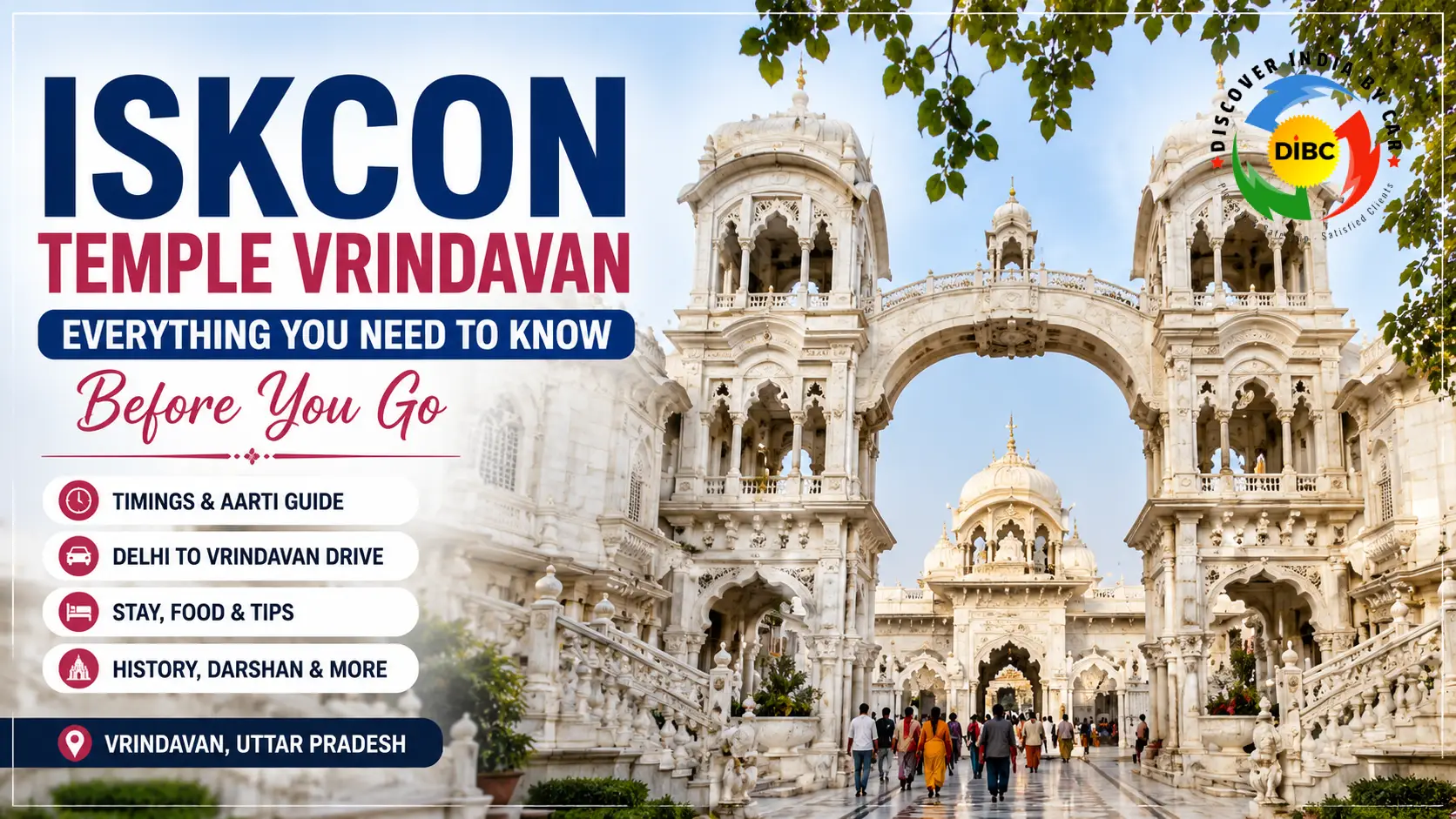
ISKCON Temple Vrindavan – Timings, History, Travel Guide & Visitor Tips
✍️ Written by Ankit Sugar | Road Trip Expert & Founder, Discover India By Car
Having navigated thousands of kilometres across Uttar Pradesh’s highways — including countless early morning runs down the Yamuna Expressway straight to Raman Reti — I created this ground-reality guide to help you experience ISKCON Vrindavan without the usual logistical chaos. From exact toll costs to parking realities and the best Aarti timings, everything in this guide comes directly from my own lived experience behind the wheel and inside the temple complex.
ISKCON Temple Vrindavan: Everything You Need to Know Before You Go
Let’s skip the usual travel blog fluff. If you’re driving down from Delhi expecting the typical temple run—crowded lanes, pushy guides, and a rushed 30-second darshan—ISKCON Vrindavan is going to completely reset your expectations. I initially thought it would be just another chaotic weekend stop. I was way off.
The ISKCON Temple — formally called the Sri Sri Krishna Balaram Mandir — sits in a part of Vrindavan called Raman Reti, which translates, roughly, as the sand where Rama played. The area feels different from the rest of the town almost immediately. Quieter. The lanes leading to it are wider than Vrindavan’s usual claustrophobic alleys. There are fewer touts. The complex itself is built in white Rajasthani marble, and on the morning I arrived — early, maybe quarter past seven, the sun still low — the whole thing was glowing in a way that made it look less like a building and more like a very large, very calm idea.
After multiple trips down the Yamuna Expressway, I’ve figured out exactly how to navigate this place without the stress. Here is the ground reality of visiting the Sri Sri Krishna Balaram Mandir.
Why the Vrindavan Temple Actually Matters (Beyond the Tourist Hype)
A lot of visitors — especially younger ones driving down from Delhi for the weekend — treat ISKCON Vrindavan as a kind of exotic tourist stop, which is fair enough, but it means they often miss the context that makes the place genuinely interesting.
ISKCON stands for the International Society for Krishna Consciousness. You’ve probably seen its members in airports — the ones in saffron robes, shaved heads, chanting Hare Krishna. The movement was founded by one man: A.C. Bhaktivedanta Swami Prabhupada, a Bengali scholar and devotee who boarded a cargo ship from Calcutta to New York in 1965 when he was 69 years old, with essentially no money and an absolute conviction that the West needed to hear about bhakti yoga.
What happened next is one of the more remarkable stories in modern religious history. Within a decade, Prabhupada had opened temples across America and Europe, translated and commented on sacred Sanskrit texts that now sit in university libraries worldwide, and built a movement with followers in the millions. George Harrison of the Beatles was among the more famous ones. He funded the purchase of the Bhaktivedanta Manor in England, which became ISKCON’s UK headquarters.
Through all of this, Prabhupada’s deepest wish was to build a temple in Vrindavan — the town in Uttar Pradesh’s Mathura district that Hindu tradition holds as the childhood home of Lord Krishna. In 1975, that temple was inaugurated. It was the first ISKCON temple built anywhere in the world — the original, the mother of all the hundreds that followed.
Prabhupada himself presided over the opening. He died two years later, in 1977, inside the very complex he had dreamed of for decades. His samadhi — his mausoleum — is here. That alone gives the place a weight that most tourist sites simply don’t have.
Inside the Complex: What to Notice
The complex is bigger than it appears in photographs. There are three separate shrines inside, and most visitors — especially those who arrive for a quick darshan and leave — see only the main one.
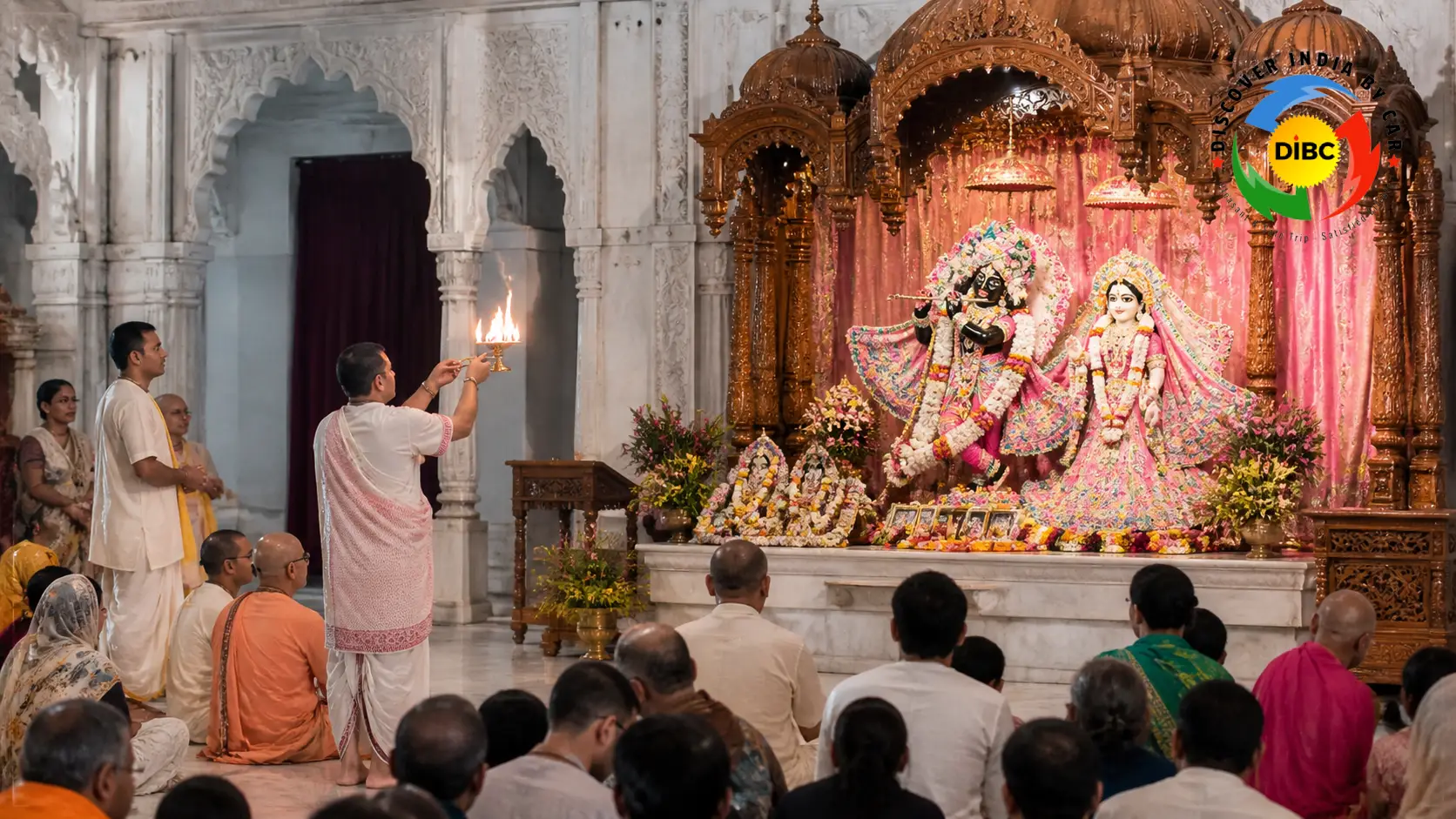
The main shrine houses the deities of Sri Sri Krishna and Balarama, the divine brothers. Krishna is the dark one; Balarama, his elder brother, is lighter in complexion. In temple practice, the deities are dressed differently multiple times throughout the day — the selection of silks, ornaments, and flowers changes with each aarti. If you visit more than once in a single day, you’re seeing different “presentations” of the same deities. Some devotees find this deeply meaningful. Even if you don’t share the theology, the sheer craftsmanship of the garments and the ritual intention behind each change is worth paying attention to.
The second shrine holds Radha and Shyamasundara — Radha being Krishna’s beloved, Shyamasundara being another name for Krishna meaning “the dark, beautiful one.” Radha-Krishna worship is the heart of Vrindavan’s entire spiritual identity. Every temple in this town is, in some way, about this relationship.
The third shrine is dedicated to Gaura and Nitai — the 16th-century saints Sri Chaitanya Mahaprabhu and Nityananda Prabhu, considered by Gaudiya Vaishnavas to be avatars of Radha and Krishna. Prabhupada’s own devotion was principally to Gaura Nitai, and this shrine has a gentleness to it that some visitors actually prefer to the grandeur of the main hall.
Then there is Prabhupada’s Samadhi.
Here is a piece of advice you shouldn’t ignore. I am not a Hare Krishna devotee. I don’t follow the tradition. But the Samadhi Mandir — the room where Prabhupada’s remains are interred — does something to you. It’s quieter than the rest of the complex. People sit in silence. Some cry. There’s a marble murti of Prabhupada seated in the meditation posture, and the room smells of fresh flowers and incense. I sat there for about twenty minutes on my second visit, not really knowing why, and found it difficult to leave.
Make time for this room. Whatever your beliefs.
The Vedic Cultural Museum inside the complex is also worth an hour if you have it. It’s a bit dated in its presentation — dioramas, painted panels, some video — but the content is genuinely substantive. The life of Prabhupada, the philosophy of bhakti, the stories from the Bhagavata Purana. If you’ve come to Vrindavan without much background on Vaishnavism, this is a decent primer. Good for children, too.
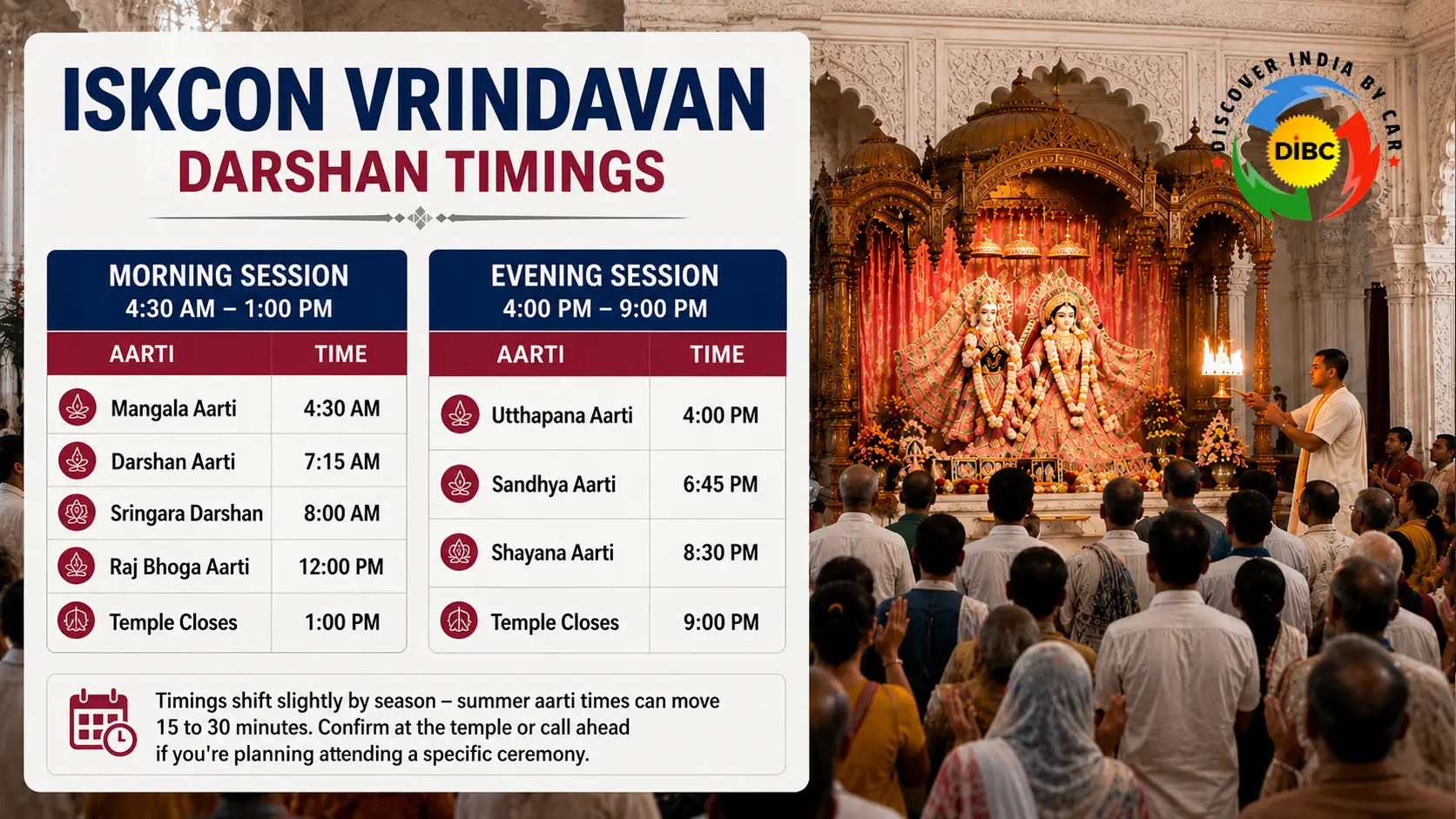
ISKCON Vrindavan Darshan Timings
Get this right before you go. The temple operates on a precise schedule built around eight daily “viewings” of the deities, each accompanied by a specific aarti ceremony. If you arrive during the midday closure, you’ll be standing outside a shut gate wondering what went wrong.
Morning Session (4:30 AM – 1:00 PM)
Aarti | Time |
Mangala Aarti | 4:30 AM |
Darshan Aarti | 7:15 AM |
Sringara Darshan | 8:00 AM |
Raj Bhoga Aarti | 12:00 PM |
Temple closes | 1:00 PM |
Evening Session (4:00 PM – 9:00 PM)
Aarti | Time |
Utthapana Aarti | 4:00 PM |
Sandhya Aarti | 6:45 PM |
Shayana Aarti | 8:30 PM |
Temple closes | 9:00 PM |
If you have to choose which Aarti to attend, here is the real deal:
Mangala Aarti (4:30 AM) is considered the most spiritually potent by devotees — the idea being that the mind is clearest at that hour, before the noise of the day begins. I did this once, driving through Vrindavan in the dark at 4 AM, and I’ll tell you: the experience of a few hundred devotees singing in the lamplight before dawn, the mridangam echoing off marble walls, is something that bypasses analysis completely. You just feel it.
Sandhya Aarti (6:45 PM) is the one I’d recommend to anyone visiting for the first time. The light inside the hall at that hour — lamps, ghee flames, the last of the day’s sunlight through the windows — combined with the sound of conch shells and the press of devotees in full kirtan creates an atmosphere that’s close to overwhelming. It’s also the most accessible timing for most people.
Timings shift slightly by season — summer aarti times can move fifteen to thirty minutes. Confirm at iskconvrindavan.com or call ahead if you’re planning around a specific ceremony.
The Delhi to Vrindavan Drive: Route, Tolls, and Reality Checks
This is exactly what you need to know before hitting the ignition.
The route from Delhi to ISKCON Vrindavan is one of the more pleasant highway drives in North India, mostly because the Yamuna Expressway is genuinely excellent — 165 kilometres of smooth, well-maintained six-lane road that runs along the river and delivers you to the outskirts of Mathura in roughly 90 minutes from Noida.
The route:
Noida → Yamuna Expressway → Mathura Exit (Exit 3) → Mathura-Vrindavan Road → ISKCON Temple
Total distance: About 120 km from Noida, 150 km from Central Delhi.
Drive time: 2 to 2.5 hours in normal conditions.
Toll: Keep ₹400–500 in cash for a round trip.
When to leave: I’ve made this drive many times and my honest advice is to leave Delhi by 6 AM at the absolute latest if you want to catch the morning darshan without stress. The Expressway is empty at that hour. You’ll hit the Mathura exit with time to spare, find parking, and walk into the Sringara Darshan at 8 AM in a completely relaxed state. Contrast this with leaving at 9 AM — you hit Noida morning traffic, the Expressway gets busier, and by the time you arrive you’re frazzled and the morning session is half-done.
On the Expressway itself: The speed limit is 100 km/h for cars and it is monitored with cameras. The road is so good that you’ll want to go faster. Don’t.
Fuel: Fill up before entering Vrindavan town. There are reliable petrol pumps near the Mathura bypass and at the Expressway service areas. The lanes inside Vrindavan get narrow and you don’t want to be hunting for petrol in there.
Parking: The temple has its own parking lot. For cars, you’re looking at ₹50–100. On regular weekdays it’s fine. On weekends, particularly during festivals, arrive before 8 AM or you’ll be parking on the main road and walking.
From Agra: 65 km via NH 19, about an hour. Makes perfect sense as part of an Agra-Vrindavan day trip.
Where to Stay — Honest Recommendations
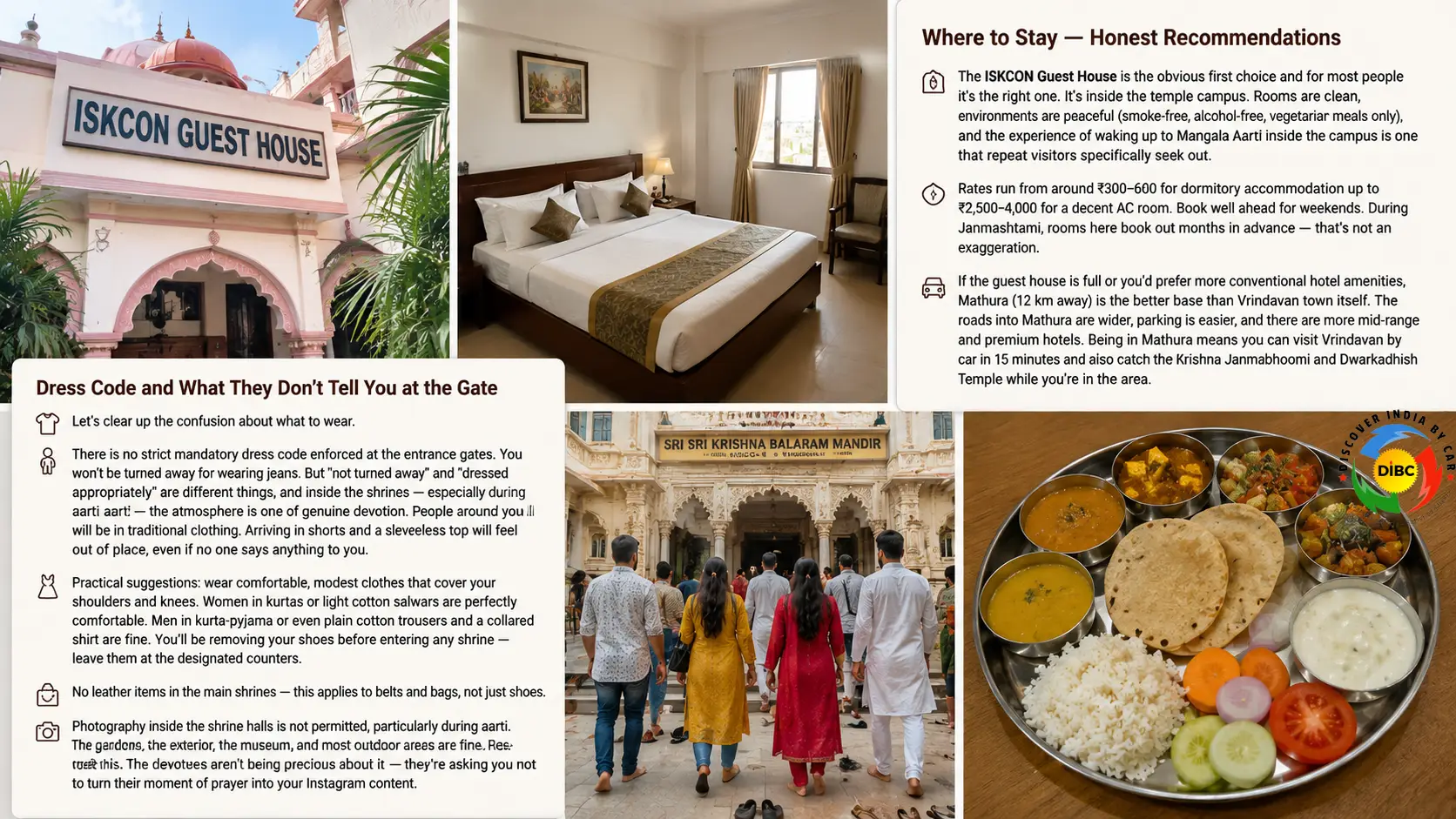
The ISKCON Guest House is the obvious first choice and for most people it’s the right one. It’s inside the temple campus. Rooms are clean, environments are peaceful (smoke-free, alcohol-free, vegetarian meals only), and the experience of waking up to Mangala Aarti inside the campus is one that repeat visitors specifically seek out.
Rates run from around ₹300–600 for dormitory accommodation up to ₹2,500–4,000 for a decent AC room. Book well ahead for weekends. During Janmashtami, rooms here book out months in advance — that’s not an exaggeration.
If the guest house is full or you’d prefer more conventional hotel amenities, Mathura (12 km away) is the better base than Vrindavan town itself. The roads into Mathura are wider, parking is easier, and there are more mid-range and premium hotels. Being in Mathura means you can visit Vrindavan by car in 15 minutes and also catch the Krishna Janmabhoomi and Dwarkadhish Temple while you’re in the area.
Dress Code and What They Don’t Tell You at the Gate
Let’s clear up the confusion about what to wear.
There is no strict mandatory dress code enforced at the entrance gates. You won’t be turned away for wearing jeans. But “not turned away” and “dressed appropriately” are different things, and inside the shrines — especially during aarti — the atmosphere is one of genuine devotion. People around you will be in traditional clothing. Arriving in shorts and a sleeveless top will feel out of place, even if no one says anything to you.
Practical suggestions: wear comfortable, modest clothes that cover your shoulders and knees. Women in kurtas or light cotton salwars are perfectly comfortable. Men in kurta-pyjama or even plain cotton trousers and a collared shirt are fine. You’ll be removing your shoes before entering any shrine — leave them at the designated counters.
No leather items in the main shrines — this applies to belts and bags, not just shoes.
Photography inside the shrine halls is not permitted, particularly during aarti. The gardens, the exterior, the museum, and most outdoor areas are fine. Respect this. The devotees aren’t being precious about it — they’re asking you not to turn their moment of prayer into your Instagram content.
The Food — Don’t Skip This
The Govinda’s Restaurant inside the complex serves vegetarian food cooked without onion or garlic — the sattvic diet of the Vaishnava tradition. First-time visitors sometimes brace themselves for something austere and are quietly surprised by how good it actually is.
The thali is the move. Rotis, dal, two vegetable preparations, rice, raita, and a sweet — around ₹150–250. It’s honest, generously portioned food cooked with actual care. The lassi is also very good.
The temple also distributes free prasadam daily — simple khichdi and sabzi, served in the main hall. This is something Prabhupada specifically insisted on: no one who comes to the temple goes away hungry. Even if you don’t eat it, it’s worth witnessing the scale of the operation — hundreds of people being fed every single day, by donation, for free.
Outside the complex, the streets around ISKCON have plenty of small vegetarian dhabas and sweet shops. The peda — a milk-based sweet that is Mathura-Vrindavan’s great culinary contribution to India — is everywhere. Buy it fresh. The best pedas are slightly soft with a faint cardamom note. The dry, crumbly ones that have been sitting out since morning aren’t worth it.
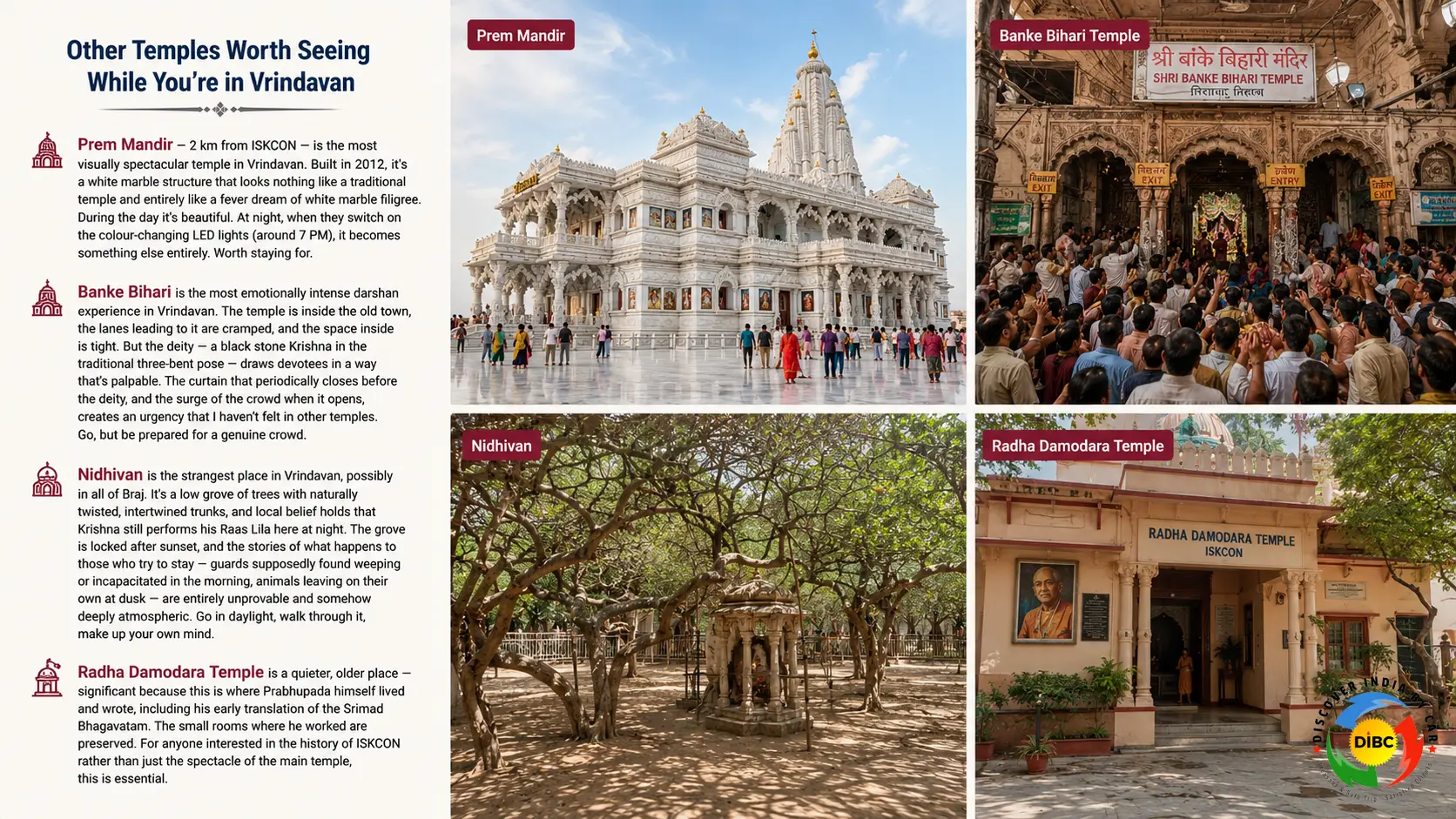
Other Temples Worth Seeing While You’re in Vrindavan
Once you’ve done ISKCON, you’ll likely have time for more. Vrindavan rewards walking — or slow driving through narrow lanes — and the concentration of temples here is staggering.
Prem Mandir — 2 km from ISKCON — is the most visually spectacular temple in Vrindavan. Built in 2012, it’s a white marble structure that looks nothing like a traditional temple and entirely like a fever dream of white marble filigree. During the day it’s beautiful. At night, when they switch on the colour-changing LED lights (around 7 PM), it becomes something else entirely. Worth staying for.
Banke Bihari is the most emotionally intense darshan experience in Vrindavan. The temple is inside the old town, the lanes leading to it are cramped, and the space inside is tight. But the deity — a black stone Krishna in the traditional three-bent pose — draws devotees in a way that’s palpable. The curtain that periodically closes before the deity, and the surge of the crowd when it opens, creates an urgency that I haven’t felt in other temples. Go, but be prepared for a genuine crowd.
Nidhivan is the strangest place in Vrindavan, possibly in all of Braj. It’s a low grove of trees with naturally twisted, intertwined trunks, and local belief holds that Krishna still performs his Raas Lila here at night. The grove is locked after sunset, and the stories of what happens to those who try to stay — guards supposedly found weeping or incapacitated in the morning, animals leaving on their own at dusk — are entirely unprovable and somehow deeply atmospheric. Go in daylight, walk through it, make up your own mind.
Radha Damodara Temple is a quieter, older place — significant because this is where Prabhupada himself lived and wrote, including his early translation of the Srimad Bhagavatam. The small rooms where he worked are preserved. For anyone interested in the history of ISKCON rather than just the spectacle of the main temple, this is essential.
Plan a Hassle-Free Road Trip to ISKCON Vrindavan
Planning to catch the early morning Darshan? Skip the stress of navigating Yamuna Expressway tolls, Mathura bypass traffic, and finding a spot in the ISKCON parking lot. Let our experienced drivers handle the exact route while you focus entirely on your spiritual journey.
Clean, comfortable cars — Sedans, SUVs & Innova available.
Expert drivers who know the exact Mathura bypass and ISKCON parking routes.
Delhi-Vrindavan trips perfectly timed to match specific Aarti schedules.
Questions People Actually Have (FAQ)
Q1. What time does ISKCON Vrindavan open?
The first aarti (Mangala Aarti) begins at 4:30 AM. For most visitors, the practical opening for morning darshan is around 7:15 AM with the Darshan Aarti. The temple closes at 1 PM for the afternoon and reopens at 4 PM.
Q2. Is it free to enter?
The temple complex itself is free. The Vedic Cultural Museum has a small entry fee. Prasadam is distributed free of charge daily.
Q3. Can non-Hindus visit?
Yes, fully and without any restriction. ISKCON temples have always been open to all. You will be welcomed.
Q4. What’s the best time of year to visit?
October to March, when the heat is manageable. Janmashtami (August) and Holi are the most electric times to visit but bring genuinely massive crowds. If peace and comfort are your priority, a weekday morning between November and February is ideal.
Q5. How long does a visit take?
If you’re doing the main darshan, gardens, samadhi, and museum: three to four hours minimum. For a full day including nearby temples, expect six to eight hours.
Q6. Is there an ATM nearby?
There are ATMs on the main road approaching ISKCON from Mathura. Carry cash — smaller shops and prasadam stalls inside the town don’t always accept cards.
Q7. Can I park my car at ISKCON Vrindavan?
Yes. The temple has a dedicated parking area with space for cars. Fees are nominal. Arrive early on weekends.
The Last Thing I’ll Say
Vrindavan is not a comfortable place in the conventional tourist sense. The town itself is dusty, the traffic is chaotic in the inner lanes, the monkeys will absolutely steal your food if you give them the chance, and the approach roads to some temples require a certain tolerance for organized disorder.
But ISKCON Vrindavan sits slightly apart from all of that. The campus is clean, the volunteers are genuinely helpful, the food is good, and the quality of silence inside Prabhupada’s Samadhi is something you don’t find everywhere.
I’ve brought sceptical friends here — people who had no particular interest in Hindu temples, in bhakti philosophy, or in anything that couldn’t be explained in a sentence. Without exception, they’ve walked out quieter than they walked in. Not converted. Just quieter. Thoughtful.
That seems like a reasonable thing for a temple to do.
Drive carefully on the Expressway.
More road trip guides: Delhi to Agra by Car, Mathura Day Trip from Delhi.
— Discover India By Car | discoverindiabycar.com