+91-9818434712
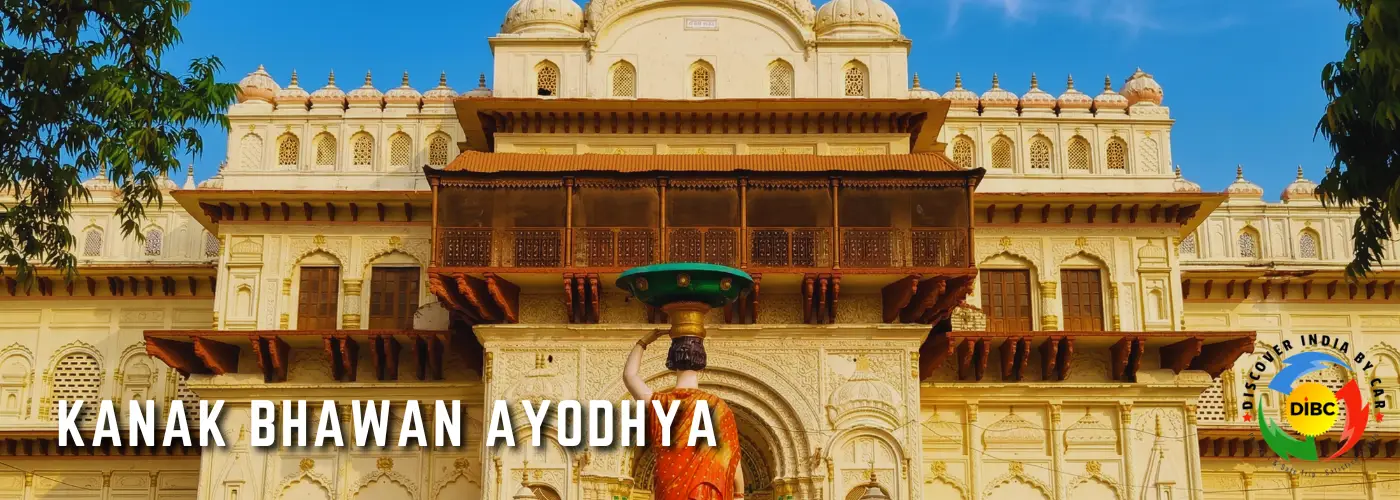
Bottom Line Up Front: Kanak Bhawan is Ayodhya’s legendary “Golden Palace,” originally gifted by Queen Kaikeyi to Mata Sita. Located right near the Ram Janmabhoomi, this stunning Bundela-style temple houses three pairs of divine idols. Best visited at dawn or during the evening Aarti. Entry is free. If you want spiritual peace away from the massive crowds, this is your spot. Read on for exact timings, crowd-avoidance tactics, and road-trip guides.
Let’s get straight to the point. Most people rushing to Ayodhya make a beeline for the main Ram Mandir. They get their darshan, take a few photos, and leave.
Big mistake.
If you skip Kanak Bhawan, you are missing the actual heartbeat of Ayodhya. You are missing the romance, the deep familial love, and hands-down the most architecturally beautiful building in the city.
I’ve seen a lot of temples. But stepping into the courtyard of Shri Kanak Mahal Ayodhya hits differently. It doesn’t feel like a public place of worship. It feels like you just walked into someone’s private, royal living room. And according to Hindu texts, that is exactly what it is.
Whether you are a lifelong Ram devotee driving in from Delhi, or a foreign tourist trying to figure out the spiritual magnitude of India, this guide breaks down everything you actually need to know. No fluff. Just hard facts, deep history, and street-smart travel tips.
Let’s clear up the basics. Kanak Bhawan is a private palace.
In the Hindu tradition, gods are not just distant entities sitting in the clouds. They live. They breathe. They have homes. When Lord Ram married Mata Sita in Janakpur and brought her to Ayodhya, she needed her own space.
This location is that space.
It sits in the Ramkot area of Ayodhya, located exactly around 300 to 400 meters (a short 5-minute walk) northeast of the main Ram Janmabhoomi complex. Locals call it “Sone ka Ghar” (The House of Gold). When you walk inside, the noise of the street vanishes. You hear live devotional music. You see priests going about their daily rituals. You see devotees sitting on the cool marble floor, completely lost in meditation.
Is it worth visiting? Yes. If you only have time for two places in Ayodhya, make it the Ram Mandir and Kanak Bhawan.
Expert Pro-Tip: Do not rush through the courtyard. The real magic happens when you sit down near the musicians on the left side of the main entrance. Spend twenty minutes just listening to the rhythmic chants of “Sita Ram.” It resets your brain.
The history of Kanak Bhawan Ayodhya isn’t a straight line. It is a wild, multi-millennium story of construction, destruction, and miraculous rediscovery. Let’s break it down by eras.
This is the era of the Ramayana. As described in revered Hindu texts, specifically echoing the grandeur detailed in the Ayodhya Kanda of the Ramayana, the story goes that Queen Kaikeyi—Ram’s stepmother—hired Vishwakarma (the celestial architect) to build this palace. It was literally made of solid gold and studded with unearthly gems. It was Kaikeyi’s muh-dikhai gift to Sita. For a long time, the divine couple lived here happily. Then came the exile. Then came the end of their earthly avatars. Over centuries, the golden palace degraded and vanished underground.
Fast forward thousands of years. Ayodhya is mostly in ruins. Lord Ram’s son, Kusha, tried to rebuild parts of it. Later, a king named Rishabdeo did some repairs.
But the wildest part of the history involves Lord Krishna.
Legend states Krishna visited Ayodhya during his lifetime. He walked to the exact spot where Kanak Bhawan used to be. There, he found an old female hermit meditating. Krishna handed her a pair of small idols of Ram and Sita. He told her to bury them right there. He promised her that one day, a great emperor would dig them up and rebuild the glory of the site.
Enter King Vikramaditya. Following local folklore and divine hints, he arrived in Ayodhya, excavated the Ramkot area, and found the exact idols Krishna left behind. Vikramaditya built a massive stone temple on the spot.
Then came the dark ages. Foreign invaders routinely attacked Ayodhya. Temples were razed. But the local priests were smart. Whenever an army approached, they hid the original idols. The building would get destroyed, but the soul of the temple survived.
Finally, in 1891, help arrived from the Bundelkhand region.
Her Highness Queen Vrishbhanu Kunwari of Orchha and Tikamgarh visited Ayodhya. Appalled by the state of the ruins, she opened her royal treasury. She commissioned the massive, sprawling, fortress-like structure you see today. She saved Kanak Bhawan. Today, this royal standard is maintained by the Shri Vrishbhan Dharmik Evam Parmarthik Trust, which flawlessly manages the temple’s daily operations, security, and crowd control.
Words matter. “Kanak” means gold. “Mahal” or “Bhawan” means palace.
If you look at the building today, it is made of stone and masonry. So why the golden name?
First, it pays homage to the original Treta Yuga structure that was literally forged from gold. Second, you just need to look inside the Garbhagriha (the inner sanctum).
The idols of Lord Ram and Mata Sita inside are not dressed in simple cotton. They are covered in heavy, blindingly bright gold crowns and ornaments. The contrast between the dark, quiet inner room and the explosive shine of the deities’ golden attire is shocking. It literally looks like a room made of gold.
You cannot just walk into a Hindu temple whenever you feel like it. The deities have a routine. They wake up, they eat, they take afternoon naps, and they sleep at night.
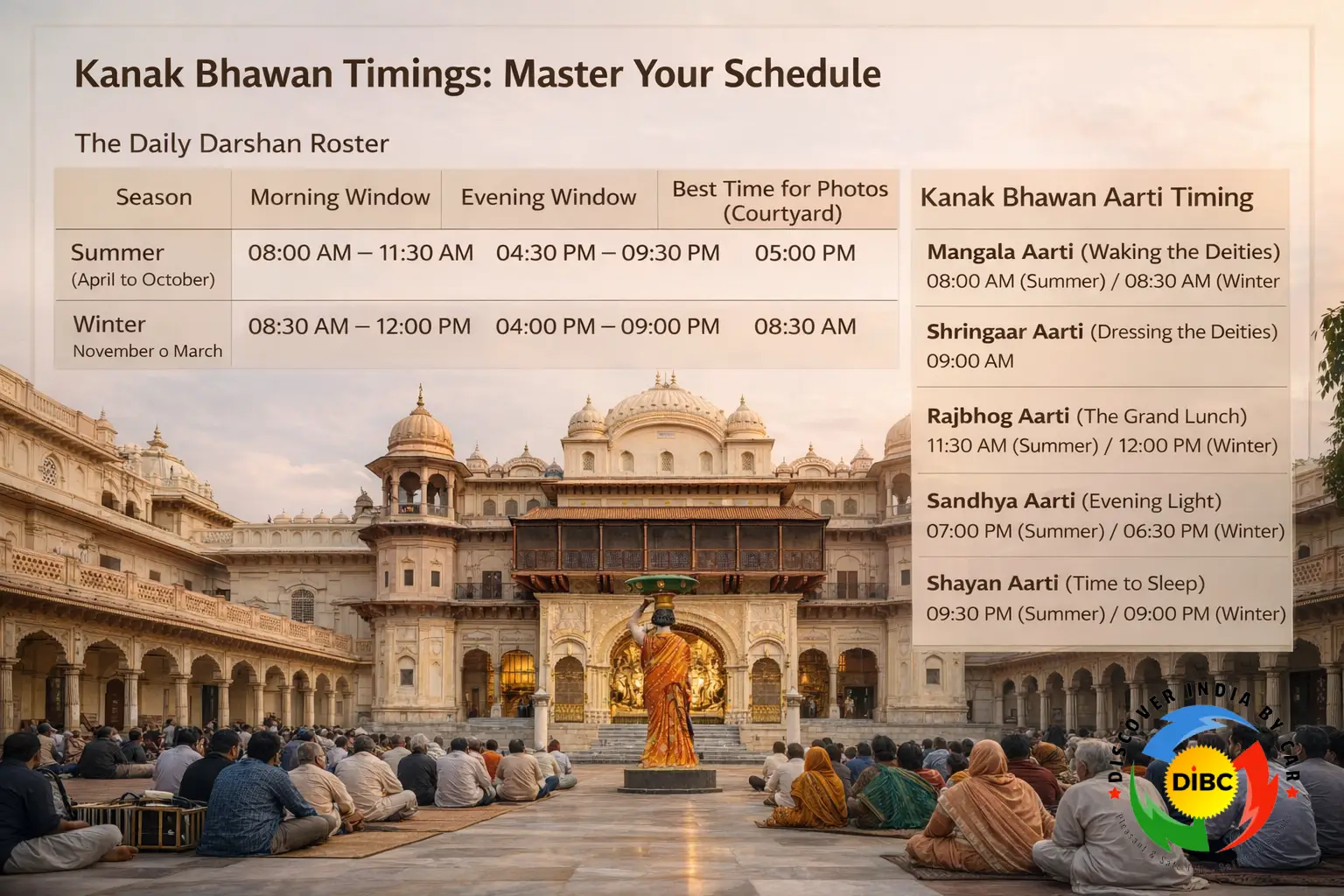
If you show up at 1:00 PM, the doors will be shut. You will be sitting outside in the heat. Plan your visit using the exact Kanak Bhawan darshan timing schedules below.
Season | Morning Window | Evening Window | Best Time for Photos (Courtyard) |
Summer (April to October) | 08:00 AM – 11:30 AM | 04:30 PM – 09:30 PM | 05:00 PM |
Winter (November to March) | 08:30 AM – 12:00 PM | 04:00 PM – 09:00 PM | 08:30 AM |
Do you want goosebumps? Attend an Aarti. This is the ritual offering of light. The brass bells ring loud enough to shake your chest. The priests wave massive flaming lamps. The entire crowd sings together.
Expert Pro-Tip: The Sandhya Aarti in the evening is the visual winner. The temple turns on these beautiful string lights. The sky gets dark. The gold inside the sanctum glows. It is heavily crowded, but 100% worth the slight claustrophobia. Get there 40 minutes early and claim a spot right near the main barricade.
Let’s talk about the Kanak Bhawan Ayodhya story.
If you know the Ramayana, you probably hate Queen Kaikeyi. She is the one who demanded Ram be exiled to the forest for 14 years so her own son, Bharat, could be king. She is the classic villain.
But this temple tells a completely different story.
Before the politics and the exile, Kaikeyi adored Ram. In fact, ancient texts say she loved Ram more than she loved Bharat. When Ram brought Sita home, Kaikeyi was the most excited. She wanted Sita to feel safe and pampered in a new city.
So, she gifted her this palace.
This building is proof of a mother-in-law’s intense love. It humanizes the epic. It shows that before the tragedy of the exile, the royal family of Ayodhya was deeply united and affectionate.
A bizarre trend online shows people searching for Kanak Bhawan in Vrindavan. Stop right there.
Vrindavan is Lord Krishna’s territory. Ayodhya is Lord Ram’s territory. There is no Kanak Bhawan in Vrindavan. If you book a cab to Mathura/Vrindavan looking for the golden palace of Mata Sita, you will be deeply disappointed. Keep your map fixed on Ayodhya, Uttar Pradesh.
You don’t need a degree in ancient architecture to see that Kanak Bhawan stands out. It does not look like the older, conical-roofed temples of North India.
It looks like a Rajput fortress.
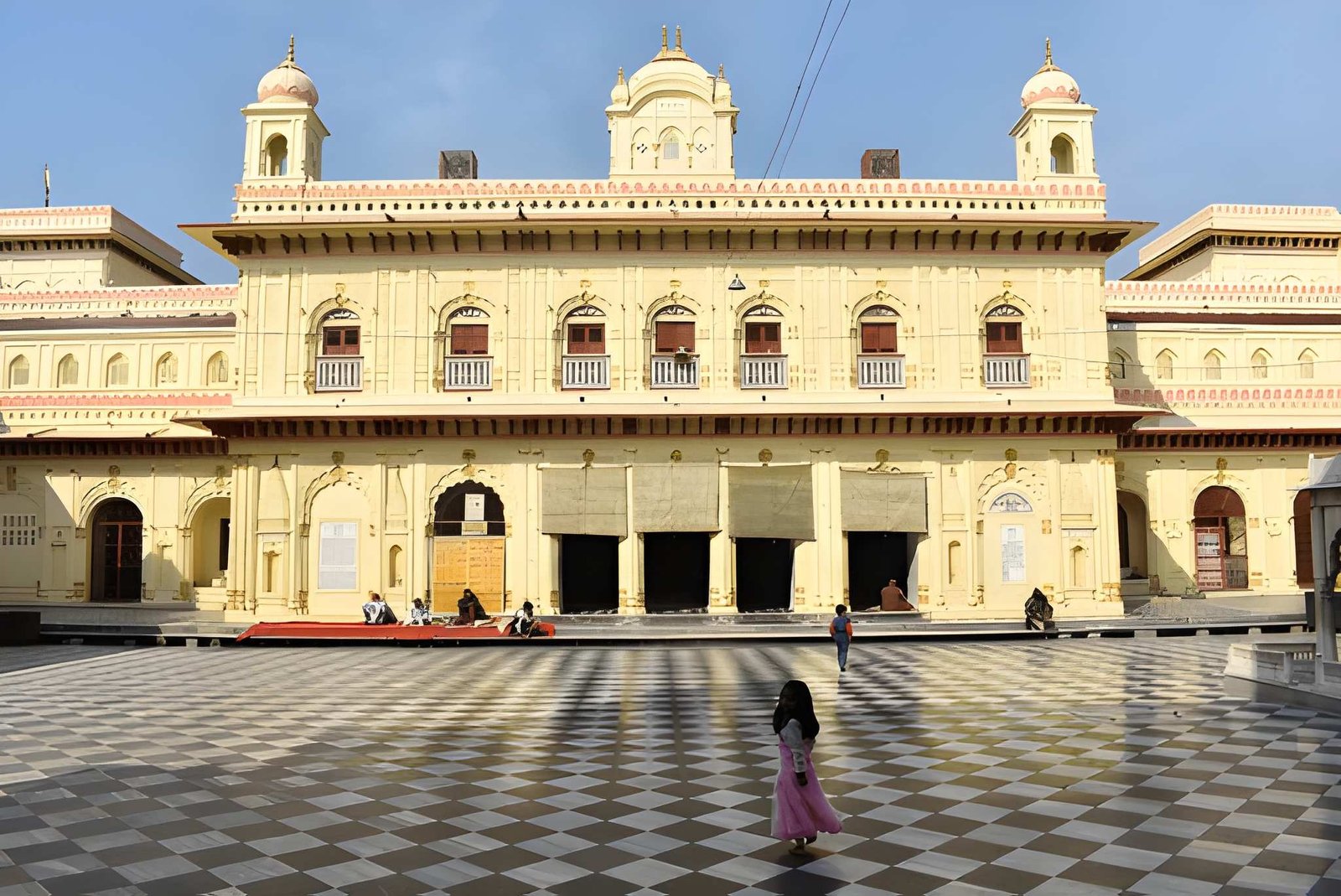
Because Queen Vrishbhanu Kunwari built the current iteration, she brought her local Bundela architectural style with her. You will see massive, sweeping archways. The courtyard is wide open, designed for huge gatherings. The outer walls are painted in vibrant hues, and the balconies look like something out of a Rajasthan heritage hotel.
When you finally get to the front of the line and look into the Garbhagriha, pay close attention. Don’t just glance and walk away. Look at the pedestals.
You will see three different pairs of Ram and Sita idols.
Seeing all three together is mind-blowing. You are looking at the Treta Yuga, the Dwapara Yuga, and the modern era all sitting on one silver throne.
Ayodhya weather does not play around.
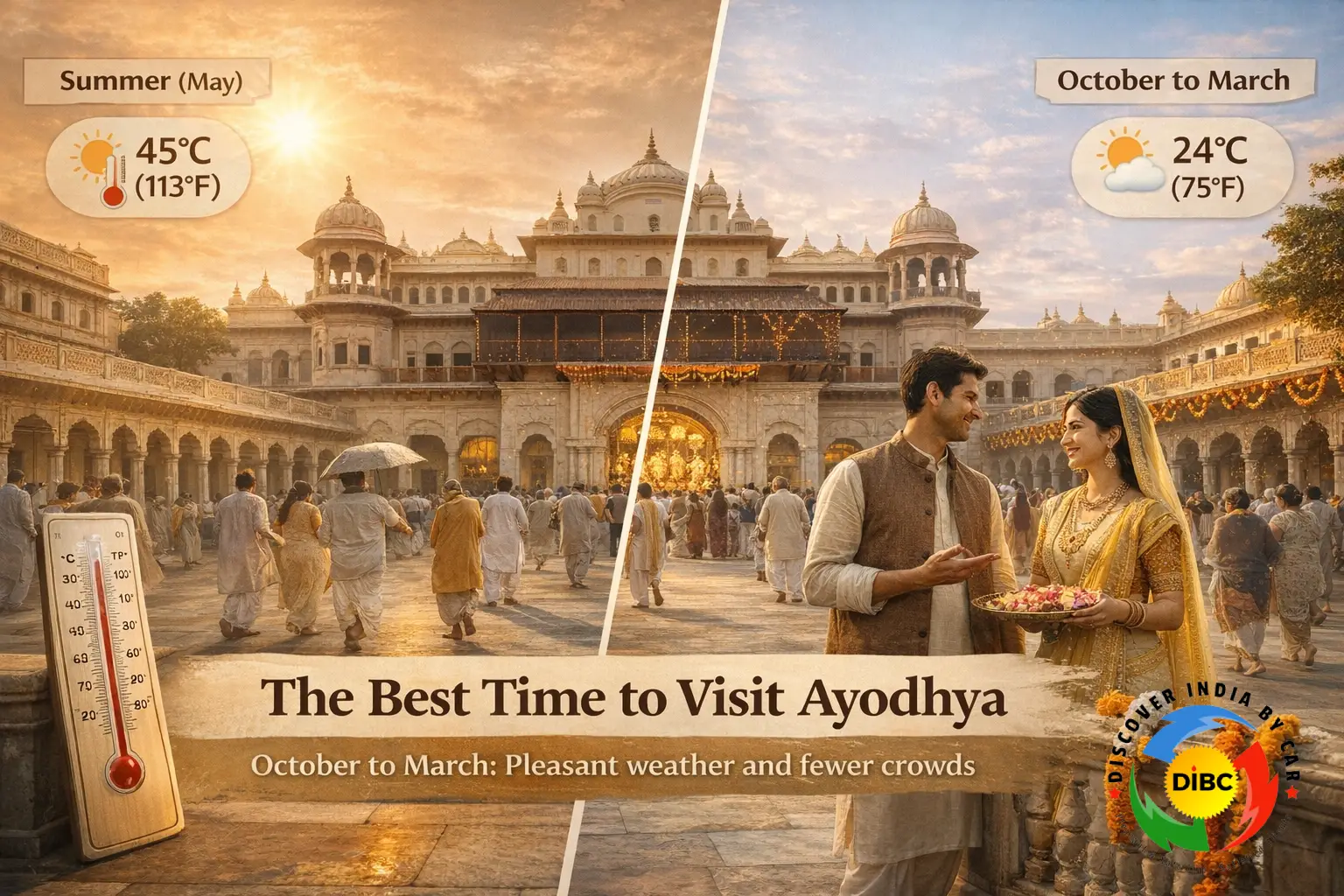
In May and June, the temperature hits 45°C (113°F). The stone floors of the temples will literally blister your bare feet. In January, dense fog rolls in, and the cold cuts right to your bones.
The Golden Window: Book your trip between October and March. The air is cool. The skies are clear. Walking from temple to temple is actually enjoyable.
If you want to see Kanak Bhawan operating at peak energy, come during a festival. Just know that the crowds will be insane.

If you are reading this, there is a good chance you are planning a road trip. Driving to Ayodhya is easily the best way to experience the region. The infrastructure has exploded in recent years. At Discover India By Car, we constantly get asked about the best driving routes. Here is the exact breakdown.
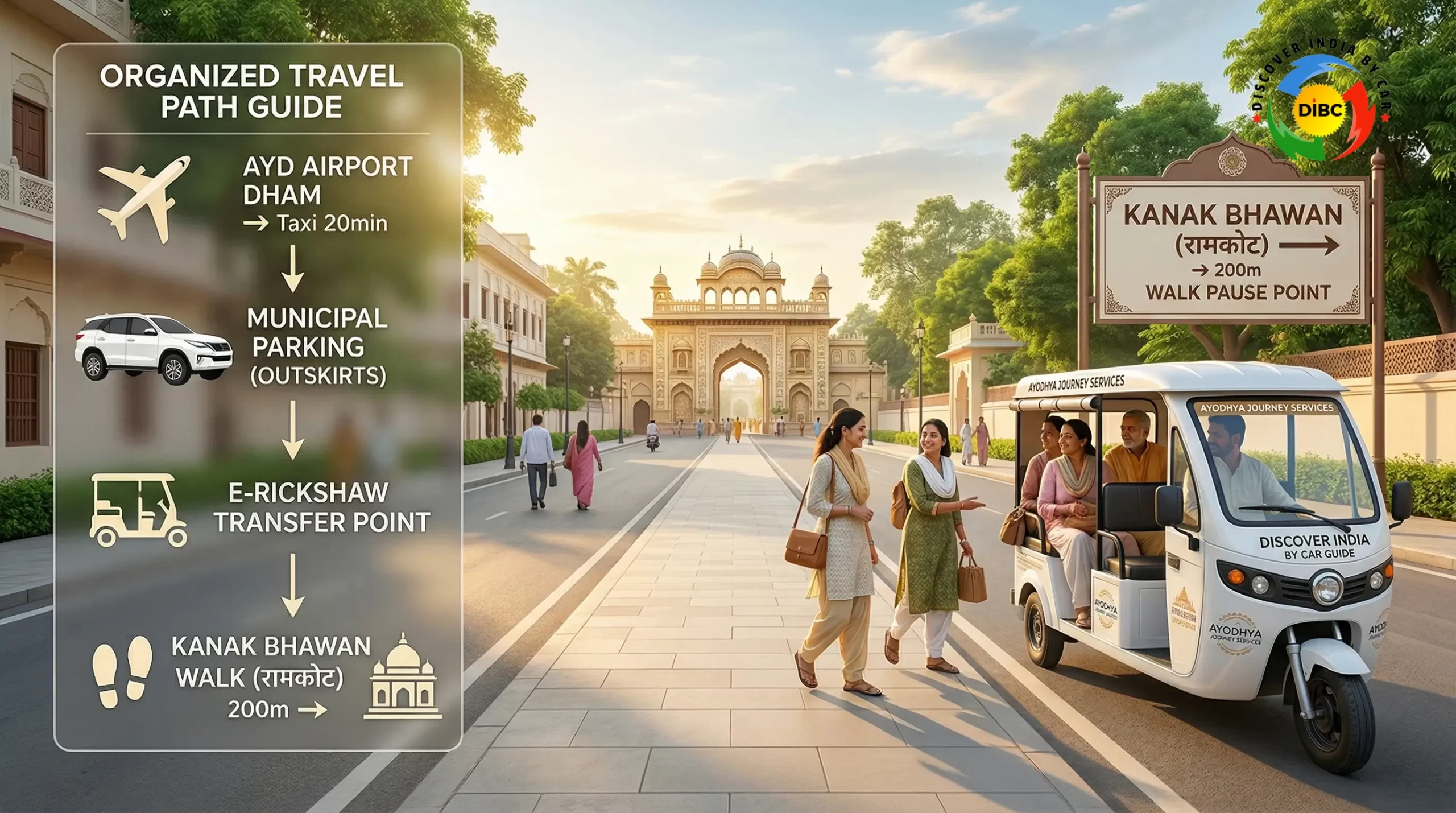
You cannot drive your SUV right up to the gates of Kanak Bhawan. The inner city (Ramkot) has narrow, heavily guarded streets.
What you need to do: Drive your car to the designated municipal parking lots near Ram Katha Park or the new multi-level parking facilities on the outskirts. Park there. Then, hire an electric rickshaw (e-rickshaw) to drop you near the Kanak Bhawan lane. You will walk the last 200 meters.
Don’t want to drive? The brand-new Maharishi Valmiki International Airport, Ayodhya Dham is fully operational. You can grab a direct flight from Delhi, Mumbai, or Bengaluru. From the airport, Kanak Bhawan is a 20-minute prepaid taxi ride.
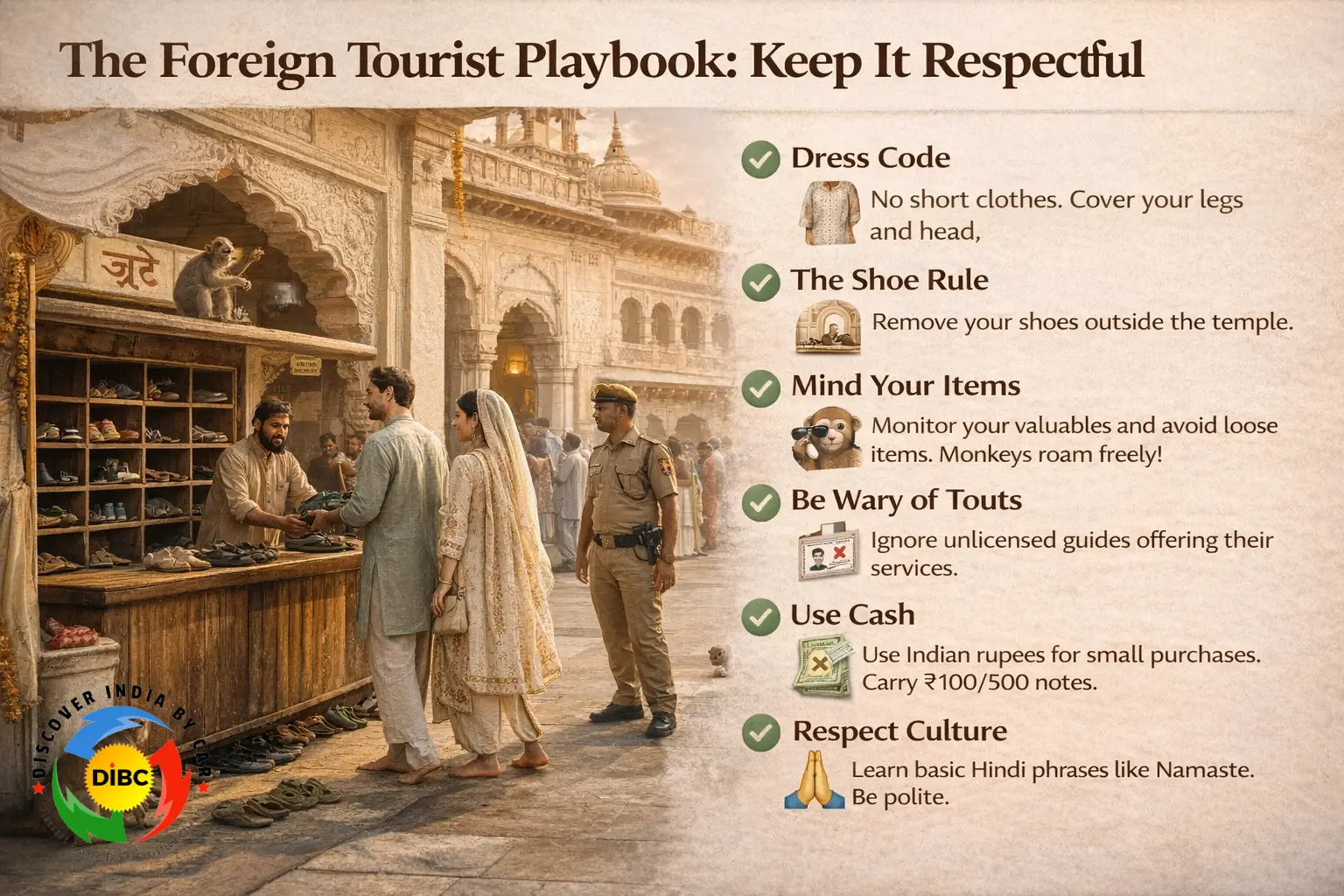
Ayodhya is seeing a massive influx of international tourists. If you are an NRI or a foreign traveler checking out the Kanak Bhawan temple history, you need to understand local ground rules. This isn’t a museum in Europe. It is an active, intensely sacred space.
Forget the shorts. Forget the sleeveless tops. If you wear them, the guards will stop you at the metal detectors. Men need to wear long pants. Women should wear long skirts, trousers, or traditional Indian suits (Kurtis). Carry a scarf to cover your head.
You must walk into the temple barefoot. There are official shoe-keeping stalls right outside the main gate. Alternatively, if you buy a basket of flowers or sweets (Prasad) from a shopkeeper outside, they will let you leave your shoes under their counter for free.
Monkeys are everywhere in Ayodhya. They are smart, and they are fast. Keep your sunglasses in your bag. Hold your phone tight. Do not carry loose food in your hands while walking down the alleys.
You will be approached by people offering to tell you the history of kanak mahal ayodhya for a fee. Politely decline unless they have an official government ID badge. Most of the time, the history is free to absorb just by looking around.
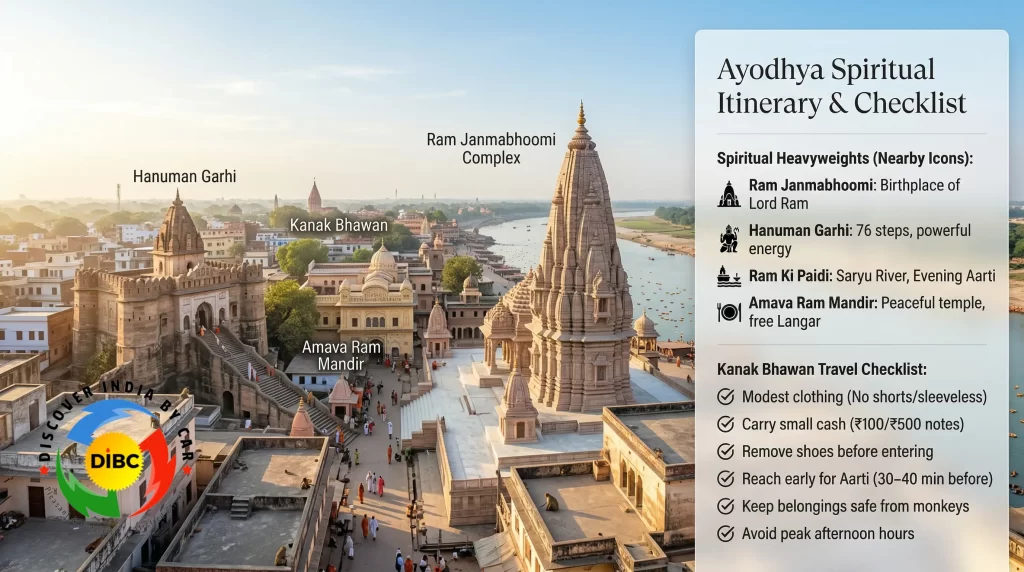
Kanak Bhawan is the emotional core of Ayodhya, but you need to round out your itinerary. All of these spots are within walking distance or a short e-rickshaw ride away.
The main event. This is the birthplace of Lord Ram. The new stone temple is an architectural marvel. Expect heavy security and long lines, but the sheer scale of the devotion here is something you have to see once in your life.
You cannot visit Ram without visiting Hanuman first. It is an unspoken rule in Ayodhya. This temple looks like a military fort. You have to climb 76 steep steps to get to the top. The energy here is loud, fast, and powerful.
This is where you end your day. As the sun goes down, walk to the sacred Saryu River Ghats. These historic ghats are not just for bathing; they form the spiritual boundary of Ayodhya. The daily evening Aarti here is spectacular. The river lights up with thousands of floating lamps.
Just down the lane from Kanak Bhawan. It is much quieter. They also run a massive free kitchen (Langar) that feeds thousands of pilgrims every single day. The food is simple, safe, and deeply satisfying.
Before you visit, make sure you:
You don’t just “tour” Kanak Bhawan. You experience it.
It strips away the massive scale of the Ramayana and boils the epic down to a very human level. A husband, a wife, and a house gifted out of pure motherly love. The gold isn’t just in the idols; it is in the atmosphere.
When you plan your Ayodhya itinerary, block out at least an hour for this specific courtyard. Wake up early, beat the heat, find a spot near the musicians, and just breathe. The Golden Palace has survived invasions, centuries of neglect, and the heavy weight of time. It stands waiting for you. Make the drive. It’s worth every mile.
Q1. Why is Kanak Bhawan so famous?
A: It is famous because it is officially recognized as the private palace of Lord Ram and Mata Sita in Hindu tradition. Queen Kaikeyi gifted it to Sita after her marriage. Today, it draws massive crowds due to its stunning Bundela architecture and the three pairs of gold-adorned idols sitting in the inner sanctum.
Q2. What is the Kanak Bhawan darshan timing today?
A: Right now, if you are visiting in the summer, the doors open from 08:00 AM to 11:30 AM, and again from 04:30 PM to 09:30 PM. In the winter months, it shifts to 08:30 AM to 12:00 PM in the morning, and 04:00 PM to 09:00 PM in the evening.
Q3. Is photography strictly banned inside Kanak Bhawan?
A: You cannot take photos of the idols inside the main sanctum (Garbhagriha). Period. The guards will confiscate your phone. However, you are totally free to snap photos of the grand courtyard, the arches, and the exterior building.
Q4. How much time should I allocate to visit Kanak Bhawan Ayodhya?
A: Plan for roughly 60 to 90 minutes. This gives you time to navigate the entrance, get a solid darshan of the deities without rushing, listen to the live kirtan (music) in the courtyard, and retrieve your shoes.
Q5. Do I need to buy a ticket to enter the temple?
A: No. Entry to Kanak Bhawan is 100% free for everyone, including foreign tourists. The only money you will spend is if you decide to buy Prasad (offerings) from the shops outside or leave a voluntary donation inside the temple boxes.