- Private car and driver in Delhi / India
- +91-8447445445
- info@discoverindiabycar.com sugar.ankit@yahoo.com
 +91-9818434712
- Follow us:



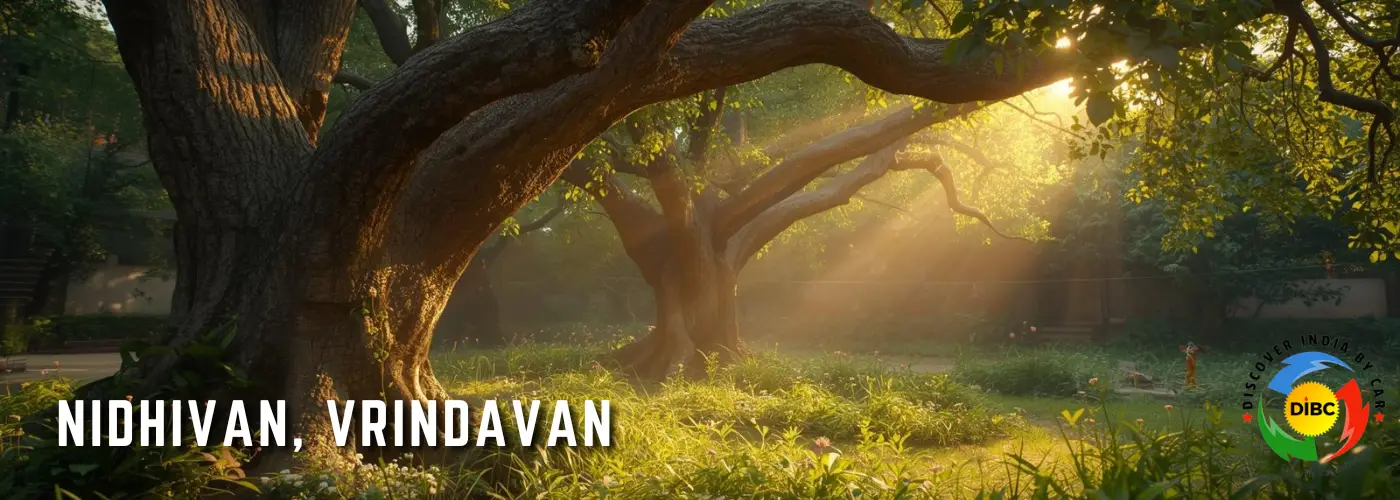
Nidhivan, Vrindavan: Night Mystery, Timings & True Story
The Nidhivan Mystery: Facts, Timings, and the Untold Story of Lord Krishna
Nidhivan is a deeply sacred forest in Vrindavan where devotees fiercely believe Lord Krishna and Radha perform the Maha Raas dance every single night. The strict rule of Nidhivan is that absolutely no human, animal, or bird can remain inside after sunset, or they face terrifying consequences.
What is Nidhivan? A Forest Defying Logic
The sun sets. The heavy iron gates slam shut. Monkeys scatter in panic. And then, the silence takes over. Welcome to Nidhivan. It is not just a tourist spot. It is an enigma that completely baffles scientists, historians, and skeptics alike. Nestled in the heart of Vrindavan within the Mathura district, this dense, green patch of land looks completely different from any standard forest you will ever see.
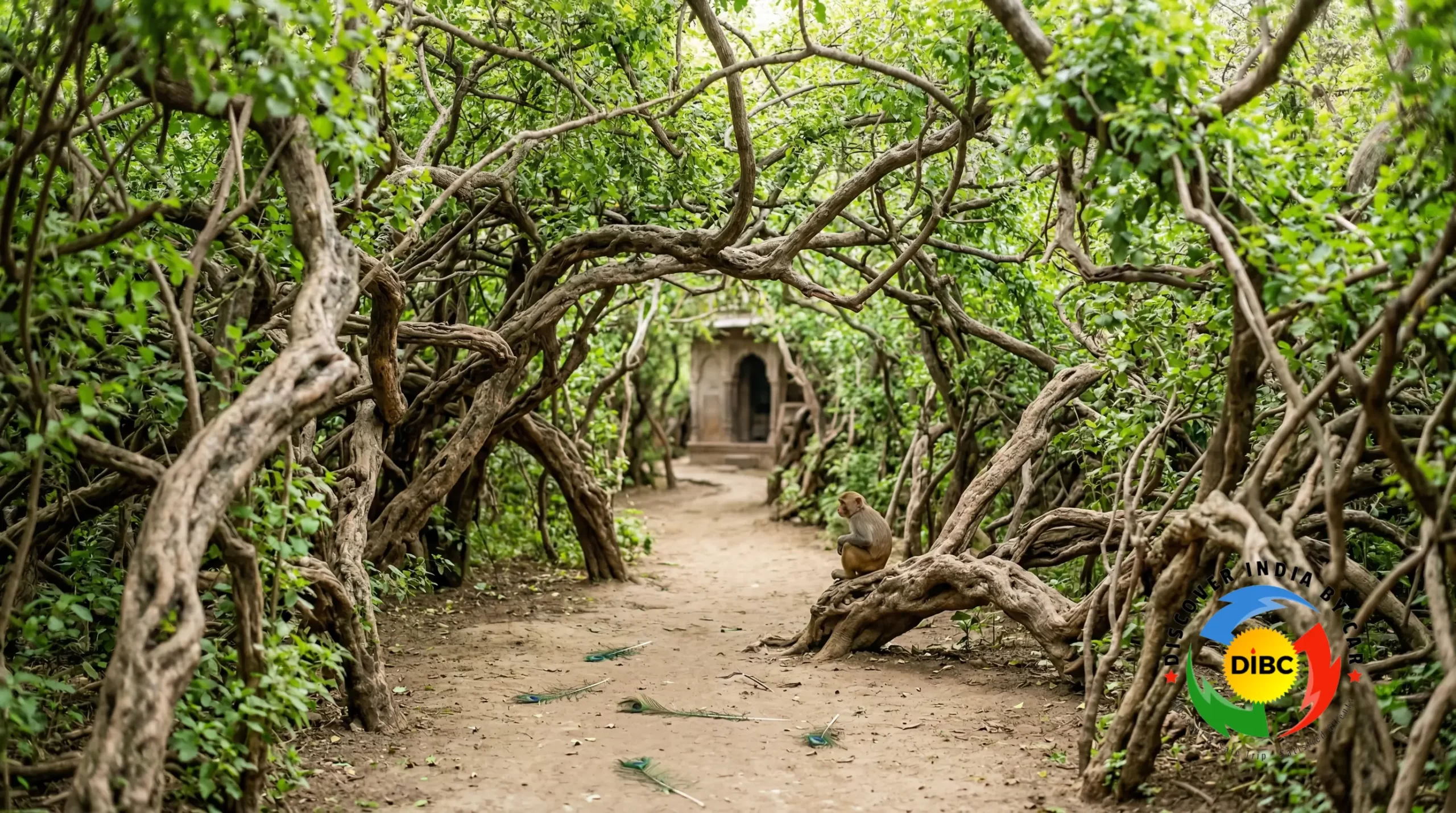
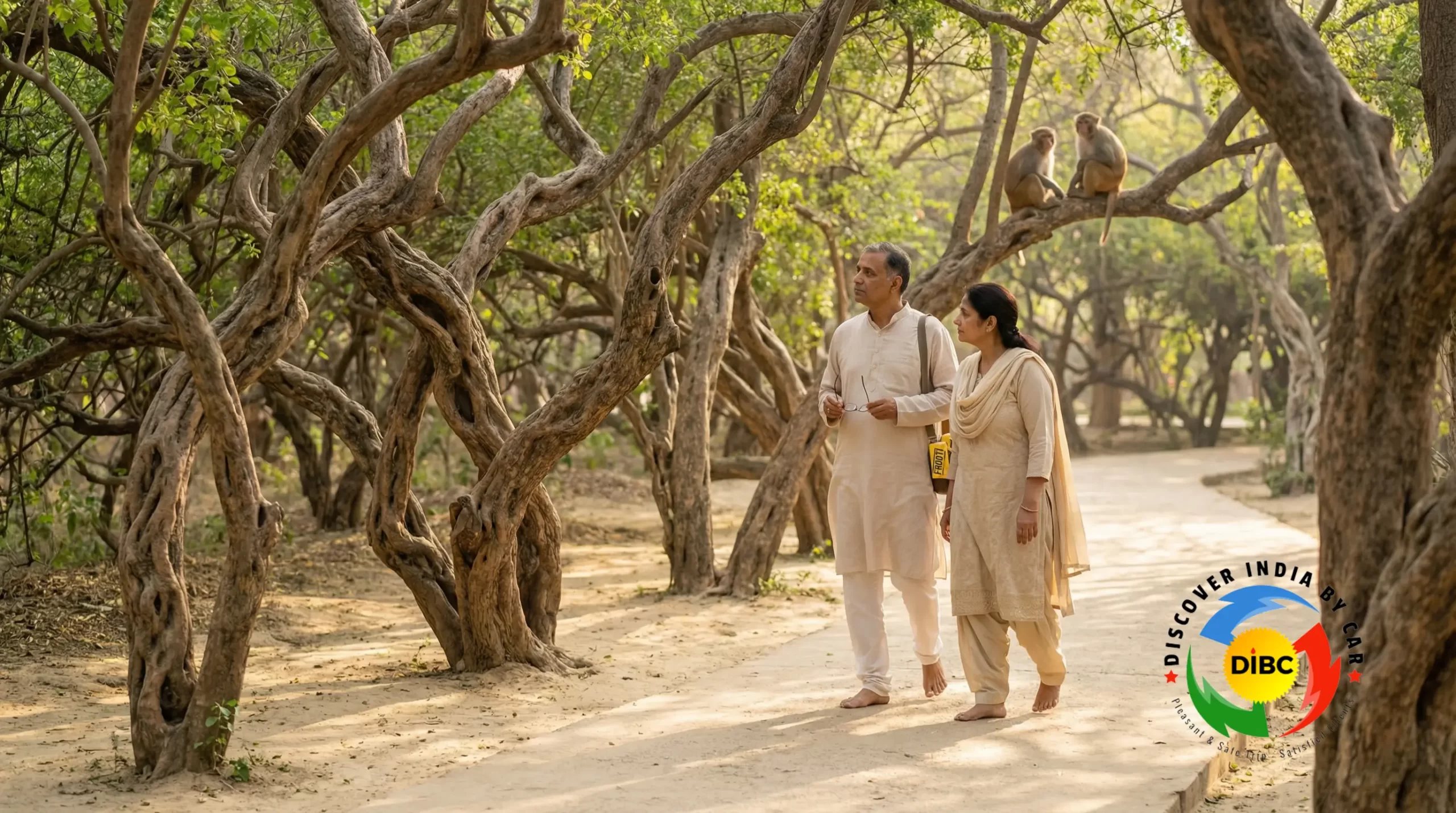
Every single tree here bends earthward. You will not find branches reaching up to the sky. Instead, the trunks twist, knot, and tangle into each other, creating a thick canopy that blocks out the blinding sun. The locals do not see ordinary wood and leaves. They see frozen devotion. According to ancient scripture, Nidhivan translates directly to the “Forest of Treasures.” But the treasure here is not gold. The treasure is divine energy.
When you walk into this forest during the daytime, a sudden wave of calm hits you. The air feels heavy. The pathways are narrow, winding through the twisted Tulsi (basil) trees. For travelers planning a spiritual road trip with Discover India By Car, entering Nidhivan feels like stepping out of modern India and walking straight into a lost chapter of ancient mythology.
But daylight is one thing. What happens when the daylight fades is what brings thousands of spiritual travelers and thrill-seekers to these gates every year.
The Mystery of Nidhivan at Night.
If you ask the locals what happens in Nidhivan at night, their faces will turn serious. They drop their voices. They will tell you that the divine Maha Raas begins.
Inside the thicket of twisted trees sits a small, unassuming temple known as the Rang Mahal. This is the exact epicenter of the Nidhivan mystery. Every single evening, right before the sun dips below the horizon, the head priests perform a very specific, meticulous ritual. They prepare a bed for Lord Krishna and Radha.
They do not just fluff the pillows. The preparation is intensely detailed. The priests lay out a fresh, beautifully adorned bed. Beside it, they place a silver glass filled to the brim with water. They leave behind a freshly made paan (betel leaf). They place two neem twigs, known as datun, which are traditionally used for brushing teeth. Sweets, a fresh saree, and bright glass bangles are laid out perfectly.
Then, the priests walk out. They lock the heavy doors of the Rang Mahal from the outside. The temple guards clear the entire forest. They double-check every corner. They lock the main gates of Nidhivan.
The chilling reality? The next morning, when the priests unlock those exact same doors, the scene inside the Rang Mahal is entirely different.
The bedsheets are visibly crushed, clearly showing the indentation of someone having slept there. The water in the silver glass is half-empty. The paan has been chewed. The neem twigs look used. The sweets are half-eaten.
Every. Single. Day.
Is this the Nidhivan true story Krishna devotees swear by? Yes. The priests have witnessed this morning aftermath for decades. Nobody has access to the locked room. There are no secret tunnels. There are no hidden doors. The items are consumed. The bed is slept in. The mystery remains entirely unsolved.
Expert Pro-Tip: Pay close attention to the local wildlife when visiting in the late afternoon. You will literally watch the monkeys, peacocks, and birds start vacating the trees as 5:00 PM approaches. They do not need to be shooed away. Their natural instincts tell them to leave.
Why No One Stays in Nidhivan at Night
You might be wondering: can tourists stay in Nidhivan? The answer is a hard, unyielding no. You cannot hide. You cannot camp. You cannot bribe a guard to let you stay inside.
Why is Nidhivan closed at night with such extreme prejudice? Even today, no one dares to stay inside Nidhivan after sunset. The legends are brutal and terrifying. The locals believe that any mortal who witnesses the divine Maha Raas will instantly lose their mind, their sight, or their life. The human brain and physical body simply cannot handle the raw, blinding energy of the Gods.
The stories surrounding this are not just ancient myths. People in Vrindavan talk about recent, chilling incidents.
There is a famous account of an overly ambitious photographer. He wanted to debunk the is nidhivan real story debate once and for all. He allegedly bribed his way in, or hid deep within the twisted Tulsi roots, armed with his camera gear. The next morning, the temple guards found him near the gates. He was completely unconscious. His camera was entirely shattered. When he woke up, he had lost his ability to speak and his sanity was permanently fractured. He spent the rest of his life staring blankly at walls.
Another widely shared local tale involves a young, curious skeptic who hid inside the bushes. When the morning light broke, he was found entirely blind, babbling incoherently about a blinding light and the sound of silver anklets.
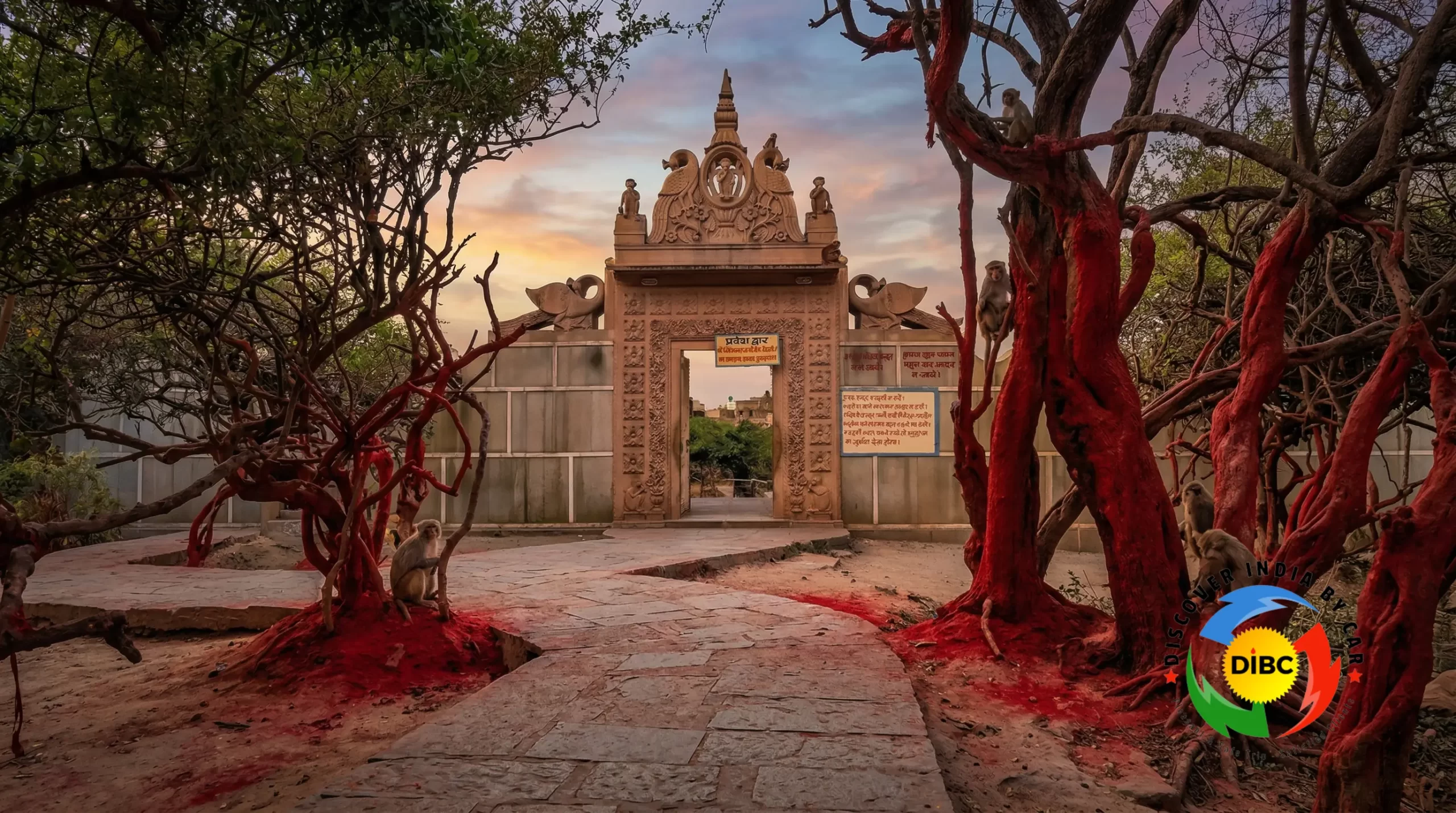
Because of these terrifying accounts, the fear is absolute. Even the houses sharing a boundary wall with Nidhivan respect the sheer terror of the night. If you walk around the perimeter, you will notice something highly unusual. Most of the windows facing the forest are entirely bricked up. The ones that are not bricked up are tightly shut and bolted before dusk. No local dares to look out their window after dark. They hear the flute. They hear the chiming of anklets. They pull their blankets tighter and shut their eyes.
Nidhivan Timings (Summer & Winter)
Timing your visit is everything. The guards operate with military precision. They do not care who you are; when the closing bell rings, you must exit. The Nidhivan darshan timing shifts slightly depending on the harsh North Indian seasons.
Below is the exact, official schedule you need to follow for your visit.
Season | Morning Darshan Timings | Evening Darshan Timings |
Summer (April to Sept) | 05:00 AM – 12:00 PM | 04:00 PM – 08:00 PM |
Winter (Oct to March) | 06:00 AM – 12:00 PM | 03:30 PM – 07:00 PM |
Note: The temple doors are strictly closed during the afternoon for the deity’s resting period. The evening Shayan Aarti happens just before the final door closing, marking the official end of human presence in the forest.
When you plan your road trip through Discover India By Car, map your arrival to match the morning opening. The energy is the most potent at dawn, right after the priests unlock the Rang Mahal.
Story of Lord Krishna & Radha in Nidhivan
To truly grasp the magnitude of this place, you have to understand the Nidhivan story Krishna devotees hold so close to their hearts.
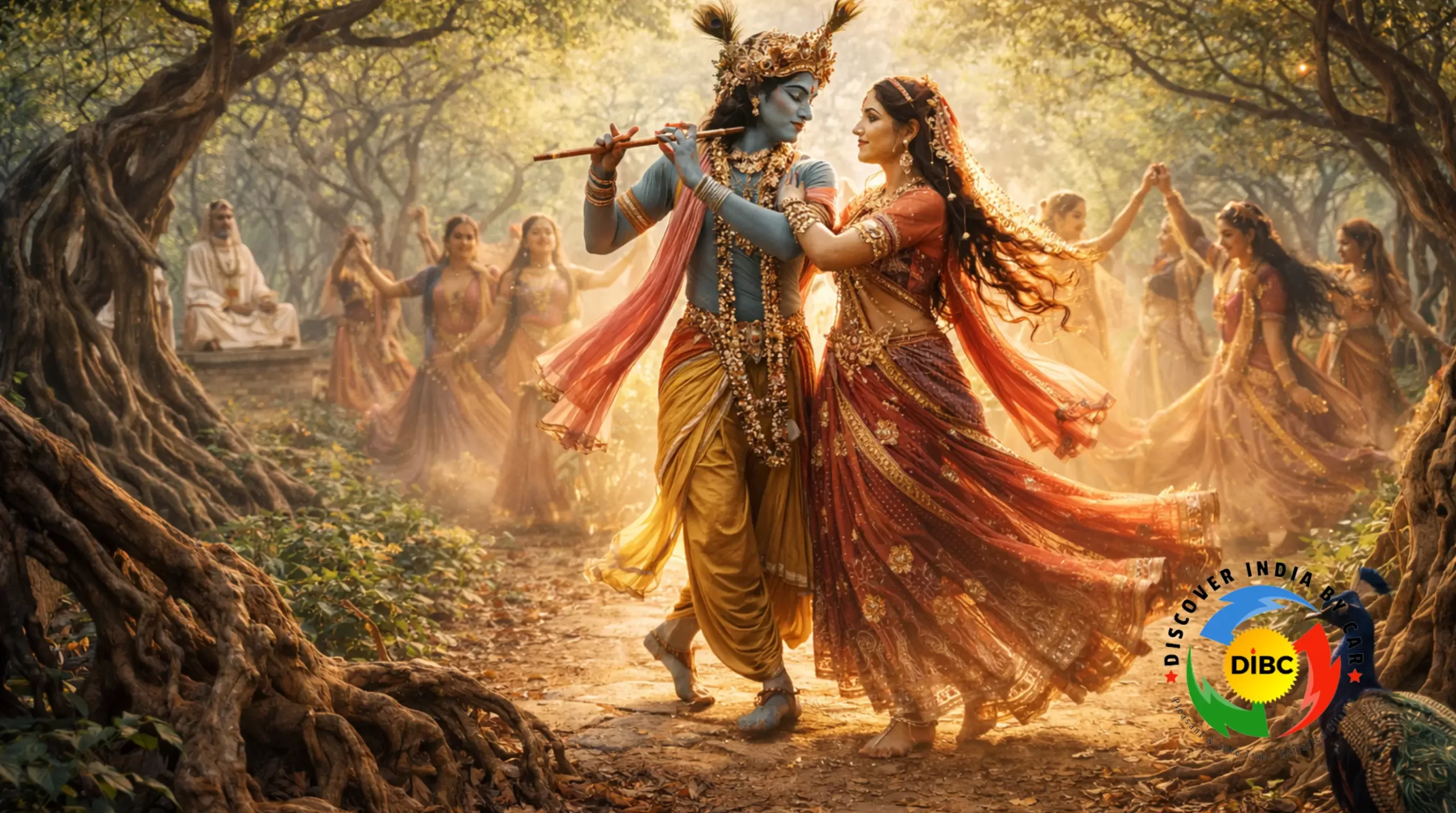
Thousands of years ago, Vrindavan was a sprawling, pristine forest. Lord Krishna, in his youth, would play his mesmerizing flute. The sound was so intoxicating that the Gopis (milkmaids) would drop everything—their chores, their families, their sleep—and run into the forest to dance with him. This divine, ecstatic dance is the Maha Raas.
In Nidhivan, the belief is that the Maha Raas never stopped. It continues every single night.
But what about the incredibly strange, twisted trees?
According to scripture, the thousands of intertwined Tulsi trees are not plants at all. They are the Gopis. Every evening, as the sun goes down, these twisted wooden trunks magically transform back into the beautiful Gopis. They dance with Krishna and Radha until the early hours of the morning. As dawn approaches and the first ray of sunlight hits the soil, they instantly freeze back into the shape of twisted trees.
This is exactly why the branches bend downwards. They are bowing in eternal reverence to the Lord.
Nidhivan also holds immense historical weight thanks to Swami Haridas. He was a 15th-century saint and a phenomenal classical musician. Legend states that Swami Haridas sat right here, deep within Nidhivan, and sang with such pure, unadulterated devotion that Lord Krishna and Radha physically appeared before him. The deities merged into a single black stone idol. That exact idol is the famous Banke Bihari, which was later moved to the iconic Banke Bihari Temple just a few streets away.
Expert Pro-Tip: Do not miss the small Samadhi (shrine) of Swami Haridas located right inside the Nidhivan premises. Sitting near it for just five minutes offers a profound sense of inner silence.
Scientific vs Spiritual Explanation
In the age of smartphones and AI, the Nidhivan mystery explained videos rack up millions of views on YouTube. Everyone wants to know the logical truth. This shocking mystery still has no scientific explanation. How can a bed look slept in? How can water disappear?
Rationalists and skeptics bring forward several arguments. Let us look at the scientific angle first.
Skeptics argue that the “used” items in the morning are simply a psychological trick, or perhaps a deeply guarded tradition maintained by the head priests to keep the faith alive. They suggest the water evaporates in the heavy brass and silver vessels. They claim the monkeys, who might sneak back in, eat the sweets.
As for the trees? Botanists point out that the unique twisting of the branches is simply a specific species trait of the Tulsi plant when grown in highly dense, resource-competitive environments. They bend downwards seeking moisture in the humid Vraj soil.
Geopathic stress experts have visited the area and noted unusual magnetic anomalies in the ground, which might explain why birds and monkeys feel physically uncomfortable and leave the area before sunset. Animals are highly sensitive to electromagnetic shifts.
But the spiritual counter-argument crushes these theories for the believers.
If the priests fake it, why has not a single whistleblower exposed them in over five hundred years? If monkeys eat the sweets, how do they perfectly chew the paan and leave the rest of the room entirely undisturbed? If the trees are just a botanical anomaly, why does this specific twisting not happen in any other dense forest in the Mathura district?
The locals smile at the scientific theories. They point to the bricked-up windows. They ask a simple question: “If it is all fake, why do the monkeys run for their lives every evening?”
The clash between science and faith here is what makes Nidhivan one of the most fascinating locations on the planet.
Rules for Visitors
If you are planning to visit, you must respect the local customs. Is Nidhivan safe to visit? Absolutely. During the day, it is perfectly safe and highly managed. But there are strict rules you must follow.
The Monkey Menace:
This is not a myth. The monkeys in Nidhivan are infamous. They are highly intelligent, aggressive, and fast. They will snatch your eyeglasses, sunglasses, mobile phones, and anything shiny right off your body. Keep your phones strictly inside your pockets. Take off your glasses before entering the main gate. If a monkey takes your belongings, the local trick is to throw a packet of fruit juice (Frooti) at them. They drop the item to grab the juice. For international tourists traveling with Discover India By Car, our guides ensure you navigate the crowds and monkey menace safely.
Dress Code:
Dress modestly. This is a highly sacred site. Shoulders and knees should be covered. Traditional Indian wear is heavily preferred, though standard modest casual wear is perfectly fine.
Walking Barefoot:
While you can wear shoes up to the gate, you must remove your footwear outside before walking through the sacred grove. The paths are generally kept clean, but watch your step.
Do Not Touch the Trees:
The trees are considered living entities (the Gopis). Plucking leaves, breaking branches, or carving your name into the trunks is considered a massive sin and is strictly prohibited by the temple guards.
Photography Restrictions:
You can take photos of the pathways and the trees, but photography inside the main shrines and the Rang Mahal is heavily restricted. Put your camera away when asked.
Best Time to Visit Nidhivan
Vrindavan experiences extreme weather. Summers are brutally hot, and winters are piercingly cold.
The absolute best time to visit Nidhivan is between October and March. The weather is cool, making the barefoot walk pleasant.
However, if you want to see the energy of Vrindavan at its absolute peak, align your visit with major Hindu festivals.
- Holi (March): Pure chaos. The good kind. Dry colors completely swallow the town. Inside Nidhivan, the singing echoes off the walls. Expect heavy, shoulder-to-shoulder crowds pushing toward the Rang Mahal.
- Krishna Janmashtami (August/September): His birthday. The locals do not hold back. Fresh flowers cover the shrines. You will literally feel the devotion radiating from the thousands of people chanting outside the main gates.
- Sharad Purnima (Autumn): The absolute peak. The holiest night. The old texts insist the most spectacular Maha Raas happens on this exact full moon. The waiting lines stretch deep into the streets. Arrive early.
Expert Pro-Tip: Visit Nidhivan early in the morning, around 7:00 AM. The crowds are thin, the air is cool, and you can actually hear the birds chirping before the heavy tourist rush begins around 10:00 AM.
How to Reach Nidhivan (Delhi / Mathura / Vrindavan)
Getting to Nidhivan is an adventure of its own. For the Discover India By Car community, this is a spectacular weekend road trip.
From Delhi:
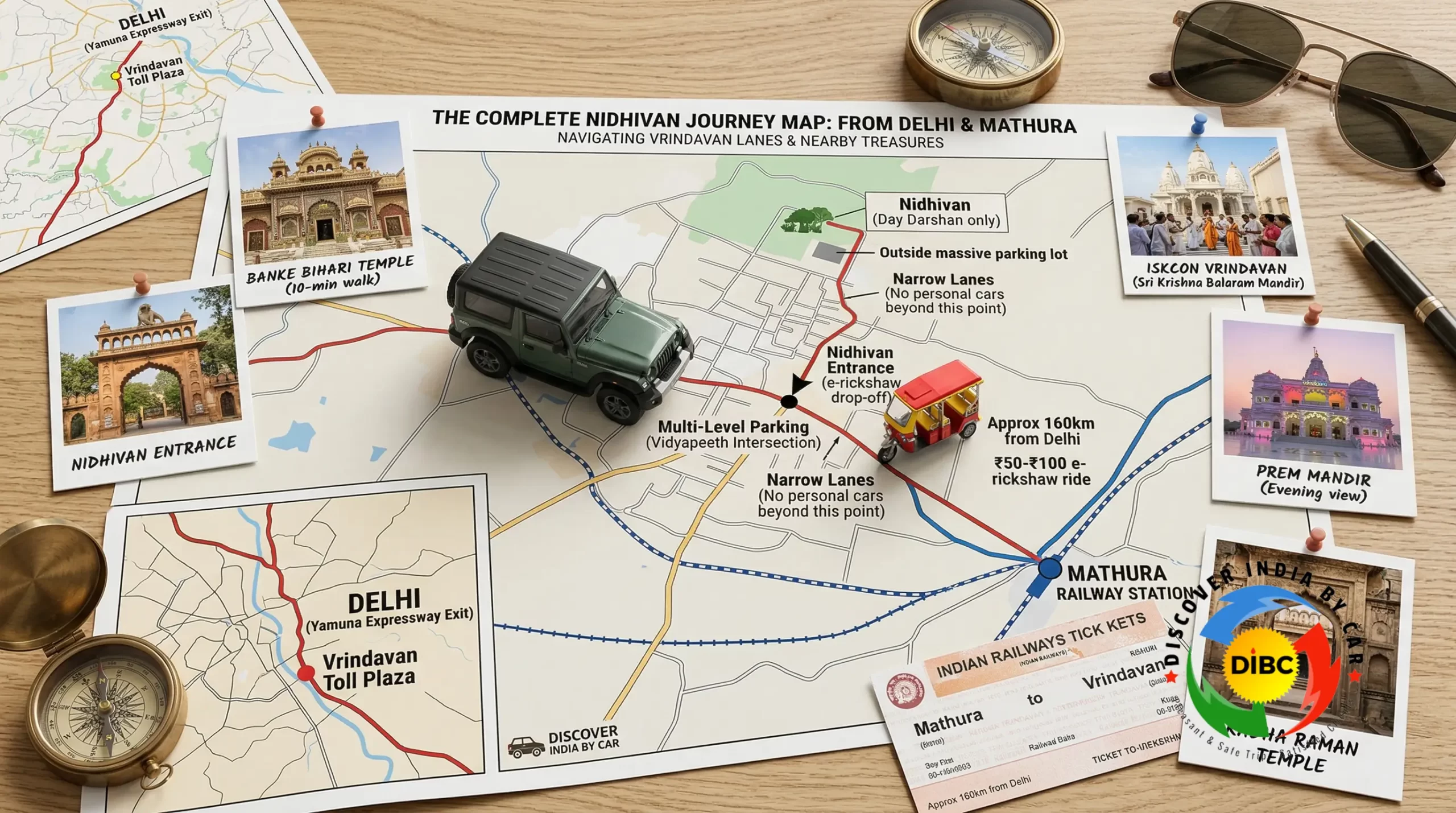
Vrindavan is approximately 160 kilometers from New Delhi. The fastest, smoothest way to drive is via the Yamuna Expressway. The road is incredibly well-maintained. You will exit at the Vrindavan toll plaza. The drive takes roughly 2.5 hours.
From Mathura:
If you are taking a train, Mathura Junction is the nearest major railway station. From Mathura, Nidhivan is about 12 to 14 kilometers away. It takes about 30 to 40 minutes depending on the city traffic.
Navigating the Vrindavan Lanes:
Here is the strict reality of driving in Vrindavan: Do not try to drive your personal car directly to Nidhivan. The streets are incredibly narrow, packed with pilgrims, cows, and street vendors. Your car will get stuck.
Park your vehicle at one of the designated massive parking lots on the outskirts of Vrindavan (like the Multi-Level Parking near the Vidyapeeth intersection). From there, hire an e-rickshaw. Tell the driver you want to go to Nidhivan. They will drop you exactly at the entrance for about ₹50 to ₹100.
Nearby Places to Visit
Your trip does not end at Nidhivan. Vrindavan is packed with architectural marvels and spiritual hubs. Once you finish your morning Darshan, check out these spots located very close by:
- Banke Bihari Temple: Just a 10-minute walk from Nidhivan. This is the most famous temple in Vrindavan. The deity here is the exact one discovered by Swami Haridas in Nidhivan.
- ISKCON Vrindavan (Sri Krishna Balaram Mandir): Stunning white marble architecture. Famous for its non-stop, mesmerizing Kirtan (chanting).
- Prem Mandir: A relatively new but absolutely breathtaking temple complex. Visit this in the late evening. The entire white marble structure lights up in glowing, shifting colors.
- Radha Raman Temple: One of the original, oldest temples in Vrindavan holding a self-manifested deity of Lord Krishna.
The Eternal Magic of Vrindavan
You can read all the theories. You can analyze the scientific data. You can debate the logic behind the disappearing water and the twisted trees. But when you physically stand inside Nidhivan, the arguments fade away.
There is a distinct, heavy energy in that forest. It forces you to stop thinking and just feel. Whether you are a hardcore believer crying at the gates, or a skeptical traveler trying to spot a hidden camera, Nidhivan leaves a permanent mark on your psyche, and the truth of Nidhivan will give you goosebumps.
The bricked-up windows look down at you. The monkeys watch you closely before making their evening escape. The guards hold the heavy iron locks, waiting for the sun to drop.
Some places on Earth refuse to be explained. They demand to be experienced. Nidhivan is exactly that kind of place. Pack your bags, fuel up your car, and drive down the expressway. The mystery is waiting for you.
Nidhivan FAQs
Q1. What happens in Nidhivan at night?
A: Locals and devotees believe Lord Krishna and Radha perform the divine Maha Raas dance every night. Temple priests prepare a bed, water, and food inside the Rang Mahal. By morning, the bed appears slept in, and the items are partially consumed. No human or animal stays inside after dark to witness it.
Q2. Is the Nidhivan story real?
A: For millions of devotees, the story is absolute reality. While scientists and skeptics attribute the morning anomalies to natural occurrences, mass psychology, or tradition maintenance by priests, the unbroken centuries-old faith and the physical behavior of local wildlife fleeing the area keep the mystery alive.
Q3. Why is Nidhivan closed at night?
A: Fear drives the lockdown. Period. The locals genuinely believe that seeing the Maha Raas will physically destroy a human. We are talking instant blindness. Loss of speech. Total psychological breakdown. The guards slam those heavy gates shut to protect the sacred ritual—but mostly, they do it to protect you.
Q4. Can tourists stay inside Nidhivan at night?
A: Absolutely not. Don’t even try it. The temple guards and local police sweep every single inch of the thicket right before the final Aarti. You will not find a hidden camping spot. Sneaking in isn’t just a massive legal offense. The entire town considers it an unforgivable insult.
Q5. Are phones allowed inside Nidhivan?
A: You can carry your phone inside, but you must be extremely cautious. The local monkeys are notorious for snatching smartphones straight out of people’s hands. It is highly advised to keep your phone deep in your pocket and avoid taking selfies openly in the pathways. Photography inside the main shrines is prohibited.
Q6. What is special about Nidhivan trees?
A: You won’t see tall, straight trunks here. Every single tree in Nidhivan twists and bends straight toward the dirt. They are hollow on the inside, yet their leaves stay bright green all year round. It completely defies basic botany. The locals don’t see wood and bark. They see the legendary Gopis, frozen in time, bowing to the ground in pure devotion.
Q7. Is photography allowed in Nidhivan?
A: Yes and no. You can snap pictures of the twisted trees and the walking paths. But the second you step near the Rang Mahal or the inner shrines? Put the phone away immediately. The guards are incredibly strict about this. Plus, keeping a shiny phone out in the open is basically handing an invitation to the local monkeys to steal it.
Q8. Why do monkeys leave Nidhivan at night?
A: This is easily the spookiest part of the whole Nidhivan mystery. Nobody actually chases them out. As dusk approaches, the monkeys, peacocks, and even stray dogs simply vanish. Locals firmly believe animals possess a heightened sixth sense. They feel the heavy divine energy shifting and instinctively know they need to clear the stage for the Maha Raas.
Q9. Can we visit Nidhivan alone?
A: Totally. During the daytime, the forest is packed with pilgrims and tourists. Walking the narrow dirt paths by yourself is a fantastic way to soak in the heavy, peaceful energy. Just stick to the official daytime hours. However, grabbing a local guide at the entrance does add a ton of rich, historical flavor to the things you are looking at.
Q10. Is Nidhivan safe for tourists?
A: 100% safe. Thousands of people walk through those gates every single day without a hitch. Your biggest threat isn’t supernatural—it’s the monkeys. They will absolutely snatch your glasses, snacks, or phone if you aren’t paying attention. Keep your belongings zipped up tight, respect the temple rules, and you will have a perfectly safe trip.
About the Author
This article is written by a travel and SEO expert who has researched and explored spiritual destinations across India. The insights shared are based on real travel experiences and deep cultural research.