- Private car and driver in Delhi / India
- +91-8447445445
- info@discoverindiabycar.com sugar.ankit@yahoo.com
 +91-9818434712
- Follow us:




Night Driving Tips for Indian Highways Avoid These Mistakes
Unmasking the Real Risk of Night Driving in India
Having spent over 15 years and hundreds of thousands of kilometres navigating India’s diverse and often unpredictable roads, I can tell you the truth: the journey is very different after sunset. If you’re here, you need reliable night driving tips in India—the kind that moves beyond theory and offers proven survival strategies. This is the expert guide I wish someone had handed me when I first started driving at night in India.
Why Night Driving on Indian Highways Is Risky
The risk factor climbs exponentially as the sun sets. The official accident statistics across the country repeatedly paint a grim picture: a disproportionate number of fatal incidents, especially heavy vehicle collisions, occur during the low-traffic hours of midnight to 6 AM. Why? Because the darkness amplifies everything—fatigue, confusion, and the inherent hazards of our highway system.
What This Guide Covers: Expert Safety Secrets
This guide is your deep dive. We will move through pre-drive preparedness (your must-have night driving safety checklist India) to advanced defensive driving at night techniques, covering visibility issues and tackling those all-too-common errors—specifically the typical night driving mistakes in India.
Who Should Read: Embracing Safe Night Driving in India
- Beginners: We focus on practical, actionable night driving tips for beginners in India.
- Families: Essential reading for planning a secure, stress-free long-distance night drive.
- Long-Distance Drivers: If the Indian highway safety tips below are not second nature, your risk profile is too high. Let’s change that now.
Why Driving at Night in India Requires a Strategic Approach: An Expert Breakdown
As an expert who has logged years behind the wheel across all states, I see the darkness as an accelerator for every challenge the highway presents. When we talk about how to drive safely at night in India, the key is to address this combination of factors.
Risk Factor: My 15-Year Expert Experience Says This Is the Problem
Poor Road Lighting: Outside of metros, the high-speed carriageway quickly becomes a pitch-black zone. This extremely low visibility driving means your eyes and headlights are your only tools.
Fatigue Factor: This is the absolute silent killer. Fighting the body’s natural urge to sleep (circadian rhythm) cripples reaction time. A long-distance night drive without adequate rest is reckless.
Heavy Vehicle Issues: Too many trucks lack proper rear lamps, and their size creates vast, hidden blind spots. Maneuvering around these requires an almost psychic anticipation.
Fog & Glare Issues: Winters bring fog, challenging driving in India, which can white out the road entirely. Just as bad is the glare control tips needed to counter high beams from thoughtless oncoming drivers.
Invisible Road Signs: Roadwork barriers, sudden potholes, and diversions are often poorly marked and lack adequate reflectors. The burden of identification falls squarely on the driver.
Look, you simply lose most of your environmental visual cues at night. The margin for error shrinks drastically, making focused, alert, safe night driving in India an essential survival skill.

The Night Driving Safety Checklist India You Can’t Afford to Skip (The 30-Minute Ritual)
Before you even turn the ignition for a significant drive, you must run through this physical checklist. I call it the 30-minute pre-flight.
- The Clarity Check: Keep Windshield Clean (Interior & Exterior): Dust films, particularly on the inside glass, turn every oncoming headlight into a blinding, hazy halo. Stop and clean it properly. Your visibility is non-negotiable for highway night driving tips.
- Lights, Lights, Lights: Confirm the proper alignment of your headlights. Even a slightly high setting on low beam will still blind an oncoming sedan driver. All turn indicators, brake lights, and rear reflectors must be clean and functional.
- Tyre & Brake Assurance: Tyre pressure needs to be correct (not under-inflated for heat, not over-inflated for handling). Press the brake pedal until it bites; it needs to be immediately responsive to counter unforeseen, sudden stops.
- The Fuel Gauge Rule: Never start an over-nighter with less than a three-quarters full tank. Running dry at 2:00 AM in a remote spot adds incredible, unnecessary risk.
- The Sleep + Rest Rule (The Most Critical Element): Seriously, if you are fighting the urge to sleep, the answer is no, do not drive. Only a short power nap (20-30 minutes, no longer) or sufficient night rest can counter the overwhelming influence of fatigue.
Safe Night Driving in India: Lane Discipline and Choosing the Right Safe Speed at Night
The open road beckons, but speed is your primary enemy at night. The core tenet of safe night driving in India is patience.
- Ideal Speed Range: The Stop Distance Rule: I tell every driver this: Do not travel faster than the speed at which you can stop completely, using maximum effort, within the visual range of your low-beam headlights. This inherently dictates a safe speed at night—typically 15–20% lower than the limit you might observe during the day.
- Understanding Night Highway Rules India: The Left-Lane Default: If the road has multiple lanes, assume the rightmost lane is only for fleeting overtaking. The safest spot is the center or left lane, minimizing traffic on your right. This keeps you slightly away from opposing high-beam glares as well.
- The Golden Overtaking Rule: Avoid overtaking heavy trucks and buses unless visibility is absolutely, flawlessly clear for miles. If you must overtake, do so quickly, decisively, and after a gentle horn tap (short) and a quick light flash to confirm you’ve been acknowledged. Never spend time side-by-side with a large truck.
- Avoid Zig-Zag Changing Lanes: The quick cuts that are possible during the day are entirely lost in the shadows. Highway driving techniques require you to minimize lane changes after dark; stick to one and stay there.
Headlight & Visibility Tips: Mastering High Beam vs Low Beam Tips
This is arguably the most essential segment in this entire guide on night driving tips in India. Headlight misuse is the single most aggressive act of unsafe driving.
The Power of the High Beam (And When to Switch Back)
The high beam should be used solely as a hazard-scanning tool when absolutely alone on the road, allowing you to see animals, stalled vehicles, and other hidden hazards. However, the moment you spot another car, no matter the distance, immediate and swift downshifting to the low beam is required. I can’t stress enough how often high beam problems in India lead to crashes due to the ensuing blindness.
Low Beam, Fog Lamps, and Anti-Glare Strategy
- The Low Beam Necessity: When an opposing vehicle approaches, always look down and to the left margin marker until the car passes. This prevents retinal burn-in from the oncoming glare, helping you apply glare control tips immediately.
- Sun Visor Strategy at Night: Yes, you can use your sun visor. If a high-placed truck headlight from the rear is hitting your center mirror, angle your rearview mirror up (into the night mode/tilt) and lower the sun visor to block the intrusive light that your tinted rear windshield hasn’t controlled.
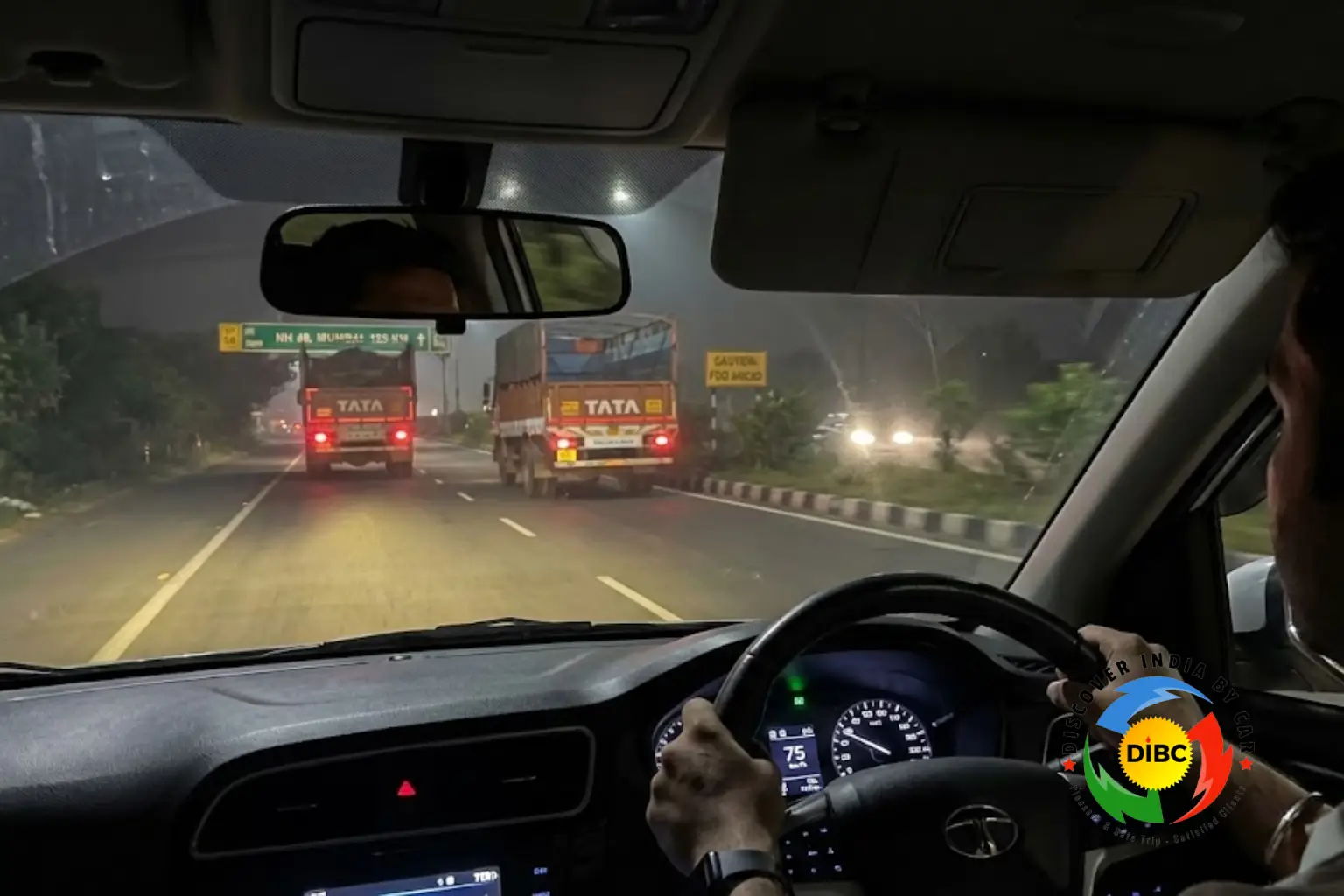
Common Night Driving Mistakes in India — AVOID THESE FATAL FLAWS!
Why are these night driving mistakes in India so prevalent? Because they feed on fatigue, impatience, and the illusion of the empty road. This section focuses on correcting those flaws.
1. The High Beam Vengeance: If someone hits you with their high beam, resist the urge to flash back with yours. You will momentarily blind them, potentially causing them to swerve into you. Practice defensive driving at night—turn your head slightly left and maintain speed.
2. Ignoring the Quiet Engine Stall: Often, the unlit, unannounced hazard on the highway is a stalled two-wheeler or minor tempo parked in the driving lane. They often lack reflectors. You won’t hear them, and their color blends with the tarmac. Your vigilance for dark shapes must be 100%.
3. The Empty Road Speed Demon: Just because you can go fast on an empty stretch does not mean you should. As noted in the safe speed at night section, the stopping distance is your ruling metric. Speeding is the most significant precursor to typical night driving mistakes in India.
4. Following Trucks Too Closely: This leaves you zero reaction time and places you inside their blind zone. Maintain the multi-second distance for self-preservation.
5. Assuming Everything Is Marked: Never assume an unknown deviation, curve, or new road construction has adequate reflectors. Anticipate and slow down before reaching the danger zone.
Defensive Driving at Night Techniques
The distinction of a master driver is not how fast they go, but how little they put themselves in danger. This is the heart of effective defensive driving at night.
- The 3-Second Rule, But Make It four at Night: Your following distance for an extended long-distance night drive should ideally be four seconds minimum. Give yourself extra milliseconds; it is the currency of survival.
- Always Maintain a Visibility Triangle: The front windshield is only one side. Continually scan your left and right mirrors to know where every vehicle is and where your path is, if a hazard appears in front.
- Keep Your Emergency Escape Path (The “Out”): Never allow yourself to be sandwiched between heavy traffic or close to an obstacle (e.g., a wall or ravine). Ensure you always have a non-impact direction—the hard shoulder, the center divide—you can immediately steer toward to avoid a crash.
- The Reaction to Blinding Lights: Look away (left and down) immediately, hold the steering wheel firmly, and ever-so-slightly lift off the accelerator. Do not stab the brake; a smooth deceleration buys you time and prepares you for potential evasive action once your sight returns. This is paramount to successfully driving safely at night in India.
How to Handle Fog, Rain & Low Visibility at Night
These elements drastically compound the existing dangers of driving at night in India. The challenge shifts from seeing what’s ahead to merely distinguishing the road surface.
- The Only Fog-Driving India Rule: Low Beams and Fog Lamps. Fog lamps are placed low on your car and aim downwards. Used with low beams (which shine under the dense fog), they offer maximum usable light penetration. Never, ever use your high beam in fog; it simply blinds you further due to reflection. This is the correct fog driving technique.
- Avoid Reflective Illusions: In heavy rain or near large water puddles, a car’s taillights can reflect and appear further away than the vehicle actually is. Slow down to verify the car’s actual location, especially in low-visibility conditions.
- When to Stop Safely: If visibility is below 20 feet (about four car lengths), you should get off the main road completely. Turn your lights off while you wait on the shoulder, but keep your hazard lights on. This prevents the false assumption that you are another lane marker.
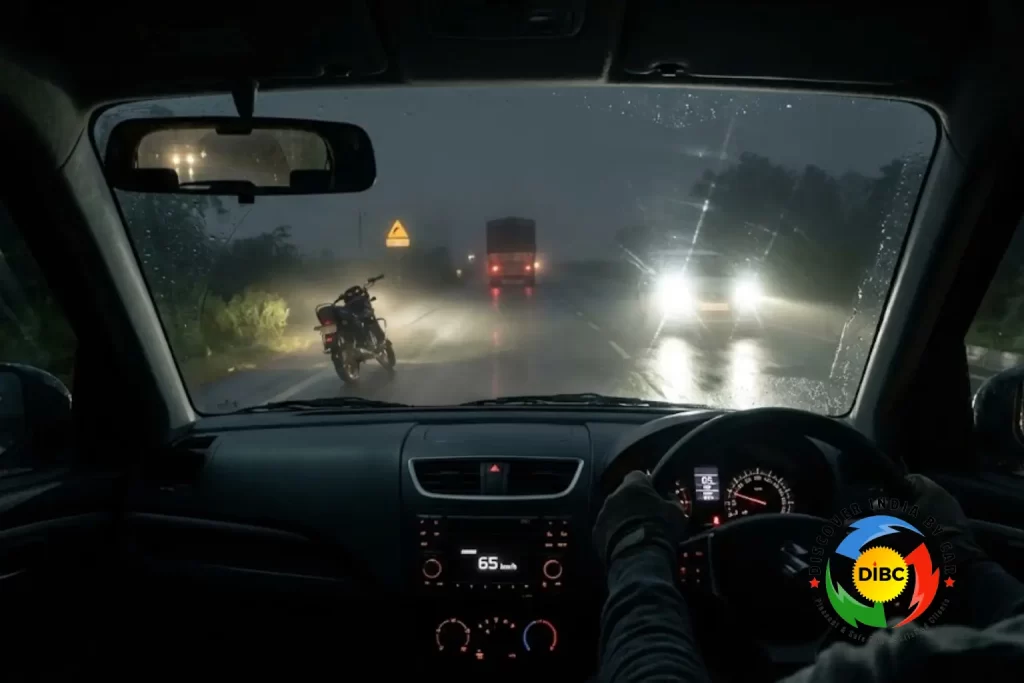
Village Roads & Forest Highways — Special Warnings for Highway Night Driving Tips
Village and forest stretches are essentially wildcards where the highway rules give way to regional unpredictability.
- Sudden Speed Breakers & Unmarked Turns: This is my warning about the need for ultra-conservative, safe speeds at night. Be prepared for a brutal, unmarked speed-breaker (road hump) every 500-1000 meters in a village zone.
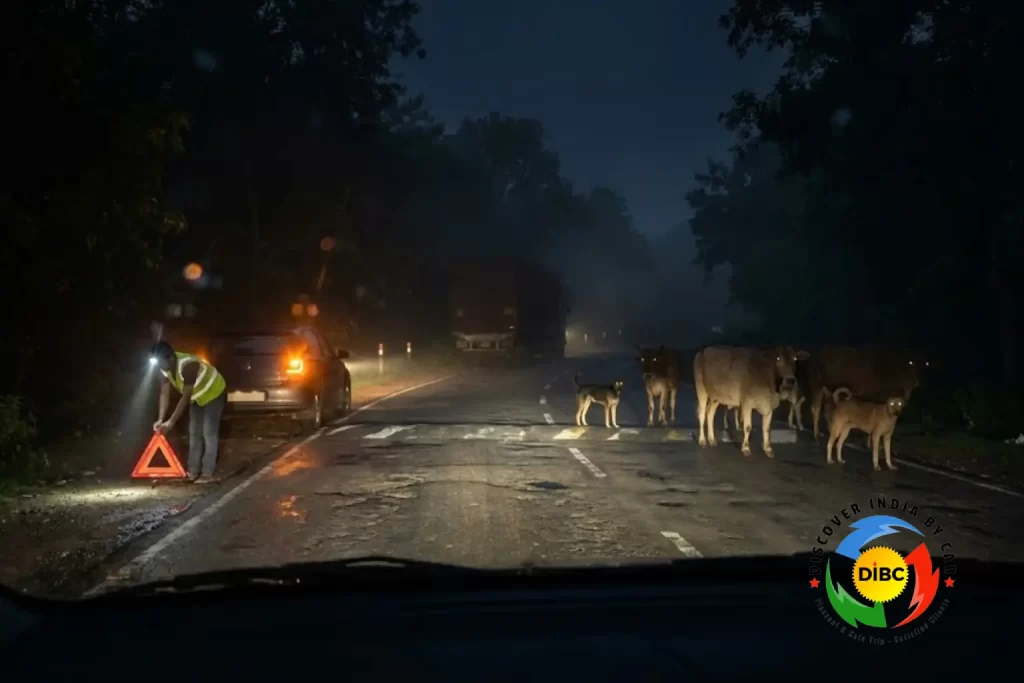
- Animals Crossing (The Real Risk): Dogs, cattle, and, in forest sections, deer or monkeys are common. Slow down, scan for glowing eye reflections (like pinpricks of light), and be prepared for an immediate, hard stop.
- No Lighting Zones: After the glow of the highway ends, your eyes may struggle. Drive slowly until your night vision fully acclimatizes.
What to Do in an Emergency (Night Breakdown Tips)
A nighttime breakdown must be treated like an immediate evacuation.
- Prioritize Parking: Immediately activate your hazard lights and steer to the farthest-possible hard shoulder. The further you are from traffic, the safer you are.
- Deploy Hazard Reflectors: Put on a safety vest if you carry one. Place your warning triangle 50-100 meters behind the vehicle, clearly marking the obstruction against the darkness. Walk against the flow of traffic to stay safe while deploying.
- Immediate SOS Contacts: Call the national Highway Helpline Numbers and relay your precise location (kilometre marker, landmark). If safe, exit the car on the non-traffic side (left) and wait for assistance.
Things to Carry for Night Highway Travel (The Ready Kit)
Trust me; these items have bailed me out countless times during a long-distance night drive.
- Reflective Safety Vest & Reflective Triangle: Non-negotiable safety items.
- Headlamp/Torch: Freeing up both your hands is crucial for checks/repairs.
- Power Bank & Pre-loaded Helpline Numbers: Keeping your phone charged and providing instant emergency access are paramount.
- Water & Hydrating Snacks: Maintaining alertness and avoiding cramps is key to sustained performance.
- Basic Tool Kit: Always include spare fuses, a tyre inflator, and jumper cables.
Real-Life Examples: Proof That Defensive Driving at Night Saves Lives
I’m telling you these to connect the theory to the consequence.
- Example 1: High Beam Blindness near Bhopal: I was trailing a small sedan that hesitated, then drove straight into a completely unmarked heap of sand in the central carriageway. The reason? The oncoming truck’s high beam caused a temporary visual blackout. Lesson: This perfectly illustrates the reality of high beam problems in India; always use a conservative speed.
- Example 2: The Silent Killer of Driver Fatigue: During a long, interstate stretch, I began hearing an almost non-existent “thud-thud-thud” that was imperceptible to my tired passenger. It was a truck in the left lane, hitting every consecutive road reflector—a classic sign of driver microsleep/weaving. We backed off instantly, practicing defensive driving at night, and sure enough, it swerved badly. Lesson: Your best safe night-driving tool in India is a rested mind.
- Example 3: Animal Strike on a State Highway: Approaching an unlit zone, my pace (my self-dictated safe speed at night) was under 60 kmph. Suddenly, a pack of stray dogs materialized, attracted to a carcass. Because my speed was manageable, a small, controlled emergency stop was possible. Lesson: Reduce your speed on rural stretches regardless of how open they look.
- Example 4: Glare Confusion Incident: On an overnight drive in heavy pre-monsoon rain, every drop created lens flare. I saw what I thought was an upcoming white reflector strip. It was the white cabin of a stalled, unlit container truck. Thankfully, my distance was generous. Lesson: Rain magnifies the need for low-visibility driving tactics, which means longer, more generous braking distances.
FAQs: Answering Your Top Queries for Highway Night Driving Tips
Q1. Is night driving safe in India?
Yes, driving at night in India can be relatively safe if you approach it with extreme caution and follow a structured night driving safety checklist India plan, prioritize being fully rested, and operate under conservative, pre-determined safe speed at night rules.
Q2. What speed is safe on Indian highways at night?
As an expert who shares countless highway night-driving tips, I suggest you keep your speed below the limit of your vision, meaning you should be able to brake completely within the light path of your low beam. Aim for 75−80 km/h maximum on major expressways and slower elsewhere.
Q3. High beam vs low beam tips—when to use?
The high beam is only for open, deserted highways where no opposing or preceding vehicle is present. The low beam must be the default in any situation where other cars or pedestrians are present, to avoid high-beam problems in India. This is the key element of responsible glare control tips.
Q4. Should beginners drive at night in India?
Night driving tips for beginners in India typically start with shorter trips on well-lit roads. New drivers should postpone long-haul, long-distance night drive adventures until they master speed, spatial awareness, and defensive driving at night during daylight hours.
Q5. What are the best safety tips for driving at night?
Always use the four-second rule for following distance, get seven hours of solid rest beforehand (non-negotiable), meticulously clean all car windows, and stay completely out of any truck’s blind zone. These are the best safety tips for driving at night.
Q6. Is it safe to drive at night in India?
Yes, with awareness. The risks—chiefly poor illumination, cattle, and high-fatigue hours—are manageable when you implement aggressive Indian highway safety tips and understand typical night driving mistakes in India.
Q7. How to reduce glare at night while driving?
To reduce glare and execute proper glare control tips, immediately look down and to the left line marker when an oncoming high beam appears. You should also ensure you don’t have a scratchy or dirty windshield (inside and out), as these scatter light violently.
Conclusion: Commitment to Responsible Travel
We have covered the fundamentals—from the technical necessity of good high-beam vs. low-beam tips to the personal need for vigilance and for combating the overwhelming effects of driver fatigue. A successful, safe night of driving in India is a disciplined practice, not an instinct.
Embrace the tenets of defensive driving at night. Let these guides to night driving in India be the anchor for your safety mindset. Drive at a sensible, safe speed at night, look out for those common mistakes, and never compromise on your preparedness.
Your safety, and the safety of the countless others on the highway, depends entirely on responsible, informed choices. Safe journeying!