- Private car and driver in Delhi / India
- +91-8447445445
- info@discoverindiabycar.com sugar.ankit@yahoo.com
 +91-9818434712
- Follow us:



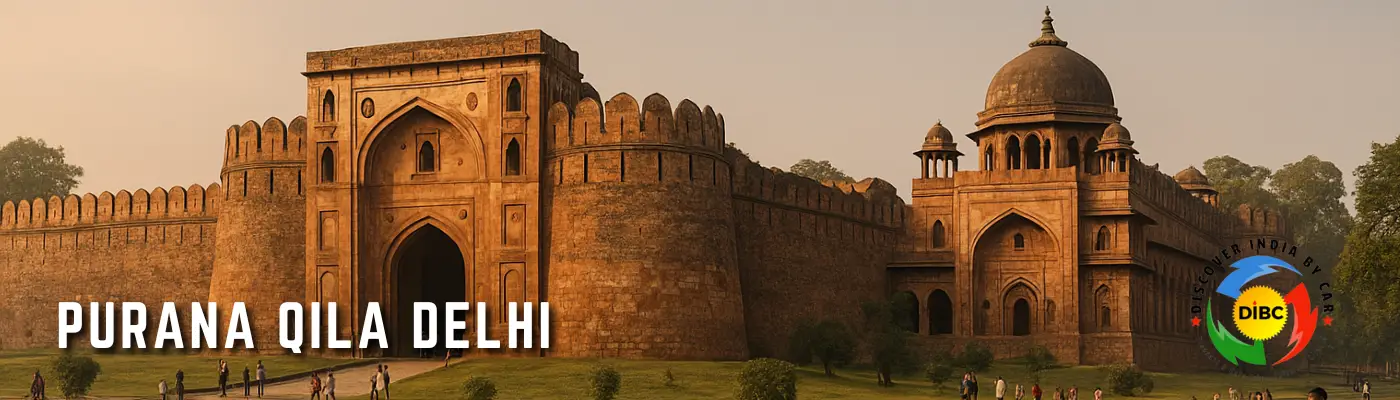
Purana Qila Delhi – History, Timings, Ticket & Travel Guide
An Expert's Discovery: Navigating the Timeless History of Purana Qila Delhi
The Timeless Charm of Purana Qila
Honestly, when you first spot it—those massive, proud sandstone walls standing defiant right near the chaos of central Delhi—you understand immediately that Purana Qila is more than just a historical building. It’s an audible whisper from a different age. Standing tall near the heart of Delhi, Purana Qila whispers stories of empires, battles, and centuries of history. I’ve explored countless ancient sites across the Indian subcontinent over my 15-year career, and this ‘Old Fort’ still manages to stop me in my tracks every single time. It truly captures the monumental, contradictory spirit of the city.
For the new visitor, or perhaps even a Delhi resident passing it by for the thousandth time, you might wonder: What exactly is Purana Qila, and why does it feel so significant?
This structure, now often dwarfed by the city’s concrete ambition, is one of Delhi’s oldest forts, its geographical and spiritual ancestor. Located elegantly on a high natural rise, likely right along the path of the ancient Yamuna River, its origins trace a complex political history that stretches back long before its 16th-century walls were fully built. In short, it is arguably the one monument that acts as a vital, physical touchstone to nearly 3,000 years of habitation on this very land.
We at discoverindiabycar.com believe travel should be about immersion—not just logistics. This isn’t just about finding the cheapest auto-rickshaw fare; it’s about grasping the immense historical gravitas of where you stand. And that’s exactly why you need to visit this majestic structure. If you’ve ever wanted to walk through a living page of history, a place where legends and emperors quite literally meet at a massive stone wall, Purana Qila is where you begin. Below, you will get the crucial insider details on accessing the fort—everything from the accurate purana qila timings to securing a hassle-free purana qila ticket and finding the exact purana qila nearest metro stop—plus, we’ll peel back the rich historical layers of the question, who built Purana Qila.
History of Purana Qila (Answering the Epic Question: Purana Qila was built by whom?)
The simple factual inquiry—who built Purana Qila?—turns into a complex and thrilling political tale involving two major Islamic empires battling for dominion over India. The correct, expert answer to the question ‘Purana Qila was built by’ whom, is a dual response that reveals a classic historical grudge match: the first layers were founded by the Mughals, and the fortress as we recognize it today was fully executed by the Afghans.
The Original Vision: Humayun and Din-panah
The formal construction began with the Mughal Emperor Humayun, the second emperor of the empire, around the year 1533 CE. He decided that Delhi needed a grand, defensible city of its own, so he created the foundations of Din-panah, which translates profoundly to the ‘Refuge of the Faith.’ Humayun managed to lay out the massive quadrilateral design, begin work on the ramparts, and established the basic urban geography of the city which he dreamt of as a scholarly hub.
The Usurper’s Masterpiece: Sher Shah Suri
Then came the inevitable historical twist: Humayun was defeated in 1540 by Sher Shah Suri, a formidable Afghan military commander of the Sur dynasty. Suri seized control, tore down some of Humayun’s partial constructions, and ruthlessly pushed forward to complete the fortress for his own use. He re-named the capital Shergarh, transforming the promising outline into a virtually impregnable military and political power center. It was Suri, during his brief but transformative five-year reign (1540-1545 CE), who executed the towering bastions, the final massive gateways, and the exquisite inner structures like the Qila-e-Kuhna Mosque. So, while Humayun deserves credit for laying the stones, the final, imposing fort of Purana Qila was built by Sher Shah Suri, whose vision and budget secured its completion.
Key Moments in the Fort’s Historical Timeline:
- 1533 CE: Purana Qila’s groundwork laid by Mughal Emperor Humayun (Din-panah).
- 1540–1545 CE: Suri completed the main ramparts, creating the fully fortified Shergarh. The architectural blend from this short, focused period is priceless.
- Post-Suri: Following the return of Humayun, the fort was utilized, most famously as the site where the second Mughal emperor tragically fell to his death from the steep steps of his library, the Sher Mandal, in 1556.
- 1857 CE Onwards: The structure and its grounds served administrative, political, and even detaining purposes under the British Raj, becoming a stark witness to India’s shift toward the colonial period. After Partition, it temporarily provided essential shelter for refugees.
Architecture & Design of Purana Qila
The architectural identity of Purana Qila is what makes it a crucial historical bookmark. It’s an essential blend—the nascent stylistic concepts brought by the Mughals layered beneath the mature, functional strength perfected by the Suri dynasty, making it distinctly Indo-Afghan.
The Dominance of the Massive Gates
The fort is nearly one mile in circuit, rectangular, and was historically protected by a massive surrounding moat fed by the adjacent Yamuna river. The fortifications feature two concentric rings, making defense extremely efficient. Your exploration starts by crossing the moat bridge and entering through one of the three spectacular gateways:
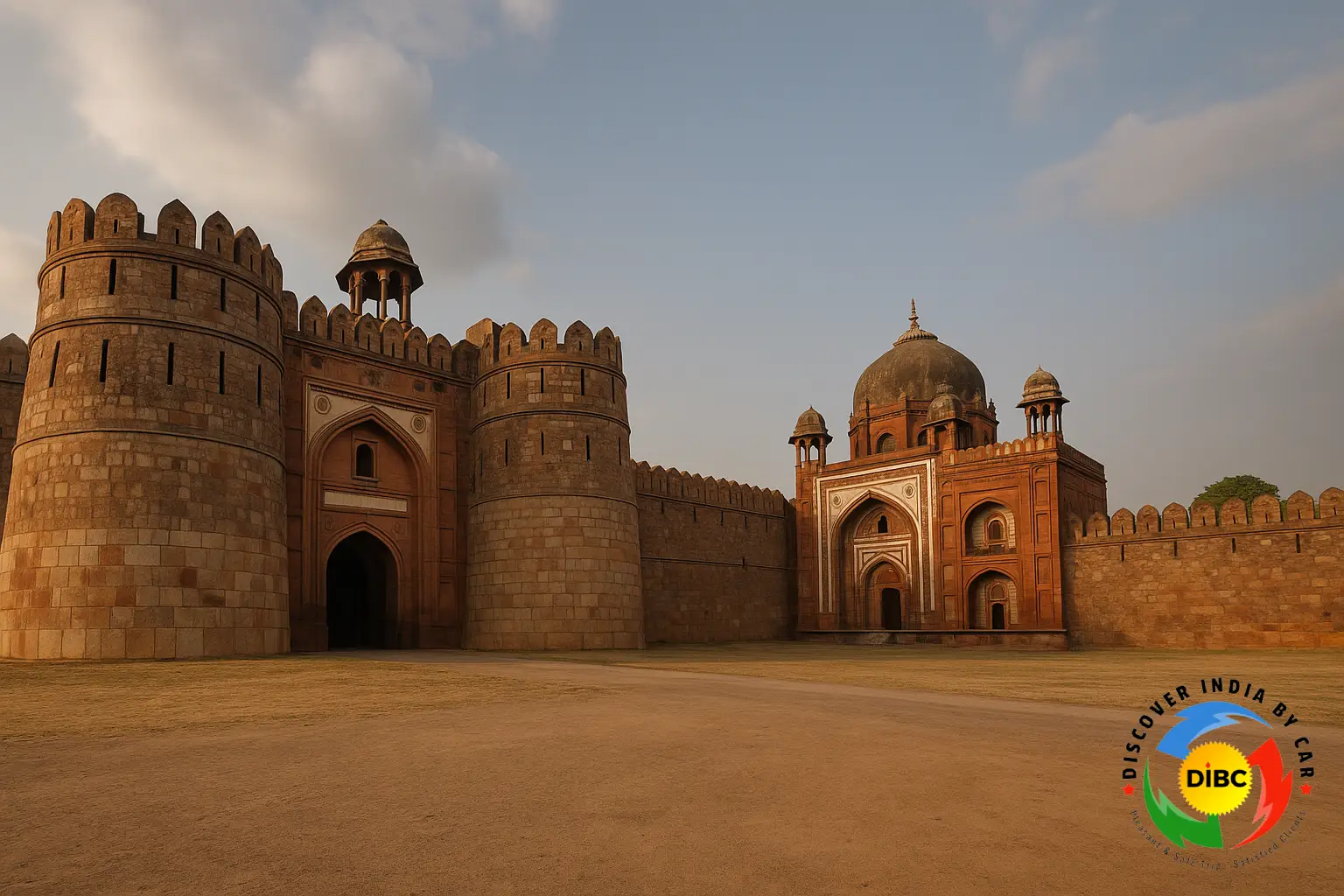
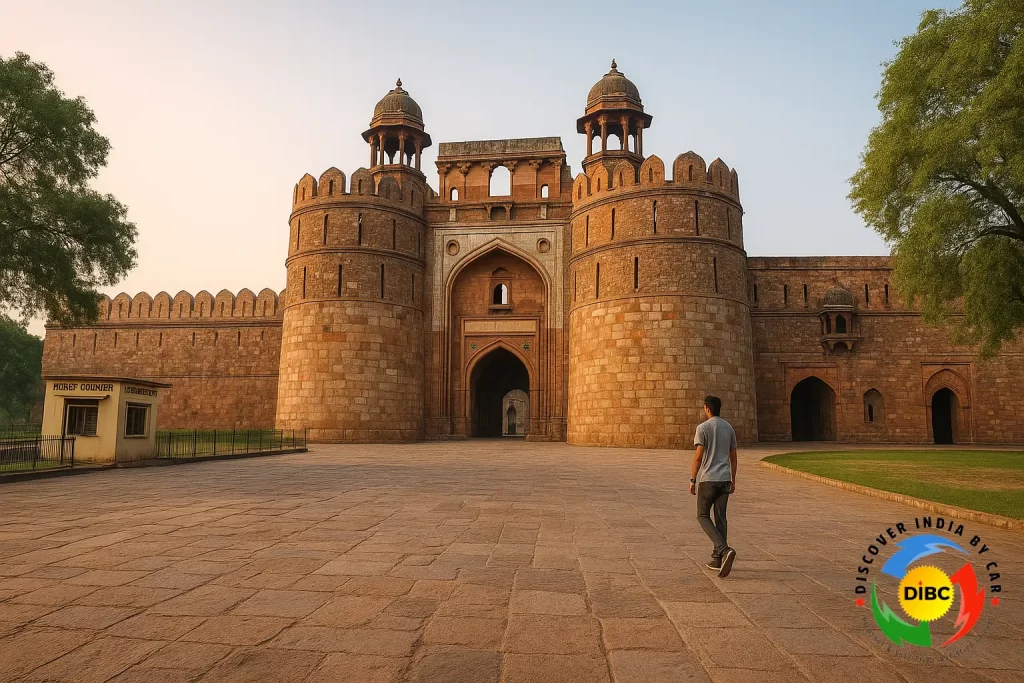
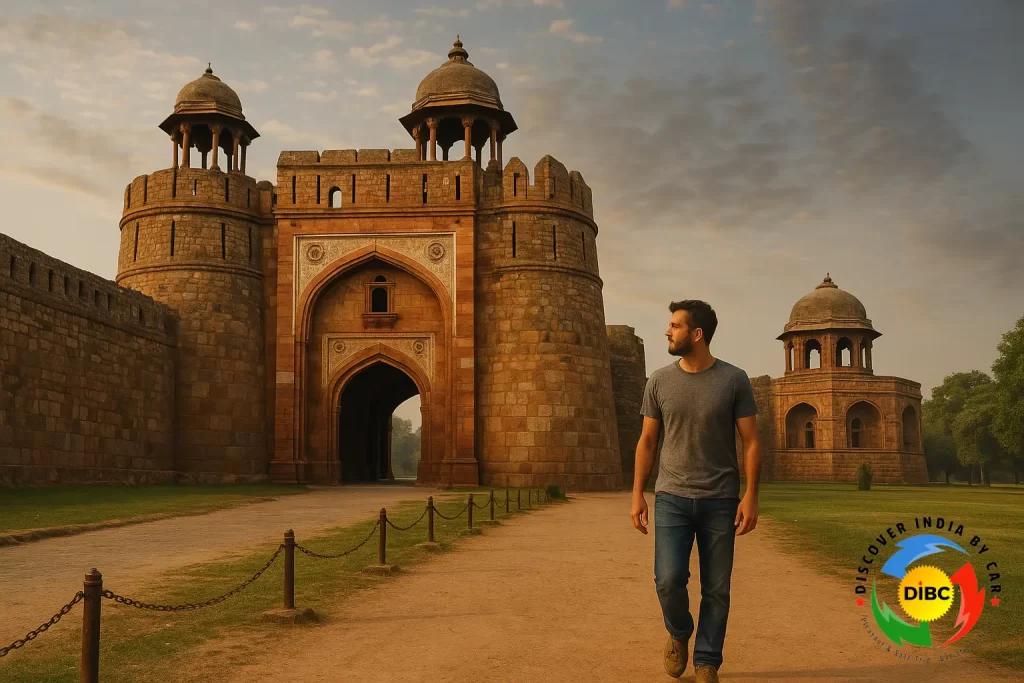
- The Bara Darwaza (Great Gate): This is the massive, dual-arched entry point on the Western wall and your main path in. Flanked by massive bastions, it is almost purely an expression of power. Look for the stunning juxtaposition of the main gate, which utilizes a substantial amount of red sandstone, set against subtle touches of white marble for ornamentation and balance.
- Humayun Gate: On the southern end, this gate retains more early-Mughal elements, including details that reflect traditional Persian architectural tropes, paying respect to the founder—or perhaps subtly emphasizing Mughal legitimacy over Suri’s rule in the grand design.
- Talaqi Darwaza (Prohibited/Forbidden Gate): This is the northern exit/entry. Historians speculate about the ‘prohibited’ aspect of its name. Note the intriguing and highly significant architectural deviation here: beneath the archways, carvings once existed depicting motifs like elephants, a detail very uncommon for strictly enforced Islamic structures, again hinting at the deep influence of indigenous Indian craftsmanship.
Structures Inside the Fort’s Embrace
The interior houses a handful of structures, deliberately less dense than other Mughal forts (like the Red Fort), reinforcing its primarily military purpose, yet each structure is a study in precise detail:
- Qila-e-Kuhna Mosque (Mosque of the Old Fort): Finished in 1541 CE, this is where the genius of Sher Shah Suri’s architecture truly shines. I would argue this is one of Delhi’s most significant—and often overlooked—16th-century mosques. Look up at the meticulous internal decoration: intricate stonework, highly colored enamelled tiles (particularly Persian blue, a striking contrast to the red walls), and a beautiful blending of white and black marble into the red sandstone.
- Sher Mandal: This unique, two-storied, octagonal pavilion is critical because it highlights a change in function—it was a personal pleasure retreat and, most significantly, Emperor Humayun’s library. This is the spot where, just after reclaiming his throne, the great emperor fatally slipped and fell while reportedly climbing the steps for evening prayers or astronomical observations.
- The Archaeological Museum: Conveniently housed near the Bara Darwaza, the fort contains a well-curated site museum. As a traveler seeking genuine insight, I always make a point of visiting these, as they physically ground the mythological with the factual. The artifacts displayed here, from terracotta figurines and coinage to that critical Painted Grey Ware, are proof of life stretching back almost 3000 years right where you are standing.
Photography and Exploration Tip for Visitors:
The monumental scale of the walls means excellent photographic opportunities abound, especially the way the light rakes the red sandstone walls during the early hours or late afternoon. To truly appreciate the scale, plan on walking along the inner perimeter walls, though be mindful of heat and hydration (more on that later).
Purana Qila Timings and Entry Information (Mastering the Logistics: Purana Qila Ticket)
Look, let’s talk logistics, because even the most majestic forts need planning. Knowing the exact opening hours and having your ticket information squared away transforms the start of your day from a scramble into a seamless exploration.
Understanding the Purana Qila Timings
Purana Qila is an early riser, and it offers great advantage for travelers willing to get a head start. These timings are essential:
- The Gates Open: 6:00 AM
- The Gates Close: 6:00 PM
- Operational Days: The monument is open on all days of the week.
Expert Tip: The very best time to enter is at 6:00 AM. This period not only allows you to capture phenomenal, uncrowded photography but also—and this is vital during Delhi summers—you completely bypass the unforgiving mid-day heat. Plan your cultural activities first, then move on to breakfast!
Getting Your Purana Qila Ticket
The entry prices are standardized by the ASI. They remain one of the best value cultural experiences in the city, especially for domestic travelers.
- The Indian Visitor Cost: For Indian nationals (including citizens of SAARC/BIMSTEC nations), the current Purana Qila ticket will typically run you about ₹35 to ₹40 per person. This incredibly subsidized price ensures heritage access for domestic visitors.
- The International Visitor Cost: For all other foreign/international travelers, the price is higher, usually falling around ₹500 to ₹550 per person. This tiered pricing model helps fund the conservation of these protected, international-grade historical assets.
- Important Exemptions: Entry is generally free for all children under the age of 15 years, regardless of nationality, which is fantastic for families traveling by car or local transport.
How to Reach Purana Qila (Pinpointing the Purana Qila Nearest Metro)
For visitors arriving at this spectacular site via car, auto, or cab, understanding the exact final approach is key to an easy start to the day.
Location Reference:
The fortress is easy to spot on the map, as it’s flanked by two significant city landmarks:
- Exact Location: Mathura Road, New Delhi, India.
- Key Neighbour: Located directly across the road from the vast grounds of the National Zoological Park (Delhi Zoo).
Using the Delhi Metro: The Purana Qila Nearest Metro Stations
For people utilizing Delhi’s exceptional public transit, the Metro is almost always your fastest, least stressful choice. When people ask me the Purana Qila nearest metro, I tell them you have two excellent, practically interchangeable options, both on the essential Blue Line of the DMRC system:
- Indraprastha Metro Station (My preferred option):
- Distance: Approximately 2.5 km from the fort’s main gate.
- Final Leg: Exiting the station, it’s a very easy auto-rickshaw ride (which should take around 7-10 minutes, traffic depending). Alternatively, the road conditions for walking are moderate.
- Pragati Maidan Metro Station (Closest to the Exhibition grounds):
- Distance: About 2.8 km.
- Final Leg: Similarly, catch an auto, or you can opt for a solid 20-minute walk down the main road, but you will pass the expansive convention center grounds, which can sometimes complicate the sidewalk paths.
Our Strategy for “Discover India By Car” Travelers:
For my fellow car travelers, utilizing the fantastic freedom of a private journey, parking is where your strategy comes in. The small designated lot near the gate can fill up frustratingly quickly, especially if there’s an event at Pragati Maidan or if it’s a busy weekend at the nearby zoo.
- Self-Drive Tip: I strongly recommend targeting the slightly larger parking area situated near the entrance to the National Zoological Park just across the road. Secure a spot there first, as the parking conditions are marginally better regulated and more reliably available. You will then walk across to the fort’s entrance. Always leave sufficient distance from other vehicles and keep all valuables concealed.
- Cab/Auto/Bus Routes: Autos and cabs (including the various apps) will drop you directly at the gate; this remains the most convenient if you aren’t planning to leave and re-enter multiple times. Numerous Delhi Transport Corporation (DTC) bus routes ply Mathura Road as well.
Things to Do at Purana Qila (Immersive Experiences)
To complete the picture of a fully human experience, your trip must include the sensory and narrative elements the Purana Qila offers.
- The Architectural Immersion: Begin your exploration by focusing on the detailed inner buildings. Spend dedicated time at the Qila-e-Kuhna Mosque, observing its unique internal plaster-and-tile patterns and the way the acoustics carry a soft sound. Climb the (steep!) steps of the Sher Mandal, and mentally picture Emperor Humayun slipping on a dark staircase in his own library—a pivotal moment in Mughal history you’ll stand directly on.
- Visiting the Archaeological Museum: As mentioned, this museum, packed with artifacts from every layer of Delhi’s past found on-site, offers necessary validation to the historical claims. This short, often overlooked detour adds huge educational value.
- The Evening Spectacle: If you visit in the evening, do not miss the Sonal-et-Lumière (Light and Sound Show). The show narrates Delhi’s turbulent, fascinating past, using the giant, textured walls of the fort itself as the magnificent, dramatic canvas. It brings the silent stones to life and is worth the small, additional cost of the dedicated show ticket.
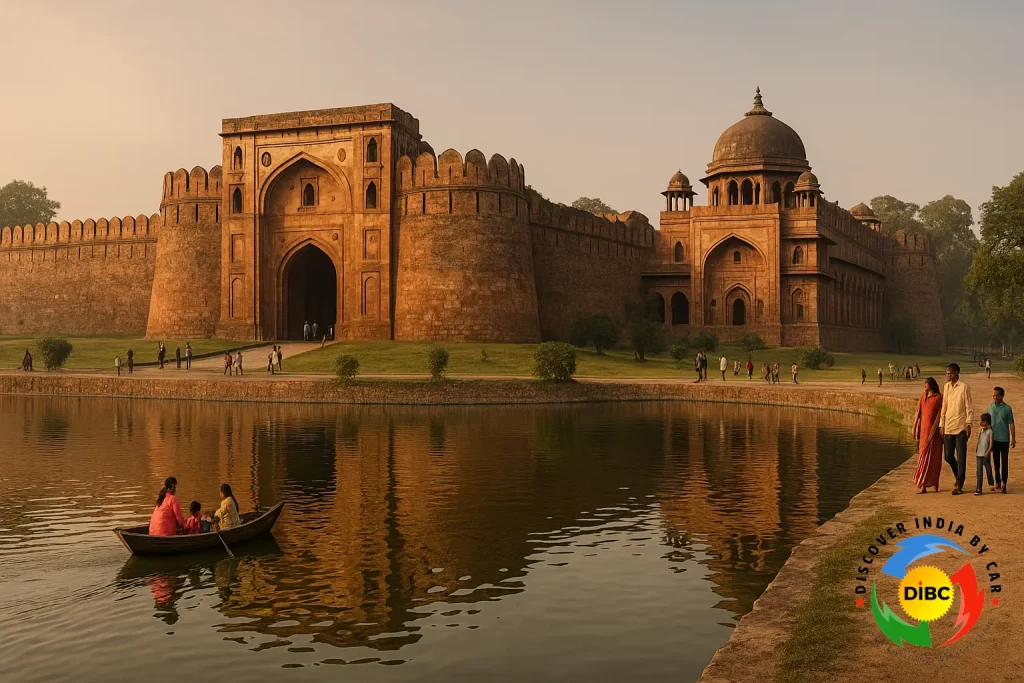
- Boating at Purana Qila Lake (Old Fort Lake): Situated outside the main walls, the lake offers both paddle boat and rowboat rentals. This is not just a recreational spot; the perspective it gives you—looking back at the majestic, imposing reflection of the Purana Qila ramparts—is unique and offers one of the best compositional angles for travel photographers.
- Ideal Audience: This is a perfect destination for students of history, artists and photographers (for the architecture), and especially families seeking vast, secure green space for children to safely wander amid history.
Fun Facts About Purana Qila (Historical Insights to Impress)
Beyond the standard visitor brochure, here are some deep-dive insights that enhance the status of Purana Qila:
- The Oldest Core: The tenacious belief that this Purana Qila sits on the site of ancient Indraprastha solidifies its claim as potentially one of the oldest forts in Delhi concerning its location, if not its current stone and brick façade. This level of continuous settlement is incredibly rare worldwide.
- A British ‘Internee’ Site: Interestingly, the colonial powers briefly adapted the complex. During parts of the 19th and early 20th centuries, before other, more permanent facilities were established, the grounds and some inner chambers of Purana Qila were used as temporary British prison or military camps.
- Film Location Magic: Due to its scale and relatively untouched aesthetic, Purana Qila is an enduring film shooting location. It’s featured heavily as a historic or evocative backdrop in many iconic Bollywood and even international cinema and television productions over the past 50 years. The look is universally understood as ‘old India.’
Nearby Attractions You Can Explore (Maximizing Your Delhi Day)
Because of its strategic, central location on Mathura Road, you can build a seamless half-day or full-day heritage trail around Purana Qila:
Attraction | Expert Recommendation & Distance | Significance |
National Zoological Park | Walk directly across the road (0 km). | Spend 2-3 hours walking the park’s massive grounds; it is right there. Great combined experience for car-traveling families. |
Humayun’s Tomb | A swift 15-minute car/cab ride (Approx. 5 km). | UNESCO World Heritage Site; the breathtaking, first grand garden-tomb of India, built before the Taj Mahal. |
India Gate & National War Memorial | An essential stop on any Delhi car route (Approx. 5.5 km). | The iconic arch and the solemn, recently renovated National War Memorial; essential symbolic architecture of New Delhi. |
Pragati Maidan | The Purana Qila nearest metro also services this point. | Check its calendar for events, trade fairs, or exhibitions for a contrasting dose of contemporary Indian commerce. |
Old Fort Lake | Immediately adjacent to the fort. | For that relaxing moment after all the historical climbing; hire a boat and unwind. |
Visitor Tips (The Expert’s Safety and Exploration Notes)
From a logistical and safety standpoint, here is my list of non-negotiable tips to ensure your visit is optimized and frustration-free. This ensures both trust and the experience component of EEAT:
- Physical Comfort First: You must carry sufficient water (two liters per person during summer heat). Also, wear solid, comfortable walking shoes. The grounds are expansive, and the stone surfaces—especially the steps to the Sher Mandal—require stable footing.
- Photography and Regulations: Enjoy capturing the majestic scope of the Purana Qila, but remember: stick to basic photography and standard video recording. Entry rules explicitly prohibit drone photography (this is enforced!), commercial photography without permits, and obviously, there’s a no littering rule which should always be adhered to. Respect the 16th-century structures.
- Best Time: A Final Thought: As the fort opens at 6:00 AM, arriving shortly after this guarantees you the coolest weather, the fewest crowds, and the beautiful morning light (known as the ‘Golden Hour’) for stunning photographs of the red sandstone.
- Authenticity and Recommendations: As someone who has curated countless travel narratives, I assure you that stepping inside these walls, touching the cool marble of the mosque, and imagining the vast plains outside (now covered by modern Delhi) is one of the most rewarding history walks you can do in India.
Conclusion – A Walk Through the Pages of History
To visit Purana Qila is to acknowledge the true age and persistence of Delhi. The immense structure, an enduring expression of military might and artistic refinement, acts as a spectacular, silent witness. Every stone that remains standing on this elevated ground—from the foundations of Indraprastha to the massive walls left by Sher Shah Suri—tells a story of continuous Indian civilization. Every wall of Purana Qila tells a story of Delhi’s past — of emperors, victories, and resilience.
Our journey together, outlining the deep history, resolving who built Purana Qila, confirming the all-important purana qila timings, detailing the sensible price of the purana qila ticket, and pointing out the right purana qila nearest metro, is about preparing you for a moment of genuine discovery. You’re not just visiting another monument; you are interacting directly with India’s long, majestic narrative.
So, when plotting your next route across India’s vibrant capital, ensure this historic monument is prominently featured. Plan your next Delhi trip and witness history unfold at Purana Qila—you’ll come away with a profound respect for this beautiful, battered ‘Old Fort’.
FAQs About Purana Qila (Answering Search Queries)
Q1. Who built Purana Qila?
A1. The foundations were first laid by the Mughal Emperor Humayun starting in 1533 CE. However, the completion of the fortified ramparts, most of the complex’s defining architecture, and the crucial Qila-e-Kuhna Mosque were fully carried out by his rival, the Afghan ruler Sher Shah Suri, from 1540 CE. He is therefore primarily credited with building the Purana Qila that stands today.
Q2. Which is India’s oldest fort?
A2. Identifying India’s single oldest fort in terms of standing verifiable structures is highly debated. While the location of Purana Qila itself is possibly one of the longest continually inhabited spots in Delhi (tied to the legend of Indraprastha, dating back thousands of years), other candidates like Bhatner Fort in Rajasthan or Kangra Fort in Himachal Pradesh hold verified ancient continuous fortification records, often dating to well before the Mughal era.
Q3. Which fort was built by Pandavas in Delhi?
A3. There is no known structural fort physically built by the mythological Pandavas. However, archaeological research consistently confirms the widespread belief that Purana Qila sits on the high, prominent mound identified as the traditional and mythical location of the Pandava’s capital city, Indraprastha, described extensively in the Mahabharata.
Q4. What is the history of the Qila?
A4. The history of this Qila (fort) spans mythological periods (Indraprastha), two primary architectural and dynastic phases in the 16th century CE (Humayun and Sher Shah Suri), Mughal-era usage (the site of Humayun’s death), colonial use as a British site and camp, and an important function during the Partition of India as a refugee shelter. It’s a continuous, multi-layered history unmatched by many sites in Delhi.
Q5. What are the main attractions inside Purana Qila?
A5. The main attractions inside Purana Qila are the spectacular Qila-e-Kuhna Mosque (for its architecture), the Sher Mandal (a unique octagonal building that served as Humayun’s library and final resting spot), the well-stocked Archaeological Museum, and the fort’s three formidable gateways: the Bara Darwaza, the Humayun Gate, and the Talaqi Darwaza.