- Private car and driver in Delhi / India
- +91-8447445445
- info@discoverindiabycar.com sugar.ankit@yahoo.com
 +91-9818434712
- Follow us:




What to Wear in India: A Local Driver’s Dress Code Guide for Temples, Cities and Every Season
Ankit Sugar
Founder of Discover India by Car
Ankit has spent 14 years driving foreign guests across Delhi, Agra, Rajasthan and Punjab in private cars, which means a great deal of time spent waiting outside temple gates, mosque steps and fort entrances while guests work out what each site expects of them.
You don’t need to buy a whole “India wardrobe” — but a few rules keep you comfortable and respectful. Here’s exactly what to wear, and where.
India has no national dress code, and nobody checks what tourists wear at the airport or on the street. What to wear in India comes down to loose, breathable clothes that cover your shoulders and knees, shoes that slip off easily, and a scarf in your bag. Religious sites are where things tighten: each temple, mosque, gurdwara or church sets its own rules, from a simple head covering at a gurdwara to traditional-dress-only codes at some temples in Kerala. Region and season matter just as much. A January sunrise in Agra, a humid afternoon in Kochi and a summer night in Ladakh need three different sets of clothes.
That’s roughly what I tell guests when the question lands in our WhatsApp a few weeks before they fly. Is there an India dress code for tourists? Will a temple turn me away? Women ask the most specific version — what to wear in India as a female traveller when it’s 40°C and you’d still like to blend in a little. Men ask whether shorts are really a problem. (Sometimes they are.)
The clothing problems we see on the road are rarely dramatic: shorts at Akshardham, a leather belt at a Jain temple, nothing warm for a January morning in Agra, which is colder than anyone believes until they’re standing in it.
Below is what to wear place by place, how it changes across India’s regions and seasons, a packing system for trips of different lengths, and a quick check to run before you leave the hotel.
The Simple Rule for Dressing in India
Shoulders and knees, loosely covered. That habit gets you comfortably through almost every temple, mosque, fort and old bazaar between Delhi and Jodhpur.
India isn’t one dress culture, though. A rooftop bar in Gurugram and a lane behind Jama Masjid are about forty kilometres and several decades apart. The trick is to look at what the people around you are wearing and roughly match it. The pattern is easy to read once you notice it: the older, more religious or more rural the place, the more people cover up. Modern malls, upscale restaurants and hotel pools sit at the relaxed end. Old cities, villages and anywhere people pray sit at the other.
Covered doesn’t have to mean hot. The local answer to a brutal summer is loose cotton — long, flowing, with air moving underneath. A thin long-sleeved cotton shirt in May is genuinely cooler than a tight synthetic T-shirt, because it keeps the sun off your skin. Tight clothing is the real mistake, for comfort as much as anything.
The other half of the rule is about your feet. You’ll take your shoes off more often in one week here than in a year at home: temples, gurdwaras, mosques, some shops, anyone’s house you’re invited into. Shoes you can step out of without sitting down save a surprising amount of time.
Quick India dress-code comparison
| Setting | What works | Best left at the hotel |
| Most temples, mosques and gurdwaras | Shoulders and knees covered, loose fit, a scarf | Shorts, sleeveless tops, short skirts |
| Strict-code temples (e.g. Padmanabhaswamy and Guruvayur in Kerala) | Traditional dress as the temple specifies | Trousers and shirts for men; western clothes for women |
| Old city areas and bazaars (Old Delhi, Jaipur's walled city) | Long trousers or skirts, tops with sleeves | Crop tops, very short shorts |
| Monuments (Taj Mahal, Amber Fort, Red Fort) | Breathable layers, walking shoes, a hat | Heels, heavy denim in summer |
| Malls, cafés, upscale restaurants in big cities | Smart casual, much as at home | Beachwear |
| Hotel pools, Goa's beaches | Swimwear is fine | Swimwear away from the pool or beach |
What to Wear at Temples and Religious Sites
This is where the rules are real, and where they’re enforced — usually politely, sometimes by a volunteer who simply hands you a cloth and points. Nobody expects a visitor to know every custom. They do expect you to try, and the people you’re sharing the space with are there to pray while you’re there to look.
It helps to separate four kinds of advice. Official rules are published by the site and checked at the entrance, like the head covering at a gurdwara or Akshardham’s dress code. Strong expectations are things staff will usually ask you to do, like wearing a robe at a mosque if you arrive in shorts. Etiquette is what people notice but nobody enforces, like not pointing your feet at a shrine. And practical tips, like socks for hot marble, are simply ours. This guide labels which is which, and the comparison table below does the same site by site.
A few habits hold almost everywhere: shoes off before you go in, quiet voices, and asking before you photograph anything inside. Beyond that, each faith and each institution has its own particulars.

Hindu temples, and Akshardham in Delhi
Most Hindu temples are relaxed about visitors as long as you’re covered and barefoot. Some don’t allow non-Hindus into the inner sanctum, and a few don’t admit non-Hindus at all; if a sign or a priest tells you so, that’s the end of the conversation. In Delhi, Swaminarayan Akshardham is the strictest site most of our guests visit. Its own visitor page asks for shoulders, chest, back and upper arms to be covered and for lower wear to reach below the knee, and it sells sarongs for ₹100 if an outfit falls short. Phones, cameras, umbrellas, food and luggage aren’t allowed into the complex, so there’s no photography inside. A free cloakroom takes them, though with a private car it’s simpler to leave everything in the car. Akshardham opens Tuesday to Sunday, with first entry at 10 am and last entry at 6:30 pm, and is closed on Mondays.
Sikh gurdwaras: Golden Temple and Bangla Sahib
Gurdwaras are some of the most welcoming places of worship in India, and they’re consistent about one official rule: everyone covers their head. Men, women, children, visitors of any faith. At the Golden Temple in Amritsar and at Gurudwara Bangla Sahib in central Delhi, simple cloth head coverings are kept at the entrances, though your own scarf or bandana will be more comfortable. Shoes go to the free shoe counter, and at the Golden Temple you walk through a shallow pool to wash your feet before entering. Tobacco and alcohol aren’t permitted anywhere in the complex. Jeans are fine; shorts and sleeveless tops are not appropriate.
Mosques: Jama Masjid in Old Delhi
Delhi Tourism’s page for Jama Masjid notes that visitors can hire robes at the northern gate, that tourists aren’t allowed in during prayer hours, and that after sunset the mosque is open only to worshippers. In practice, visitors who arrive with bare arms or legs are usually asked to put a robe on, and women are often asked to cover their hair — treat both as strong expectations rather than printed rules, and go with whatever the staff at the gate ask. Shoes come off before the courtyard. Mornings are easiest, and Friday midday prayers make that the busiest slot of the week. Other mosques set their own practice, so the same approach applies: cover up, and follow the gate.
Jain temples, and Ranakpur
Many Jain temples ask visitors to leave leather outside — belts, wallets, handbags, camera straps, sometimes watch straps — in keeping with the Jain principle of non-violence towards all living things. How strictly this is applied varies from one temple to the next, so take the cautious route and leave leather in the car. At Ranakpur, the marble temple between Udaipur and Jodhpur, staff do check, and lockers are available at the entrance. Mornings are kept for Jain worship, and non-Jain visitors are generally admitted from noon to 5 pm. The temple trust sets these hours and can change them, so confirm on the day. Our Ranakpur temple guide covers tickets and the drive from Udaipur.
What to wear at the Taj Mahal
The Taj Mahal is a mausoleum rather than a temple, and there’s no published dress code. Still, it’s a tomb, there’s a working mosque on the grounds, and you’ll be sharing it with thousands of Indian families, so dress as you would for a cathedral: shoulders covered, nothing very short. That part is etiquette. The official part is the shoes: the Taj Mahal website says shoe covers are provided free with SAARC, BIMSTEC and foreigner tickets, and you wear them (or go barefoot) on the marble of the main mausoleum.
The useful advice is practical. There’s a lot of walking on stone, the white marble platform gets painfully hot by late morning in summer, and shade is scarce. Comfortable shoes, a hat and a pair of socks in your pocket for the marble make a real difference. The official site lists the Taj as closed to general visitors on Fridays. Our page on Taj Mahal timings and tickets covers gates and entry times.
Your temple day bag, and what to check before you go
Most temple problems are solved by a small bag you’re carrying anyway. The things that earn a place in it:
- A large scarf or dupatta, which covers a head or bare shoulders and, tied as a wrap, bare knees
- A pair of socks for hot marble in summer and cold stone floors in winter
- Small notes and coins for robe hire, lockers and any shoe stand that isn’t free
- Wet wipes for your feet after a barefoot temple circuit
- A cloth bag to carry your shoes in, where that’s allowed
- Nothing leather, if a Jain temple is on the day’s route
Before any major religious site, check four things on the institution’s own website or the notice board at the gate: whether there’s a dress code and who it applies to; whether visitors of other faiths can enter every area; what you can’t bring in, such as phones, bags or leather; and the hours for tourists, which often differ from the hours for worshippers. Each temple’s own trust or board sets these rules, and some change them — Mumbai’s Siddhivinayak introduced a dress code in 2025, for example — so a guide written last year can be out of date.
Dress rules at major religious sites (checked 20 November 2026)
| Site | What to wear | Head and feet | Special restrictions | Rule status | Check before you go |
| Taj Mahal, Agra | Modest; shoulders covered | No head covering; shoe covers or barefoot on the tomb platform | Closed to general visitors on Fridays | Shoes: official. Dress: etiquette |
Ticket type; Friday closure |
| Jama Masjid, Old Delhi | Arms and legs covered; robes at the north gate | Women often asked to cover hair; shoes off | No tourists in prayer hours; worshippers only after sunset | Hours: official. Robe and hair: expected |
Prayer times on the day |
| Akshardham, Delhi | Shoulders, chest, back, upper arms covered; below the knee | No head covering; shoes off inside | No phones, cameras, umbrellas, food or luggage; closed Mondays | Official | Entry hours (10 am–6:30 pm) |
| Gurudwara Bangla Sahib, Delhi | Modest; no shorts | Everyone covers head; shoes off at the counter | No tobacco or alcohol | Head covering: official | — |
| Golden Temple, Amritsar | Modest; no shorts | Everyone covers head; shoes off, feet washed | No tobacco or alcohol | Head covering: official | Crowd levels at festivals |
| Ranakpur Jain Temple, Rajasthan | Shoulders and knees covered | No head covering; shoes off | No leather inside; lockers at entrance | Official (checked by staff) | Non-Jain hours (generally 12–5 pm) |
| Sree Padmanabhaswamy, Thiruvananthapuram | Men: mundu or dhoti, no shirt. Women: sari, set-mundu, skirt-and-blouse or half-sari |
Shoes off | Strict traditional code | Official | Current rules and entry eligibility |
| Guruvayur Sri Krishna Temple, Kerala | Men: plain white or cream dhoti, no shirt. Women: sari, skirt-and-blouse or churidar |
No footwear | Non-Hindus generally not admitted | Dress: official. Entry: reported |
Whether you can enter |
| Siddhivinayak, Mumbai | No short skirts, revealing clothes or torn jeans | Shoes off | Covering cloth offered at the temple | Official (since 2025) | Current notice |
| Jagannath Temple, Puri | — | — | Only Hindus allowed inside, per sign at the gate | Official | Entry eligibility |
City and Sightseeing Wear
Away from religious sites you have far more freedom than you might expect. In Delhi’s newer neighbourhoods — Hauz Khas, Khan Market, the malls in Saket and Gurugram — young Indians wear jeans, dresses and T-shirts, and nobody will look twice at a visitor doing the same. The old cities are a different story. Chandni Chowk, the bazaars inside Jaipur’s walled city, the blue lanes of Jodhpur: these are traditional neighbourhoods, and long trousers or a long skirt will make the day noticeably easier.
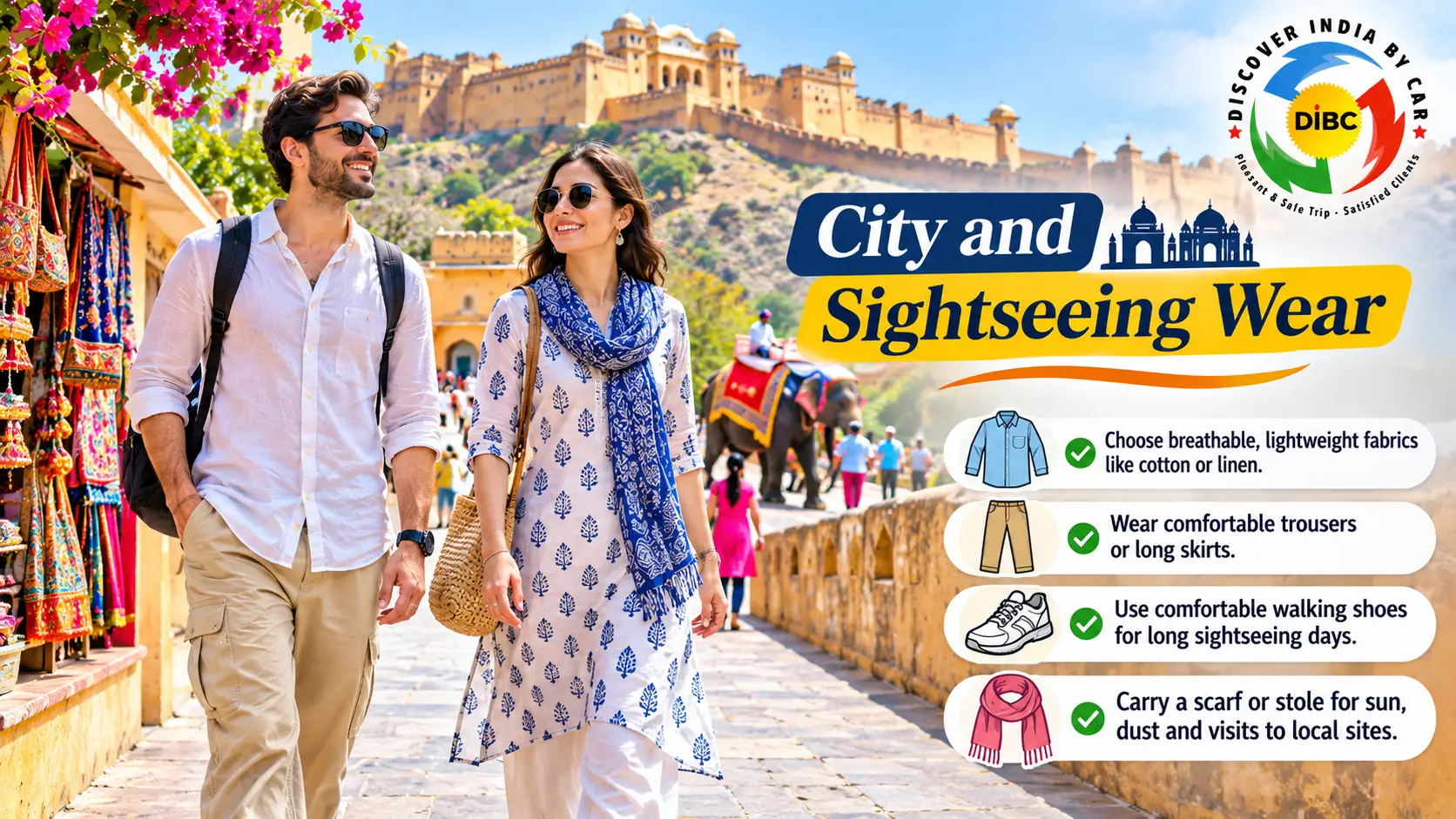
For a typical sightseeing day: light trousers or a midi or maxi skirt, a cotton shirt or T-shirt with sleeves, the scarf, and shoes you can walk in for hours and slip off quickly. Forts are the part people underestimate. Amber Fort in Jaipur and Mehrangarh in Jodhpur involve ramps, uneven old stone and a lot of stairs, so save thin-soled sandals and anything with a heel for dinner. If you’re planning the capital, our two-day Delhi itinerary shows how much walking each day really involves.
Several stops in one day
A road trip changes the logic. One Golden Triangle day can start with a sunrise visit to the Taj in single-digit January temperatures, continue with hours in an air-conditioned car, and end in a Jaipur bazaar in the mid-twenties. Dress for the coldest and most conservative stop of the day and peel layers off as you go, rather than dressing for the afternoon. Something soft that doesn’t crease badly helps too, because you’ll often go straight from the car into a monument.
For evenings, smart casual covers almost every restaurant in India, including the good hotel restaurants in Agra, Jaipur and Udaipur.
Regional Dress Differences Across India
Most of this guide is written from the north, where we drive. India is big enough that the advice shifts as you travel, so here is how it changes by region — with the caveat that customs vary from town to town and temple to temple.
North India: Delhi, Agra, Jaipur, Rajasthan, Amritsar and Varanasi
The rules above apply. This is the region of extremes: Delhi and the Rajasthan plains regularly pass 40°C in May and June, while December and January bring foggy mornings that can drop to around 4°C in Delhi, and desert nights in Jaisalmer and Bikaner colder still. Varanasi needs a little more care than Delhi. The ghats are working religious spaces, including cremation grounds, and covered, low-key clothing fits better there than anywhere on the Golden Triangle. Kashi Vishwanath has been reported to require traditional dress — dhoti-kurta for men, sari for women — for devotees seeking sparsh darshan, the ritual of touching the lingam, though reports at the time conflicted; ordinary darshan asks only for modest clothes, so check the notice at the gate. The dawn boat ride on the Ganges is genuinely cold in December and January.
South India: Kerala, Tamil Nadu, Karnataka and Andhra Pradesh
South Indian temples are where dress codes become most specific, and they differ between institutions. At Sree Padmanabhaswamy Temple in Thiruvananthapuram, Kerala Tourism describes a strict code: men wear a mundu or dhoti and no shirt of any kind, and women wear a sari, set-mundu, skirt-and-blouse or half-sari. At Guruvayur, Kerala Tourism lists a plain white or cream dhoti for men, with shirts, trousers and jeans not allowed, and saris, skirts with blouses or churidar for women; travel guides also report that the temple admits only Hindus. Dhotis can usually be bought near temple gates.
In Tamil Nadu, large temples such as Meenakshi Amman in Madurai expect shoulders and legs covered, and some inner areas are closed to non-Hindus. At Tirumala in Andhra Pradesh, the temple trust (TTD) has applied a traditional dress code — dhoti or kurta-pyjama for men, sari or churidar for women — to sevas and several ticketed darshan categories; published accounts differ on how far it extends to free darshan, so check TTD’s current notice for your booking type. In Karnataka, the ruined temples at Hampi are protected monuments where ordinary modest sightseeing clothes are fine, while living temples set their own rules.
Outside the temples, the south is hot and humid for most of the year, and the rain calendar differs from the north: Kerala gets its heaviest rain from June with the southwest monsoon, while Tamil Nadu gets most of its rain from October to December. Light cotton, a sun hat and sandals that can get wet do most of the work. Kerala’s houseboats and beach resorts are relaxed, but its towns are conservative, so cover up between the beach and the street.
Western India: Goa, Maharashtra and Gujarat
Goa is the one place in India where swimwear is normal on the sand. Even so, the Goa Tourism Department’s official advice says nudity on beaches and in public places is forbidden and punishable under law, and asks visitors to dress with decency at temples, churches and mosques. In practice: swimwear on the beach, a cover-up at the beach shack, and proper clothes in town, at markets and in the churches of Old Goa. A beach holiday and a cultural trip need different suitcases, and Goa is where the two meet.
Mumbai dresses like any large international city, but its temples have been tightening up. In January 2025 the Siddhivinayak temple trust announced that devotees in short skirts, revealing clothes or torn jeans would not be allowed in, and the temple offers cloth for visitors to cover up. Gujarat is largely traditional and home to many Jain temples, so the leather caution from Ranakpur applies there too.
Himalayan and mountain regions: Ladakh, Himachal Pradesh, Uttarakhand and Kashmir
In the mountains, temperature matters more than modesty. Leh sits at about 3,500 metres. In July, daytime averages are around 25°C but nights fall to about 10°C, and in January even the daytime average is below freezing. Hill towns in Himachal and Uttarakhand are much milder, but evenings turn cool even in summer, and the monsoon brings heavy rain and landslide-prone roads from July to September, so a proper rain jacket and shoes with grip matter more than another sweater. Pack layers — thermal base, fleece, windproof jacket — plus sunglasses and sunscreen, because the sun at altitude is fierce.
At Ladakh’s Buddhist monasteries, it’s customary to cover your shoulders, take off your hat and sunglasses inside prayer halls, remove shoes where others have, and walk clockwise around stupas and prayer wheels. Kashmir is a Muslim-majority region where modest, loose clothing is the norm. Check your own government’s travel advice before planning a trip there, as several countries carry specific warnings for parts of Jammu and Kashmir.
Eastern and Northeastern India: West Bengal, Odisha, Assam and the Northeast
Kolkata is hot and very humid for much of the year, so the light-cotton logic of the plains applies, with modest clothing for temples such as Dakshineswar and Kalighat. Rules can change quickly here too: in October 2025, the Mahakal temple in Darjeeling began a trial dress code barring women in short dresses, with long skirts available to rent, according to news reports.
Odisha shows how much depends on the individual site. The Jagannath Temple in Puri admits only Hindus — a sign at the main gate says so — while the Sun Temple at Konark, a protected monument, is open to all visitors in ordinary modest clothes.
The Northeast is the wettest part of India. Mawsynram and Sohra (Cherrapunji) in Meghalaya are among the rainiest places on earth, and most of that rain falls in the monsoon months, so quick-dry clothes, a real rain jacket and grippy footwear are essential rather than optional. Sikkim’s monasteries, such as Rumtek near Gangtok, follow the same customs as Ladakh’s: modest dress, hats off inside, shoes off where asked, and clockwise around shrines.
Villages and rural areas
Rural India is more conservative than its cities, and here the practical reasons line up with the cultural ones. You’ll often sit on floors, walk through dust and fields, and spend hours in direct sun. Loose trousers or a long skirt, a top with sleeves and a scarf are comfortable for all of that and draw less attention than shorts. A village stop in Rajasthan’s Shekhawati region is a good example: what works in a haveli courtyard works for the drive as well.
What to wear across India’s regions
| Region | Everyday clothing | At religious sites | Weather to plan for |
| North (Delhi, Agra, Rajasthan, Amritsar, Varanasi) | Loose and modest; long trousers or skirts in old cities | Shoulders and knees covered; head covered at gurdwaras and mosques | Very hot April–June; cold, foggy mornings December–January |
| South (Kerala, Tamil Nadu, Karnataka, Andhra Pradesh) | Light cotton; modest in towns | Some of India's strictest codes; traditional dress may be required | Hot and humid; Kerala rains from June, Tamil Nadu October–December |
| West (Goa, Maharashtra, Gujarat) | Swimwear on Goa's beaches only; city clothes in Mumbai | Cover up at temples, churches and mosques; leather caution at Jain temples | Humid; heavy monsoon on the coast |
| Himalaya (Ladakh, Himachal, Uttarakhand, Kashmir) | Layers and grippy walking shoes | Shoulders covered; hats and shoes off where asked | Cold nights even in summer; monsoon rain in the lower hills |
| East and Northeast (West Bengal, Odisha, Assam, Meghalaya, Sikkim) | Light, quick-dry, modest | Site-specific; some temples admit only Hindus | Humid plains; very heavy monsoon rain in the hills |
| Villages and rural areas | Loose, covered and practical | Follow local practice | Dust and sun |
Dressing for the Seasons (Summer, Monsoon, Winter)
The calendar below is North India’s, where most first trips start. The south, the coast and the mountains run on different weather, as the regional section explains. If you’re still choosing dates, our month-by-month guide to the best time to visit India goes through the year in detail.
Summer (April to June)
This is the hard one on the plains. Delhi regularly passes 40°C in May and June, and parts of Rajasthan go higher. Choose light colours, long sleeves that keep the sun off, a wide-brimmed hat and sunglasses, and carry a scarf you can wet and wrap around your neck. Leave dark synthetics at home; they trap heat and don’t dry. Plan sightseeing for early morning and late afternoon, and keep the middle of the day for the hotel, the car or a long lunch. Summer is also when the Himalayan hill towns and Ladakh are at their most comfortable.
Monsoon (late June to September)
The monsoon brings heavy bursts of rain rather than all-day drizzle, along with humidity that keeps cotton damp for hours. Quick-dry fabrics earn their place in this season, and clothes take longer to dry in hotel rooms, so pack one extra set. A packable rain jacket beats an umbrella, and not only for convenience — umbrellas aren’t allowed inside Akshardham. Shoes or sandals with real grip matter on wet marble and flooded streets. One more thing worth knowing: thin white or pale cotton can turn see-through when it’s wet, so darker prints are the safer pick.
Winter (November to February)
Winter catches out more of our guests than summer does, because almost nobody pictures India as cold. In December and January, Delhi mornings can drop to around 4°C, and thick fog often sits over Delhi, Agra and the expressway between them until late morning. By afternoon it might be 20°C and sunny. The answer is layers: a thermal top, a sweater or fleece, and a warm jacket you can peel off as the day warms. Sunrise at the Taj or Amber Fort is the coldest hour of the day, so dress for that, not for lunch. Jaipur follows a similar pattern; desert nights further west are properly cold, and heating in older havelis and heritage hotels can be patchy, so warm socks and something cosy to sleep in are worth the space. November and February are gentler. Himalayan winter is a different category altogether — Leh’s January nights average around −15°C — and needs proper cold-weather gear.
What to wear in North India, season by season
| Season | Months | What to expect | What to wear |
| Summer | April–June | Very hot and dry; often above 40°C in Delhi and Rajasthan | Loose cotton or linen, long sleeves, hat, sunglasses, sandals |
| Monsoon | Late June–September | Heavy showers, high humidity, wet streets | Quick-dry fabrics, darker prints, rain jacket, grippy shoes |
| Winter | December–January | Cold, foggy mornings (can dip to ~4°C); mild afternoons | Thermal layer, fleece, warm jacket, closed shoes, warm socks |
| Shoulder months | October–November, February–March |
Warm days, cool evenings | Tops with sleeves, light trousers, one warm layer |

Indian Clothing Terms Worth Knowing
Temple notices and shopkeepers use these words, and several are worth buying on arrival. Visitors in Indian clothes are generally taken as paying a compliment.
Indian traditional clothing terms
Quick reference for common outfits and temple-ready attire
| Term | What it is | When it’s useful |
| Kurta | Long, loose tunic, usually cotton; worn by men and women | Everyday wear in the heat; temple-friendly |
| Dupatta | Long scarf worn with a kurta or salwar suit | Head or shoulder cover at religious sites |
| Salwar kameez (salwar suit) | Kurta with loose trousers and often a dupatta | Comfortable, modest outfit for women anywhere in India |
| Churidar | Close-fitting trousers gathered at the ankle, worn under a kurta | Accepted for women at some strict temples, such as Guruvayur |
| Saree (sari) | Long draped cloth worn with a blouse and underskirt | Required for women at some South Indian temples |
| Dhoti / veshti | Unstitched cloth wrapped around the waist and legs | Required for men at some South Indian temples |
| Mundu / set-mundu | Kerala’s white wraparound; set-mundu is the women’s two-piece version | Kerala temple dress codes |
What Women Travellers Should Know
First, the honest part. Clothing is about comfort and respecting local norms; it isn’t a safety tool. Foreign women get looked at in India, sometimes for longer than is comfortable, sometimes by people who only want a selfie, and that happens whatever you wear. It is never your fault, and no outfit prevents it. What dressing in line with local norms does do is make many days feel less conspicuous, especially in old cities and villages.
In cities and on sightseeing days
Loose trousers, palazzo pants or a maxi skirt with a cotton shirt or T-shirt work everywhere from Old Delhi to a Jaipur fort. Kurtas are the easiest upgrade: inexpensive, cool and easy to find in every city we drive through, from Delhi’s markets to chain stores like Fabindia. In our experience, necklines and very short hemlines draw more attention than bare forearms, so a modest neckline matters more than full sleeves on a hot day.
Sleeveless tops and short dresses: where they work
They’re ordinary in big-city malls, upscale restaurants and bars, hotel pools, and Goa’s beach areas, and many young Indian women wear them in those places. They’re out of place at religious sites, in old-city bazaars and in villages. The simple fix is a scarf or light overshirt in your bag, so the same outfit works for lunch in a mall and a temple stop after it.
Religious sites and head coverings
You don’t need to cover your hair in India in general — only at gurdwaras, where it’s required of everyone, and at mosques, where women are usually asked to. At strict South Indian temples, some require a sari, set-mundu or churidar; check before you go. Leggings are fine under a longer top that covers the hips.
Solo travel and long road trips
On long drives, wear something comfortable that also works for an unplanned stop at a dhaba or a roadside temple: loose trousers, a top with sleeves, the scarf within reach. Car air-conditioning runs cold, so keep a light layer handy. For advice beyond clothing, our honest guide to safety in India has a section for women and solo travellers.
Beach and resort clothing
Swimwear is normal at hotel pools and on Goa’s beaches. Cover up before you walk back into town, a market or a church.
What Men Should Wear in India
Men have fewer rules to remember, but they’re the ones most often turned back at temple gates, nearly always for shorts.
The everyday answer is long trousers in light cotton or linen and a shirt or T-shirt with sleeves. That gets you into almost every religious site in the north and looks right in old-city bazaars. Jeans are fine in cities and at most religious sites, though they’re hot from April to June, and torn jeans are now explicitly refused at some temples, such as Siddhivinayak in Mumbai.
Shorts are fine at the hotel, in resorts, on the beach and around modern city districts. Leave them behind for temples, mosques, gurdwaras, old cities and villages. Sleeveless vests fall in the same category: fine at the pool, out of place almost everywhere else.
Two things tend to surprise men. In some Kerala temples, Padmanabhaswamy and Guruvayur among them, men must take their shirt off and wear a dhoti or mundu — the opposite of covering up. And at gurdwaras, men cover their heads exactly as women do; a bandana or large handkerchief in your pocket saves borrowing one. At mosques, long trousers and sleeves are expected, and a robe may be offered if you arrive in shorts.
For footwear, slip-on walking shoes or sturdy sandals cover most trips; add closed shoes for winter mornings and the mountains. Seasonally, the same packing logic below applies: linen and cotton in summer, quick-dry shirts and a rain jacket in the monsoon, and a thermal layer, fleece and jacket for North Indian winter mornings. Away from temples, chinos and a collared shirt suit any good restaurant.
A Packing System for India
You really don’t need much. Laundry is quick and inexpensive at almost every hotel, and anything you forget can be bought here. The trick is to pack mix-and-match pieces in two or three colours that go together, so every top works with every bottom, and to make sure at least half of what you bring is temple-ready — shoulders and knees covered.
How much to pack, by trip length
| Trip | Everyday and temple-ready clothes | Footwear | Layers, rain and sun | Laundry |
| 3–5 days (e.g. Delhi and Agra) | 2 bottoms, 3–4 tops with sleeves, 1 scarf | Slip-on walking shoes | One light layer; season-specific extras only | Usually none needed |
| 7–10 days (e.g. Golden Triangle) | 2–3 bottoms, 4–5 tops, 1–2 scarves, 1 smart-casual outfit | Walking shoes + flip-flops | Light layer; winter set or rain jacket by season; hat and sunglasses | Once, mid-trip |
| 14 days (Golden Triangle + Rajasthan or Varanasi) | Same as 7–10 days — don’t double it | Walking shoes + sandals + flip-flops | As above | Every 4–5 days at hotels |
| Multi-region road trip (e.g. Rajasthan in winter + Kerala or Goa) | Core list once, plus one warm set and one beach set | Add grippy sandals for wet or coastal stops | Thermal and jacket for the north; swimwear and cover-up for the coast | Every 4–5 days |

Across every trip length, the same few items earn their space: socks for hot marble and cold floors, a light layer for car and restaurant air-conditioning, a hat and sunglasses for forts with little shade, and a non-leather belt and wallet if a Jain temple is on the route. Add the temple day bag described above, and you’re covered. What to leave behind: anything that needs ironing, heavy denim in summer, heels, and anything you’d be upset to get dusty. If you’re budgeting the rest of the trip, our India budget guide breaks down daily costs.
Before you leave the hotel: a quick check
- Any temple, mosque or gurdwara on today’s route? Shoulders and knees covered, or a wrap in your bag.
- Scarf or bandana packed for head covering.
- Socks in your pocket if there’s marble to cross.
- Leather left behind if a Jain temple is on the list; phone left in the car if it’s Akshardham.
- A layer for an early start or a cold car, and a hat for the afternoon.
- Rain jacket in the monsoon; small notes for shoe stands and lockers.
Frequently Asked Questions
Q1. Is there a dress code for tourists in India?
No, India has no national dress code for tourists. Individual temples, mosques and gurdwaras set their own rules, which range from a head covering to traditional dress only. Everywhere else, loose clothing that covers the shoulders and knees is the comfortable norm.
Q2. What should tourists wear in India?
Loose, breathable cotton or linen that covers shoulders and knees, shoes that slip off easily, and a scarf. Add layers for North Indian winter mornings and rain gear in the monsoon. Big-city malls and restaurants are more relaxed; old cities and villages are more conservative.
Q3. Can women wear shorts in India?
Yes, in hotels, resorts, Goa’s beach areas and some modern city districts. Shorts are out of place at religious sites, in old-city bazaars and in villages, where a maxi skirt or loose trousers are more comfortable choices.
Q4. Can men wear shorts in India?
Yes, at the hotel, on the beach and in modern city areas. Men in shorts are often turned away at temples, mosques and gurdwaras, so wear light long trousers on any day that includes a religious site.
Q5. What should women wear at Indian temples?
Clothing that covers shoulders and knees, such as a kurta with loose trousers or a long skirt, plus a scarf. Some South Indian temples, including Padmanabhaswamy and Guruvayur in Kerala, require a sari or similar traditional dress, so check the specific temple first.
Q6. Do tourists need to cover their heads in India?
Only at certain places. Everyone must cover their head at Sikh gurdwaras such as the Golden Temple, and women are usually asked to at mosques. Most Hindu and Jain temples don’t require it.
Q7. What should I wear at the Taj Mahal?
There’s no official dress code, but modest clothing covering the shoulders is respectful because it’s a mausoleum with a mosque. Wear comfortable walking shoes and a hat. Foreign ticket holders get free shoe covers for the marble platform, and the Taj is closed on Fridays.
Q8. What should tourists wear in South India?
Light cotton for the heat and humidity, with modest dress in towns. At temples, rules vary: some Kerala temples require men to go shirtless in a dhoti and women to wear a sari, set-mundu or churidar. Check each temple’s current rules.
Q9. What should I wear in Goa?
Swimwear on the beach, a cover-up at beach shacks, and normal modest clothes in towns, markets and churches. Goa’s tourism department advises decency at religious places and states that nudity on beaches and in public places is punishable under law.
Q10. What clothes should I pack for a two-week India trip?
About the same as for one week: 2–3 bottoms, 4–5 tops with sleeves, 1–2 scarves, one smart-casual outfit, walking shoes and flip-flops, plus seasonal layers or rain gear. Use hotel laundry every four or five days instead of packing more.
Q11. What should I wear in India during winter?
In North India in December and January, pack layers: a thermal base, a sweater or fleece and a warm jacket. Delhi and Agra mornings can drop to around 4°C with fog, while afternoons are mild. Himalayan destinations like Ladakh need full cold-weather gear.
Q12. Are jeans acceptable in Indian religious places?
Usually yes, if they’re not ripped and you wear a modest top. Some temples are stricter: Mumbai’s Siddhivinayak refuses torn jeans, and Guruvayur in Kerala doesn’t allow jeans or trousers for men.
Travel North India the Easy Way
Most of what makes dressing in India tricky is logistics, not rules, and a private car takes a lot of that away. Your bags stay with the car while you’re inside, so the phone that isn’t allowed into Akshardham or the leather belt that isn’t allowed at Ranakpur simply stays behind. You can add a warmer layer after a foggy morning at the Taj or change shoes before a fort climb without carrying everything all day. Long drives between cities are easier in clothes you chose for the car, and the day itself can be planned around the weather — early starts in summer, later ones when January fog sits on the expressway.
That’s what we do at Discover India by Car: 100% private tours across Delhi, Agra, Jaipur, Rajasthan and Amritsar, with licensed drivers and fixed, transparent pricing agreed before you travel. If you’d like a price for your dates, take a look at our Golden Triangle private car tour or message us on WhatsApp for a free quote. We’re happy to answer packing questions too.
Discover India By Car
Contact Information
C-51, First Floor, Kiran Garden, Uttam Nagar, New Delhi - 110059
Sources and How We Checked This Guide
Rules for specific religious sites were checked on 20 November 2026 against the institutions’ own websites or state tourism departments where they publish them, and against reputable news reports where they don’t. Claims that rest on news or travel-guide reporting are worded as “reported” in the text. Where sources disagreed — on Jama Masjid’s visitor fees, for example — we left the detail out rather than guess. The practical advice on clothing, weather and road days comes from our own work driving guests around North India.
- Taj Mahal official website: visitor information (shoe covers) and visiting hours (Friday closure)
- Swaminarayan Akshardham, Delhi: visitor information and dress code
- Delhi Tourism: Jama Masjid (robes, prayer hours) and visiting hours after sunset
- The Tribune: Golden Temple guidance to visitors
- Kerala Tourism: Padmanabhaswamy Temple dress code and Guruvayur Temple dress code
- Deccan Herald (PTI): Siddhivinayak temple dress code, January 2025
- Goa Tourism Department: Do’s and Don’ts for tourists (PDF)
- Deccan Chronicle: Puri Jagannath Temple entry for non-Hindus
- LatestLY: Mahakal Temple, Darjeeling dress code, October 2025
- The Hans India: Kashi Vishwanath sparsh darshan dress code report
- Incredible India: Delhi monthly temperature ranges
- Leh-Ladakh monthly climate averages